Comparative Evaluation of Retention, Cariostatic Effect and Discoloration of Conventional and Hydrophilic Sealants - A Single Blinded Randomized Split Mouth Clinical Trial
- PMID: 30294150
- PMCID: PMC6169278
- DOI: 10.4103/ccd.ccd_132_18
Comparative Evaluation of Retention, Cariostatic Effect and Discoloration of Conventional and Hydrophilic Sealants - A Single Blinded Randomized Split Mouth Clinical Trial
Abstract
Introduction: Pit and fissures are approximately eight times vulnerable than the smooth surface caries lesion. Sealants are effective in preventing, arresting, and progression of pit-and-fissure occlusal caries lesions. The failure of sealant resin-based retention is mainly attributed to the moisture contamination. To overcome this drawback, UltraSeal XT® hydro, a moisture-friendly sealant, has been introduced.
Aim: This study aimed to compare and evaluate the retention, cariostatic effect, and discoloration of conventional Clinpro™ 3M™ ESPE™ and hydrophilic UltraSeal XT® sealants among 12 to 15-year-old schoolchildren for 3 months.
Materials and methods: A single-blinded, randomized, split-mouth clinical trial was conducted among thirty schoolchildren aged 12-15 years. Sealants used in the present study were Group I - Clinpro™ and Group II - UltraSeal XT® hydro. Sealants were provided in the school by two operators based on the computer-generated random sequence and the study participants were evaluated after 3 months for sealant coverage, caries incidence, and discoloration using Color, Coverage and Caries sealant evaluation system. Sealant coverage between the two sealants was compared using Mann-Whitney U-test and Z-test for proportions.
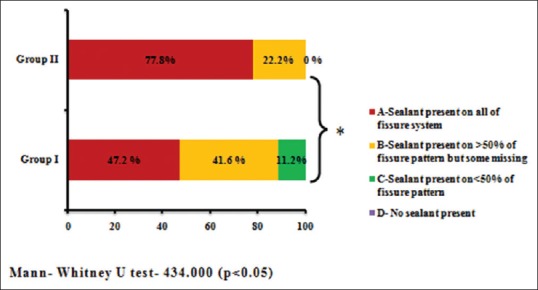
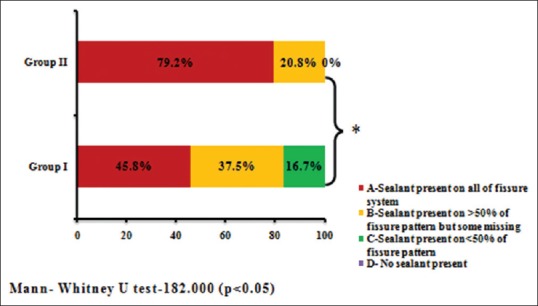
Results: A total of 47 teeth (78.3%) with UltraSeal XT® Hydro had the sealant covering in all the fissures compared to Clinpro™ 3M™ ESPE™ which was 46.7% (28 teeth) and the difference was observed to be statistically significant.
Conclusion: Hydrophilic UltraSeal XT® Hydro yielded better sealant coverage (retention) compared to the conventional Clinpro™ 3M™ ESPE™. No difference was observed with regard to cariostatic effect and discoloration.
Keywords: Clinpro™ 3M™ ESPE™; UltraSeal XT® hydro; retention; split-mouth trial.
Conflict of interest statement
There are no conflicts of interest.
Figures

References
-
- Young DA, Nový BB, Zeller GG, Hale R, Hart TC, Truelove EL, et al. The American dental association caries classification system for clinical practice: A report of the American Dental Association Council on Scientific Affairs. J Am Dent Assoc. 2015;146:79–86. - PubMed
-
- Morales E, Martínez A, Hernández J, Alvarado K, Pozos A. Evaluation of marginal seal and microleakage of a sealant modified with silver nanoparticles in primary molars:In vitro study. ODOVTOS Int J Dent Sci. 2014;16:107–13.
-
- Ripa LW, Leske GS, Sposato A. The surface-specific caries pattern of participants in a school-based fluoride mouthrinsing program with implications for the use of sealants. J Public Health Dent. 1985;45:90–4. - PubMed
-
- Wright JT, Crall JJ, Fontana M, Gillette EJ, Nový BB, Dhar V, et al. Evidence-based clinical practice guideline for the use of pit-and-fissure sealants: A report of the American Dental Association and the American Academy of Pediatric Dentistry. J Am Dent Assoc. 2016;147:672–82. - PubMed
-
- Simonsen RJ. Clinical Applications of the Acid Etch Technique. 1st ed. Chicago, IL: Quintessence Publishing Co., Inc.; 1978. Pit and fissure sealants; pp. 19–42.