Review
. 2018 Oct 8;7(1):32.
doi: 10.1186/s40169-018-0210-9.

Combination systemic therapies with immune checkpoint inhibitors in pancreatic cancer: overcoming resistance to single-agent checkpoint blockade

Affiliations
Review

Combination systemic therapies with immune checkpoint inhibitors in pancreatic cancer: overcoming resistance to single-agent checkpoint blockade

Jun Gong et al. Clin Transl Med. .

Abstract

Immune checkpoint inhibitors have demonstrated broad single-agent antitumor activity and a favorable safety profile that render them attractive agents to combine with other systemic anticancer therapies. Pancreatic cancer has been fairly resistant to monotherapy blockade of programmed cell death protein 1 receptor, programmed death ligand 1, and cytotoxic T-lymphocyte associated protein 4. However, there is a growing body of preclinical evidence to support the rational combination of checkpoint inhibitors and various systemic therapies in pancreatic cancer. Furthermore, early clinical evidence has begun to support the feasibility and efficacy of checkpoint inhibitor-based combination therapy in advanced pancreatic cancer. Despite accumulating preclinical and clinical data, there remains several questions as to the optimal dosing and timing of administration of respective agents, toxicity of combination strategies, and mechanisms by which immune resistance to single-agent checkpoint blockade are overcome. Further development of biomarkers is also important in the advancement of combination systemic therapies incorporating checkpoint blockade in pancreatic cancer. Results from an impressive number of ongoing prospective clinical trials are eagerly anticipated and will seek to validate the viability of combination immuno-oncology strategies in pancreatic cancer.

Keywords: Checkpoint inhibitor; Clinical trials; Combination therapy; Immuno-oncology; Pancreatic cancer.


Figures
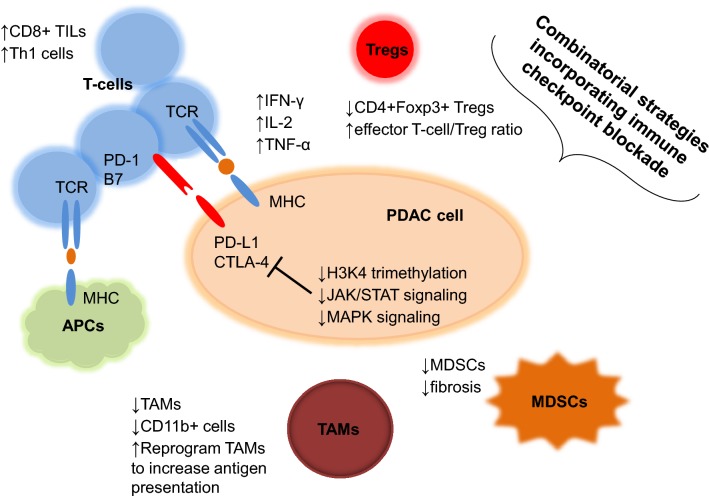
Fig. 1
Fig. 1
Mechanisms of immune resistance to checkpoint blockade in pancreatic cancer. Preclinical evidence supports that combinatorial strategies incorporating checkpoint inhibitors can attenuate primary and acquired resistance to checkpoint blockade through multiple tumor cell-intrinsic and tumor cell-extrinsic mechanisms. For example, targeting of H3K4 trimethylation, JAK/STAT signaling, and mitogen-activated protein kinase (MAPK) signaling mitigates tumor cell-intrinsic upregulation of PD-L1 expression. Combination regimens with checkpoint blockade can also target tumor cell-extrinsic mechanisms of immune resistance by decreasing tumor-associated macrophages (TAMs) or reprogramming TAMs to increase antigen presentation and antitumor T-cell activity. MDSCs myeloid-derived suppressor cells, APCs antigen-presenting cells, MHC major histocompatibility complex, TCR T-cell antigen receptor, PD-1 programmed cell death protein 1 receptor, B7 B7 family of ligands, TILs tumor-infiltrating lymphocytes, PD-L1 programmed death ligand 1, CTLA-4 cytotoxic T-lymphocyte associated protein 4, IFNγ interferon-γ, IL-2 interleukin 2, TNF-α tumor necrosis factor alpha, Tregs regulatory T-cells

References

    1. Gong J, Chehrazi-Raffle A, Reddi S, Salgia R. Development of PD-1 and PD-L1 inhibitors as a form of cancer immunotherapy: a comprehensive review of registration trials and future considerations. J Immunother Cancer. 2018;6:8. doi: 10.1186/s40425-018-0316-z. - DOI - PMC - PubMed
    1. Geng L, Huang D, Liu J, Qian Y, Deng J, Li D, et al. B7-H1 up-regulated expression in human pancreatic carcinoma tissue associates with tumor progression. J Cancer Res Clin Oncol. 2008;134:1021–1027. doi: 10.1007/s00432-008-0364-8. - DOI - PubMed
    1. Loos M, Giese NA, Kleeff J, Giese T, Gaida MM, Bergmann F, et al. Clinical significance and regulation of the costimulatory molecule B7-H1 in pancreatic cancer. Cancer Lett. 2008;268:98–109. doi: 10.1016/j.canlet.2008.03.056. - DOI - PubMed
    1. Nomi T, Sho M, Akahori T, Hamada K, Kubo A, Kanehiro H, et al. Clinical significance and therapeutic potential of the programmed death-1 ligand/programmed death-1 pathway in human pancreatic cancer. Clin Cancer Res. 2007;13:2151–2157. doi: 10.1158/1078-0432.CCR-06-2746. - DOI - PubMed
    1. Okudaira K, Hokari R, Tsuzuki Y, Okada Y, Komoto S, Watanabe C, et al. Blockade of B7-H1 or B7-DC induces an anti-tumor effect in a mouse pancreatic cancer model. Int J Oncol. 2009;35:741–749. - PubMed