


Sacroiliac Joint Ankylosis in Young Spondyloarthritis Patients Receiving Biologic Therapy: Observation of Serial Magnetic Resonance Imaging Scans
- PMID: 30295426
- PMCID: PMC6915840
- DOI: 10.1002/art.40750
Sacroiliac Joint Ankylosis in Young Spondyloarthritis Patients Receiving Biologic Therapy: Observation of Serial Magnetic Resonance Imaging Scans
Abstract
Objective: To assess the temporal relationship between initiating biologic therapy and magnetic resonance imaging (MRI) scores of inflammation and structural damage in young patients with spondyloarthritis.
Methods: A local adolescent/young adult patient rheumatology database was searched for patients ages 12-24 years who had evidence of sacroiliitis on MRI and a clinical diagnosis of enthesitis-related arthritis (ERA) with axial involvement or nonradiographic axial spondyloarthritis. Patients treated with tumor necrosis factor inhibitor (TNFi) therapy who had undergone a minimum of 1 MRI scan before and 2 MRI scans after starting TNFi therapy (over ≥2 years) were included. Images of the sacroiliac joints were scored for inflammation and structural abnormalities (including erosions, fat metaplasia, and fusion). The effects of TNFi therapy and of time since initiation of TNFi therapy on inflammation and structural abnormalities were assessed using a mixed-effects regression analysis.
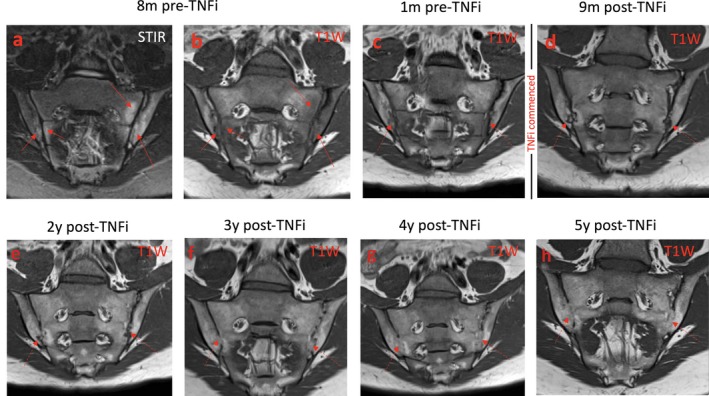
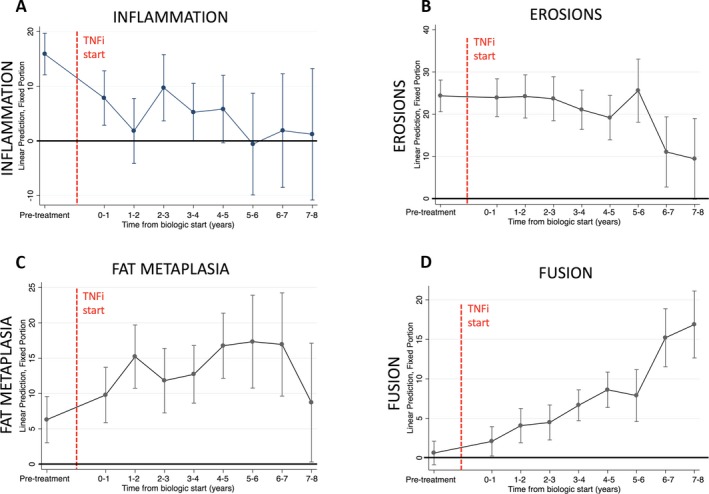
Results: Twenty-nine patients (ages 12-23 years) with ERA or nonradiographic axial spondyloarthritis who underwent TNFi therapy were included. Inflammation scores were significantly lower in patients receiving TNFi treatment (P = 0.013), but there was no significant effect of time from TNFi initiation on inflammation (P = 0.125). Conversely, there was no significant effect of active TNFi treatment on fusion scores (P = 0.308), but fusion scores significantly increased with time from TNFi initiation (P < 0.001); a similar positive relationship between time since biologic start and fat metaplasia scores was observed.
Conclusion: TNFi therapy failed to prevent the eventual development of joint ankylosis in this cohort of young patients with spondyloarthritis, despite a substantial reduction in inflammation with TNFi therapy.
© 2018 The Authors. Arthritis & Rheumatology published by Wiley Periodicals, Inc. on behalf of American College of Rheumatology.
Figures
Comment in
-
Observation by Magnetic Resonance Imaging of Sacroiliac Joint Ankylosis in Young Spondyloarthritis Patients Receiving Biologic Therapy: Comment on the Article by Bray et al.Arthritis Rheumatol. 2019 Dec;71(12):2128-2129. doi: 10.1002/art.41050. Epub 2019 Oct 21. Arthritis Rheumatol. 2019. PMID: 31328408 No abstract available.
-
Reply.Arthritis Rheumatol. 2019 Dec;71(12):2130-2131. doi: 10.1002/art.41049. Epub 2019 Oct 21. Arthritis Rheumatol. 2019. PMID: 31328427 No abstract available.
-
Do Microinjury Mechanisms Complement Inflammation in Sacroiliac Joint Ankylosis on Magnetic Resonance Imaging of Young Spondyloarthritis Patients? Comment on the Article by Bray et al.Arthritis Rheumatol. 2019 Dec;71(12):2129-2130. doi: 10.1002/art.41048. Epub 2019 Oct 23. Arthritis Rheumatol. 2019. PMID: 31529620 No abstract available.
References
-
- Sieper J, Poddubnyy D. Axial spondyloarthritis. Lancet 2017;390:73–84. - PubMed
-
- Petty RE, Southwood TR, Manners P, Baum J, Glass DN, Goldenberg J, et al. International League of Associations for Rheumatology classification of juvenile idiopathic arthritis: second revision, Edmonton, 2001. J Rheumatol 2004;31:390–2. - PubMed
-
- Rudwaleit M, Landewé R, van der Heijde D, Listing J, Brandt J, Braun J, et al. The development of Assessment of SpondyloArthritis international Society classification criteria for axial spondyloarthritis (part I): classification of paper patients by expert opinion including uncertainty appraisal. Ann Rheum Dis 2009;68:770–6. - PubMed
-
- Schett G, Stolina M, Dwyer D, Zack D, Uderhardt S, Krönke G, et al. Tumor necrosis factor α and RANKL blockade cannot halt bony spur formation in experimental inflammatory arthritis. Arthritis Rheum 2009;60:2644–54. - PubMed
Publication types
MeSH terms
Substances
Grants and funding
LinkOut - more resources
Full Text Sources
Medical
