. 2018 Oct 17;140(41):13375-13386.
doi: 10.1021/jacs.8b08371. Epub 2018 Oct 8.

Mechanism of Permanganate-Promoted Dihydroxylation of Complex Diketopiperazines: Critical Roles of Counter-cation and Ion-Pairing

Affiliations

Mechanism of Permanganate-Promoted Dihydroxylation of Complex Diketopiperazines: Critical Roles of Counter-cation and Ion-Pairing

Brandon E Haines et al. J Am Chem Soc. .

Abstract

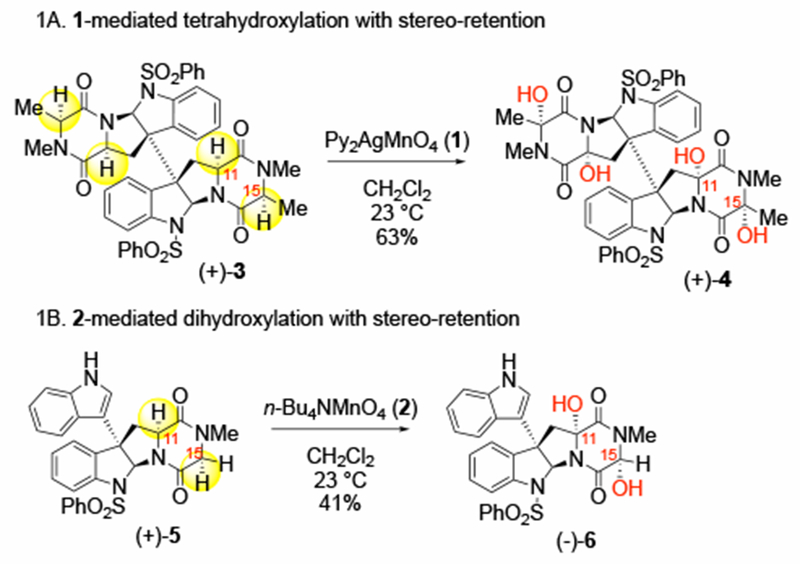
The mechanism of permanganate-mediated dual C-H oxidation of complex diketopiperazines has been examined with density functional theory computations. The products of these oxidations are enabling intermediates in the synthesis of structurally diverse ETP natural products. We evaluated, for the first time, the impact of ion-pairing and aggregation states of the permanganate ion and counter-cations, such as bis(pyridine)-silver(I) (Ag+) and tetra- n-butylammonium (TBA+), on the C-H oxidation mechanism. The C-H abstraction occurs through an open shell singlet species, as noted previously, followed by O-rebound and a competing OH-rebound pathway. The second C-H oxidation proceeds with a second equivalent of oxidant with lower free energy barriers than the first C-H oxidation due to directing effects and the generation of a more reactive oxidant species after the first C-H oxidation. The success and efficiency of the second C-H oxidation are found to be critically dependent on the presence of an ion-paired oxidant. We used the developed mechanistic knowledge to rationalize an experimentally observed oxidation pattern for C3-indole-substituted diketopiperazine (+)-5 under optimal oxidation conditions: namely, the formation of diol (-)-6 as a single diastereomer and lack of the ketone products. We proposed two factors that may impede the ketone formation: (i) the conformational flexibility of the diketopiperazine ring, and (ii) hindrance of this site, making it less accessible to the ion-paired oxidant species.


Conflict of interest statement

The authors declare no competing financial interests.

Figures
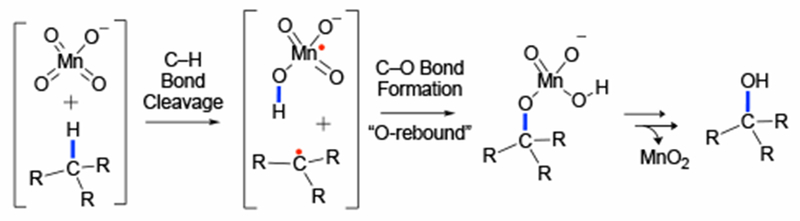
Figure 1.
Figure 1.
Previously proposed mechanism for alkyl C–H oxidation by permanganate ion. For the sake of simplicity, here we present only the hydrogen atom transfer (HAT) mechanism, while the reaction can also proceed via the hydride transfer pathway (see text).
Figure 2.
Figure 2.
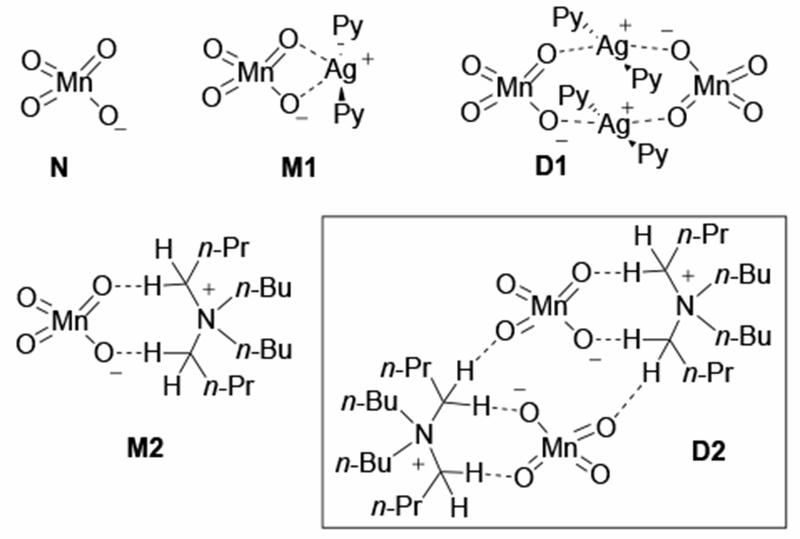
Model oxidants used in this study. Here, Py = pyridine.
Figure 3.
Figure 3.
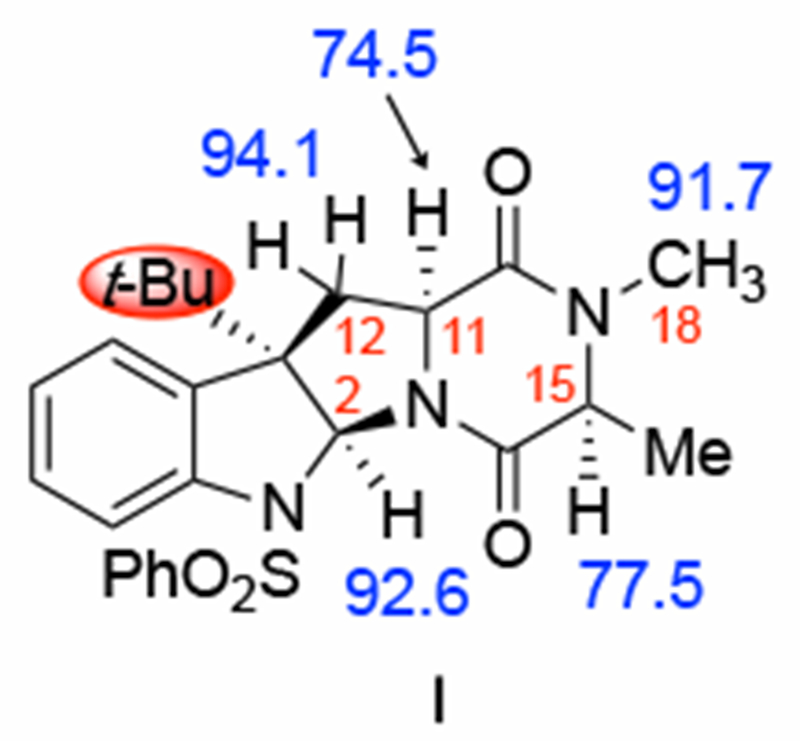
Model diketopiperazine I used for this mechanistic study and computed bond dissociation energies (BDEs) shown in blue and reported in kcal/mol.
Figure 4.
Figure 4.
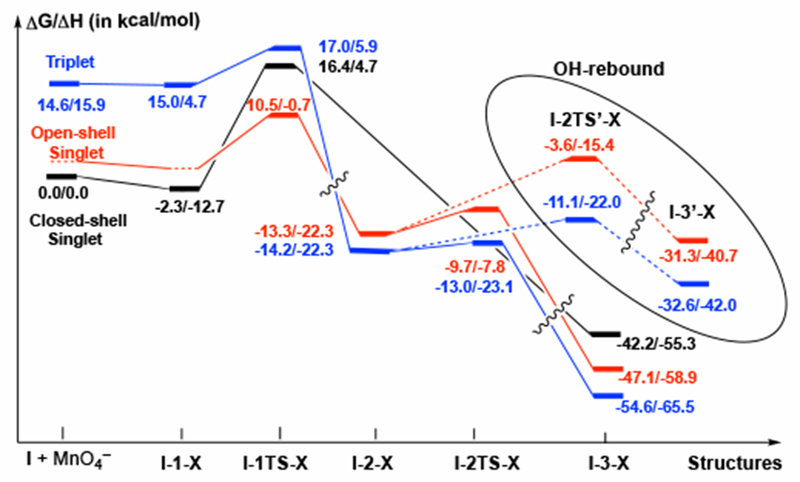
Schematic presentation (unscaled) of the free energy surface of the first C11–H oxidation. Relative energies are presented for the X = N oxidant. The calculated energies for the oxidants M1 and D1 are consistent and are given throughout the rest of this section.
Figure 5.
Figure 5.
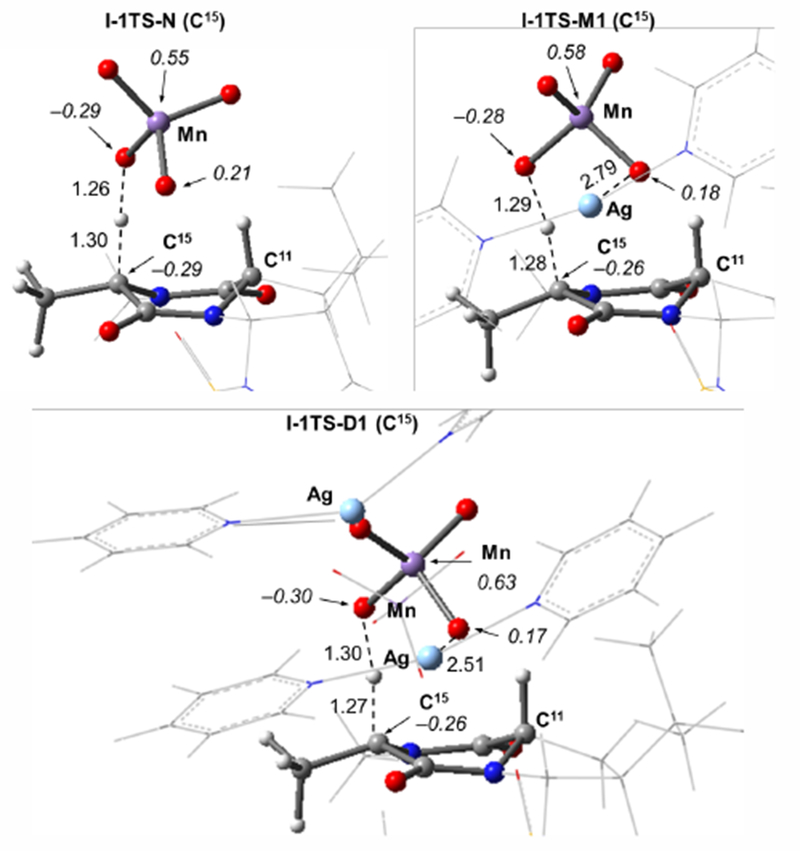
Optimized transition states for C–H abstraction at C15 (I-1TS-X) using the N, M1, and D1 model oxidants. Bond distances are in Å and Mulliken spin density values in |e| are shown in italics.
Figure 6.
Figure 6.
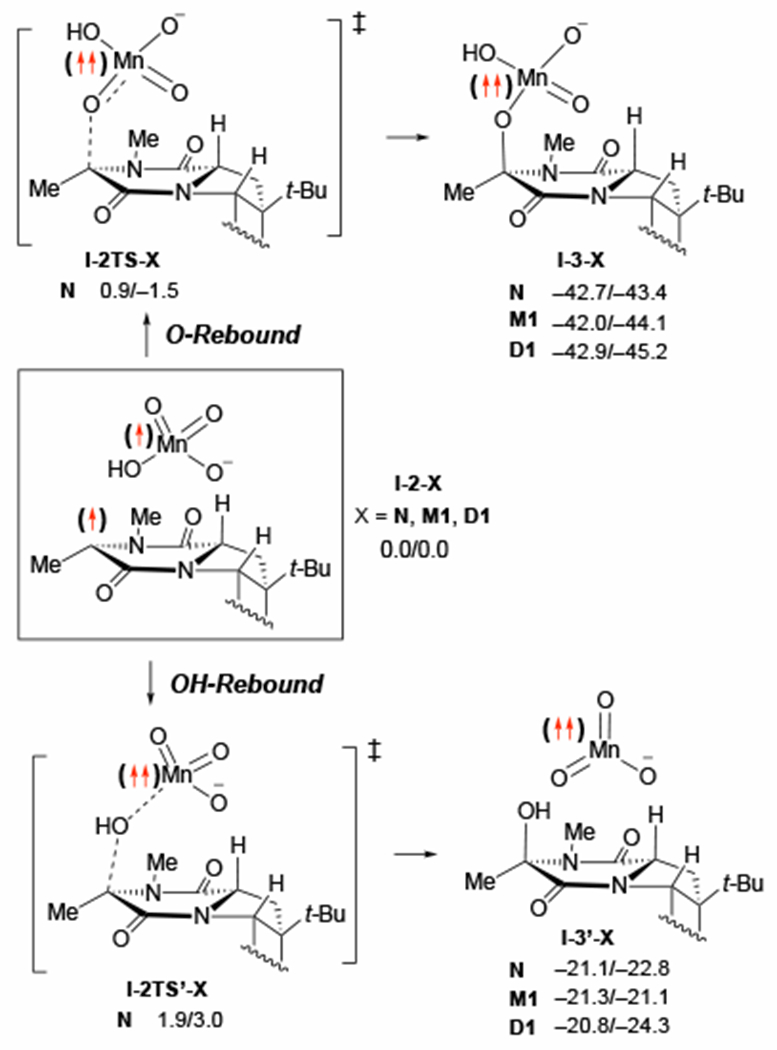
The examined O-rebound and OH-rebound pathways: energies are calculated relative to I-2-X and are given as ΔG/ΔH in kcal/mol. For sake of simplicity, here the schematic reaction pathway was shown only for model oxidant without counter-cation, i.e. for X = N.
Figure 7.
Figure 7.
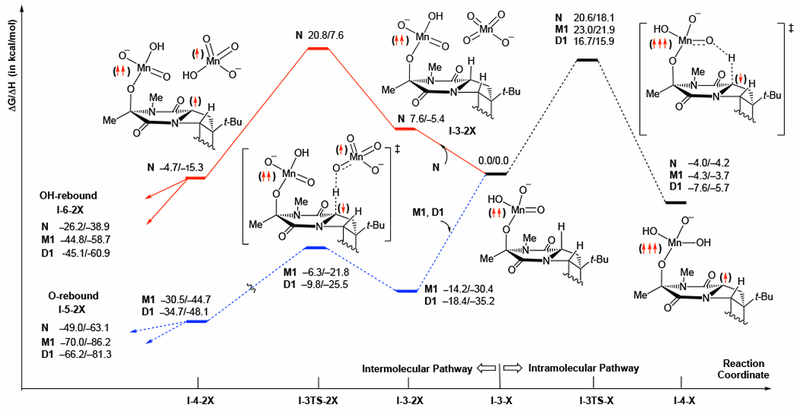
Schematic presentation intramolecular and intermolecular pathways of the C–H abstraction at the C15 position of the C11 permanganate intermediate I-3-X (i.e. the second C–H oxidation). All energies are calculated relative to the I-3-X + X dissociation limit. For simplicity, only the structures with N are depicted.
Figure 8.
Figure 8.
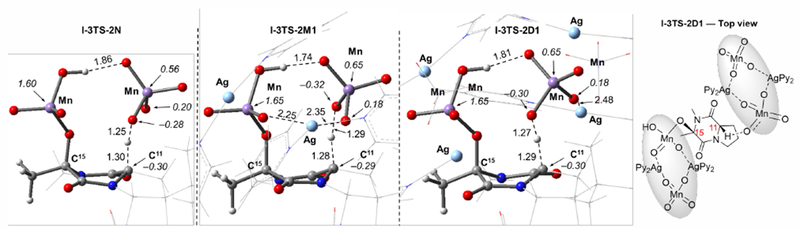
Optimized transition state structures for the second C–H abstraction through the intermodular pathway (I-3TS-2X) for the model oxidants N, M1, and D1. Bond distances (in Å) and Mulliken spin density values (in |e|) are shown in italics. Some parts of the counter-cations have been removed from the visual representation for clarity.
Figure 9.
Figure 9.
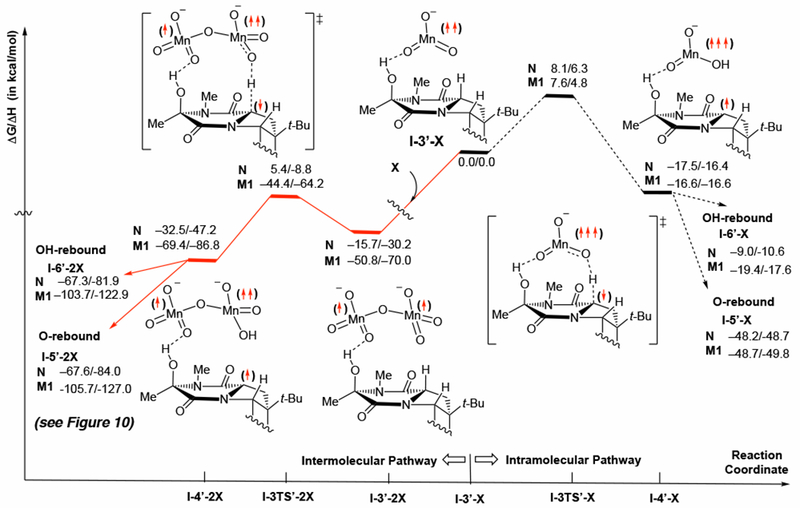
Schematic presentation of the intramolecular and intermolecular pathways for C11–H abstraction starting from the C15 alcohol intermediate I-3’-X. All energies are calculated relative to the I-3’-X + X dissociation limit. For simplicity, only the structures with N are depicted.
Figure 10.
Figure 10.
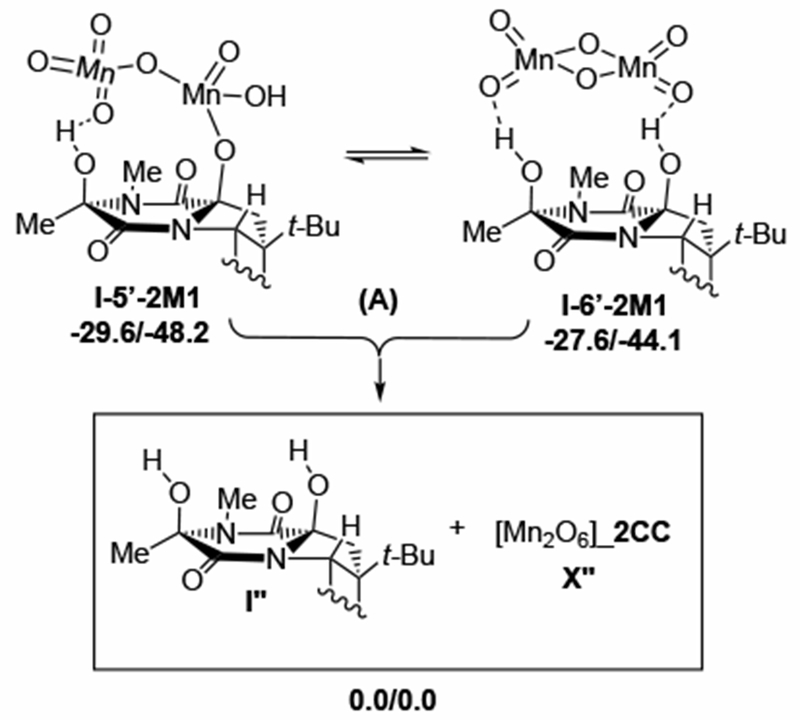
Schematic presentation of the O-rebound, I-5’-2X, and OH-rebound I-6’-2X, intermediates of the intermolecular pathway for the second C–H oxidation at the C11 position starting from the C15 alcohol intermediate I-3’-X (see Figure 9 for more details). Counter-cations (CC = Py2Ag+) are not shown for clarity. Relative energies, as ΔG/ΔH, are given in kcal/mol.
Figure 11.
Figure 11.
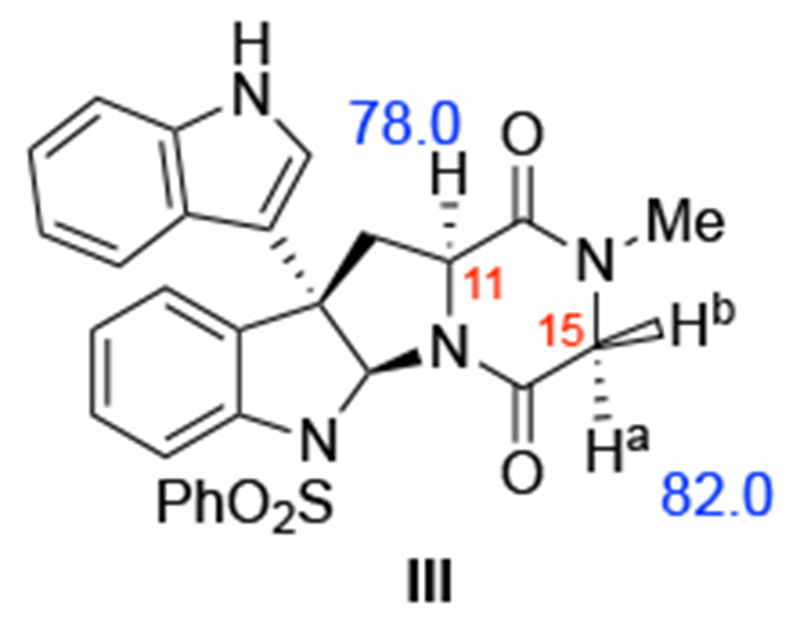
Model diketopiperazine III used for (+)-5 and computed bond dissociation energies (BDEs, in kcal/mol) shown in blue.
Figure 12.
Figure 12.
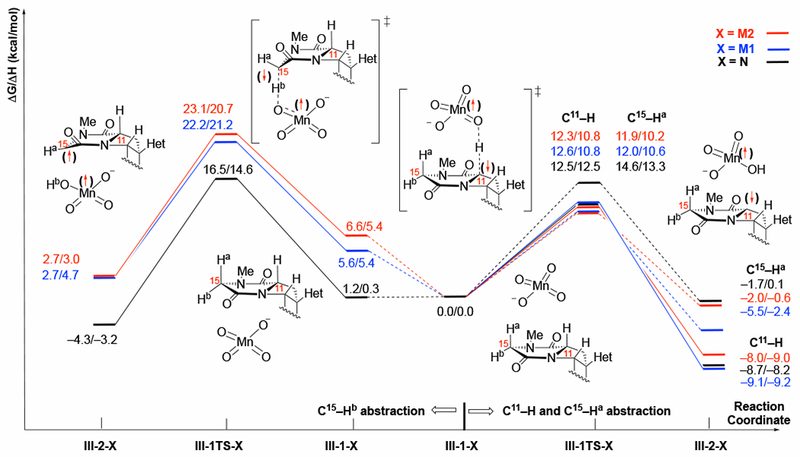
Schematic presentation of the pathways for C–H abstraction of the C11–H, C15–Ha and C15–Hb bonds of III with model oxidants N, M1 and M2. All energies are reported as ΔG/ΔH and are calculated relative to the III-1-X for the a face (C11–H, C15–Ha). For simplicity, only the structures with N are depicted. We also omitted structures associated with the C15–Ha abstraction.
Figure 13.
Figure 13.
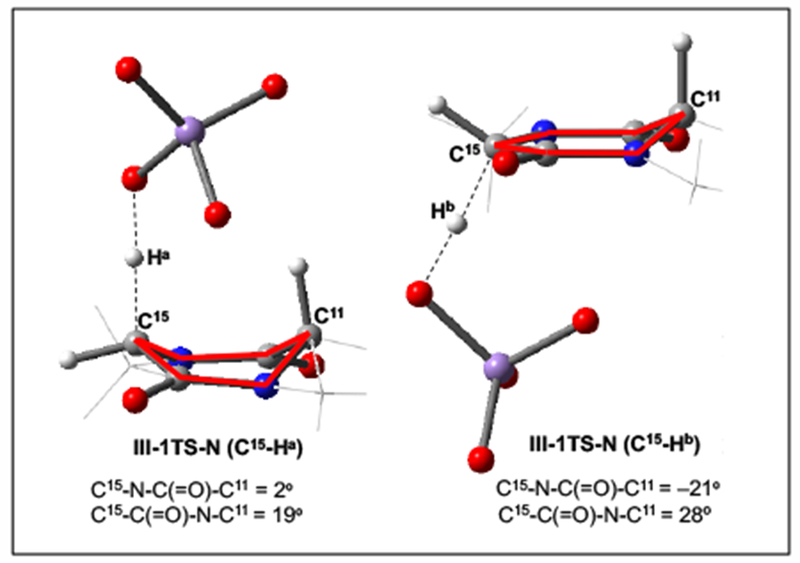
Optimized C–H abstraction transition state structures for the C15–Ha and C15–Hb bonds of III with the model oxidant N (III-1TS-N). The important dihedral angles are reported in deg. and highlighted in red. Some parts of the structures have been removed from the visual representation for clarity.
Scheme 1.
Scheme 1.
Representative hydroxylations of complex dimeric diketopiperazines enabling the synthesis of complex ETPs.

References

    1. Kim J; Movassaghi M Biogenetically-Inspired Total Synthesis of Epidithiodiketopiperazines and Related Alkaloids. Acc. Chem. Res 2015, 48, 1159–1171. - PMC - PubMed
    1. Hauser D; Weber HP; Sigg HP Isolation and Structure Elucidation of Chaetocin. Helv. Chim. Acta 1970, 53, 1061–1073. - PubMed
    1. Katagiri K; Sato K; Hayakawa S; Matsushi T; Minato H Verticillin a, a New Antibiotic from Verticillium-Sp. J. Antibiot 1970, 23, 420–422. - PubMed
    1. Jiang CS; Guo YW Epipolythiodioxopiperazines from Fungi: Chemistry and Bioactivities. Mini-Rev. Med. Chem 2011, 11, 728–745. - PubMed
    1. Kim J; Movassaghi M Biogenetically Inspired Syntheses of Alkaloid Natural Products. Chem. Soc. Rev 2009, 38, 3035–3050. - PubMed

Publication types