. 2019 Feb 19;21(3):380-391.
doi: 10.1093/neuonc/noy162.

Nonmalignant and malignant meningioma incidence and survival in the elderly, 2005-2015, using the Central Brain Tumor Registry of the United States

Affiliations

Nonmalignant and malignant meningioma incidence and survival in the elderly, 2005-2015, using the Central Brain Tumor Registry of the United States

Rebecca L Achey et al. Neuro Oncol. .

Abstract

Background: Meningioma incidence increases significantly with age. In the expanding elderly population, we lack complete understanding of population-based trends in meningioma incidence/survival. We provide an updated, comprehensive analysis of meningioma incidence and survival for individuals aged over 65.

Methods: Data were obtained from the Central Brain Tumor Registry of the United States (CBTRUS) from 2005-2015 for nonmalignant and malignant meningioma. Age-adjusted incidence rates per 100000 person-years were analyzed by age, sex, race, ethnicity, location, and treatment modalities. Survival was analyzed using Kaplan-Meier and multivariable Cox proportional hazards models for a subset of CBTRUS data.

Results: Nonmalignant meningioma incidence doubled from adults age 65-69 years to adults over age 85 years and was significantly greater in females than males for all ages. Malignant meningioma incidence did not differ by sex for any age grouping. Nonmalignant and malignant meningioma incidence was significantly greater in black populations versus others. Nonmalignant meningioma survival was worse with age, in black populations, and in males, including when analyzed by 5-year age groups. Surgical resection and radiation did not improve survival compared with resection alone in nonmalignant meningioma.

Conclusions: This study reports increasing nonmalignant meningioma incidence in the elderly, increased incidence in black populations, and in females. In contrast, malignant meningioma incidence did not differ between sexes. Risk of death was higher for black individuals and males. Additionally, radiation did not confer a survival advantage when combined with resection for nonmalignant meningioma. Thus, we identify clinically relevant discrepancies in meningioma incidence/survival that require further study.

Keywords: CBTRUS; SEER; incidence; meningioma; survival.


Figures

Fig. 1
Fig. 1
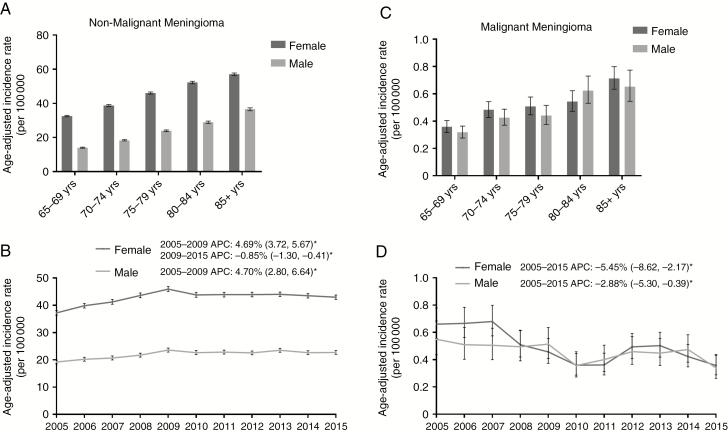
(A–D) Age-adjusted incidence rates and annual percent changes (APCs) for nonmalignant meningioma by (A) sex by 5-year age groupings, and by (B) sex over time from 2005–2015. Age-adjusted incidence rates and APCs for malignant meningioma by (C) sex by 5-year age groupings and (D) sex over time in 2005–2015. APCs are accompanied by 95% CIs in parentheses. *Only significant changes in APC are reported in the figures. (CBTRUS 2005–2015)
Fig. 2
Fig. 2
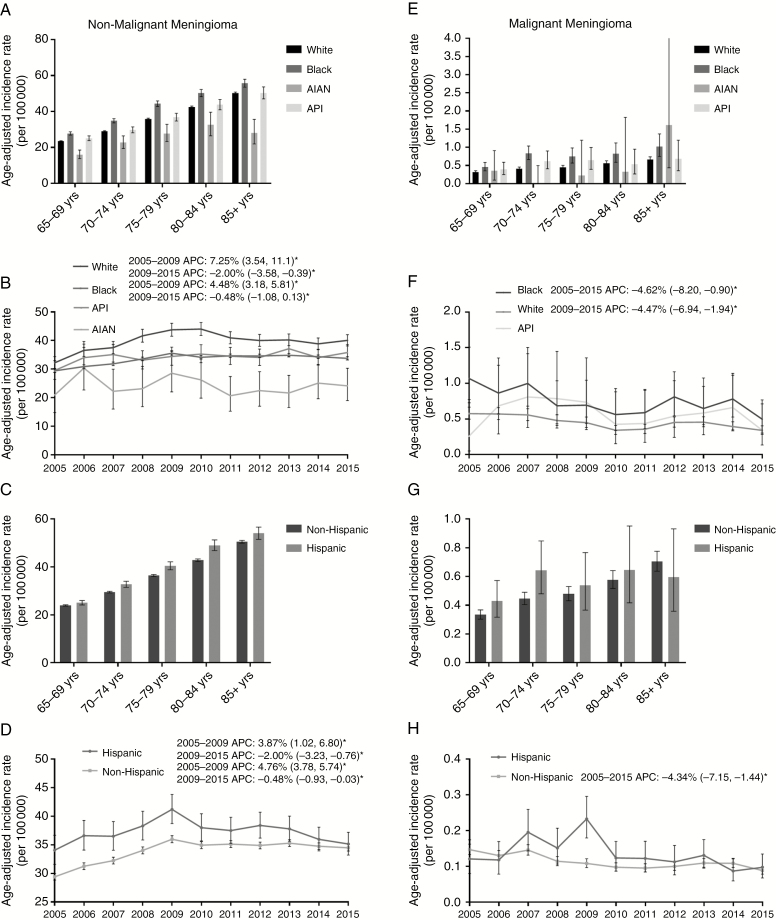
(A–D) Age-adjusted incidence rates and annual percent changes (APCs) for nonmalignant meningioma by (A) age and race, including black, white, Asian/Pacific Islander (API), and American Indian Alaskan Native (AIAN), (B) race over time in 2005–2015, (C) age and ethnicity, and (D) ethnicity over time in 2005–2015. (E–F) Age-adjusted incidence rates and APCs for malignant meningioma by (E) age and race, (F) race over time in 2005–2015, (G) age and ethnicity, and (H) ethnicity over time in 2005–2015. APCs are accompanied by 95% CI in parentheses. *Only significant changes in APC are reported in the figures. (CBTRUS 2005–2015)
Fig. 3
Fig. 3
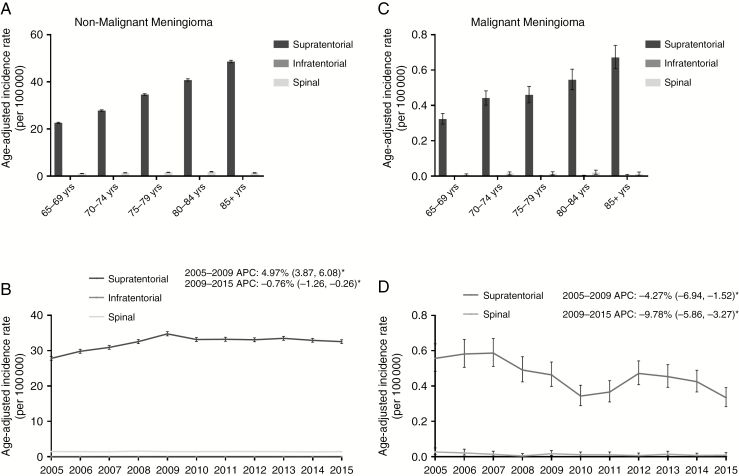
(A–B) Age-adjusted incidence rates and annual percent changes (APCs) for nonmalignant meningioma by (A) age and location and (B) location over time in 2005–2015, including supratentorial, infratentorial, and spinal nonmalignant meningioma. (C, D) Age-adjusted incidence rates and APCs for malignant meningioma by (C) age and location and (D) location over time in 2005–2015, including supratentorial, infratentorial, and spinal malignant meningioma. APCs are accompanied by 95% CIs in parentheses. *Only significant changes in APC are reported in the figures. (CBTRUS 2005–2015)
Fig. 4
Fig. 4
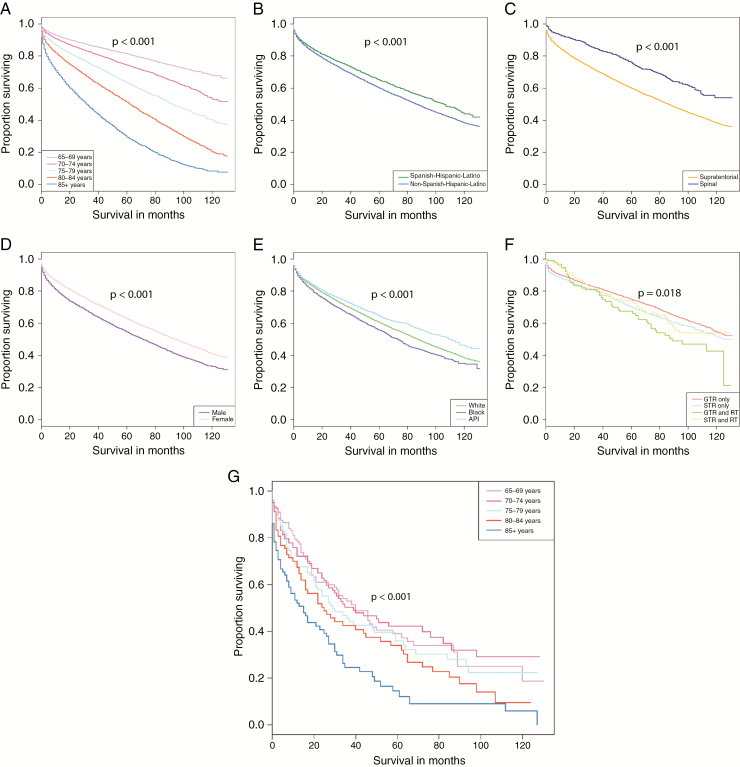
Kaplan–Meier curves depicting variables with significant differences in survival for nonmalignant (A–F) and malignant meningioma (G). Significant associations with survival for nonmalignant meningioma included (A) 5-year age groups (P < 0.001), (B) ethnicity (P < 0.001), (C) location (P < 0.001), (D) sex (P < 0.001), (E) race (P < 0.001), and (F) surgical resection/radiation treatment (P = 0.018). The only significant association with survival for malignant meningioma was (G) 5-year age groups (P < 0.001).

References

    1. Ostrom QT, Gittleman H, Liao P, et al. CBTRUS Statistical Report: primary brain and other central nervous system tumors diagnosed in the United States in 2010–2014. Neuro Oncol. 2017;19(suppl_5):v1–v88. - PMC - PubMed
    1. Gittleman HR, Ostrom QT, Rouse CD, et al. Trends in central nervous system tumor incidence relative to other common cancers in adults, adolescents, and children in the United States, 2000 to 2010. Cancer. 2015;121(1):102–112. - PMC - PubMed
    1. Kshettry VR, Ostrom QT, Kruchko C, Al-Mefty O, Barnett GH, Barnholtz-Sloan JS. Descriptive epidemiology of World Health Organization grades II and III intracranial meningiomas in the United States. Neuro Oncol. 2015;17(8):1166–1173. - PMC - PubMed
    1. Wiemels J, Wrensch M, Claus EB. Epidemiology and etiology of meningioma. J Neurooncol. 2010;99(3):307–314. - PMC - PubMed
    1. Ikawa F, Kinoshita Y, Takeda M, et al. Review of current evidence regarding surgery in elderly patients with meningioma. Neurol Med Chir (Tokyo). 2017;57(10):521–533. - PMC - PubMed

Publication types

MeSH terms