Review
. 2019 Mar;1862(3):382-393.
doi: 10.1016/j.bbagrm.2018.09.010. Epub 2018 Oct 5.

It's complicated… m6A-dependent regulation of gene expression in cancer

Affiliations
Review

It's complicated… m6A-dependent regulation of gene expression in cancer

Christina M Fitzsimmons et al. Biochim Biophys Acta Gene Regul Mech. 2019 Mar.

Abstract

Cellular function relies on multiple pathways that are coordinated to ensure the proper execution of gene expression networks. Failure to coordinate the multiple programs active in the cell can have catastrophic consequences and lead to diseases such as cancer. At the post-transcriptional level, RNA modifications play important roles in the regulation of gene expression. N6-methyladenosine (m6A) is the most abundant internal messenger RNA (mRNA) modification and has gained increasing interest in the last few years as a dynamic regulator of RNA metabolism. Modifications regulate all stages of the RNA life cycle, from transcription to decay. Recent studies have pointed to the role of RNA methylation in cancer initiation and progression, and aberrant modification has served as a biomarker of early-stage diagnosis in several cancers. Here, we review the regulation of m6A, disruptions to methylation-dependent pathways that influence carcinogenesis, and potential avenues for m6A-related therapeutic strategies.

Keywords: Cancer; Epitranscriptome; Gene regulation; m(6)A.


Figures

Figure 1:
Figure 1:. Cycle of methylation and demethylation.
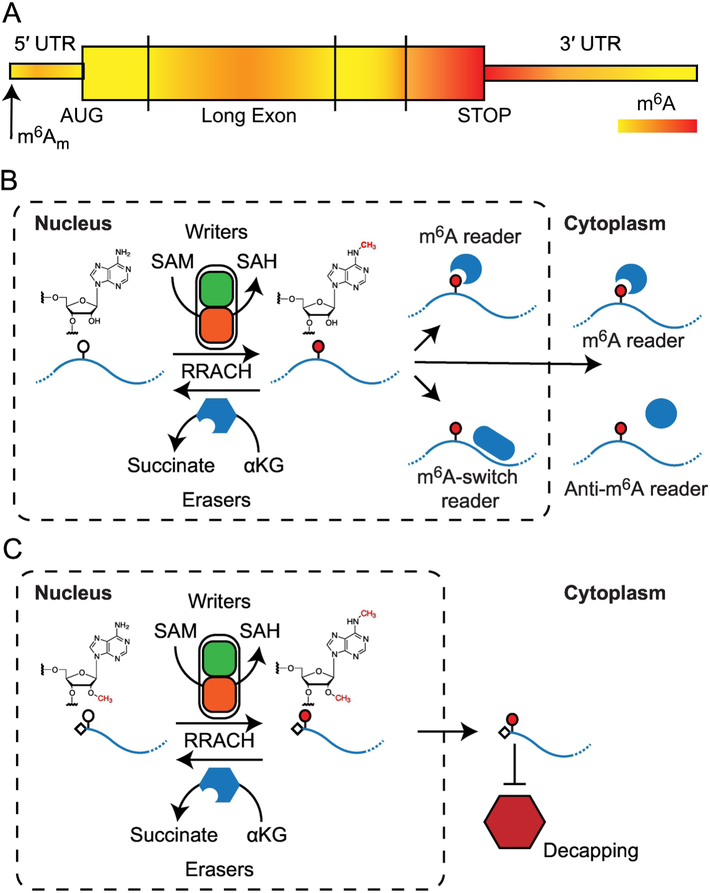
(A) The modified bases N6-methyladenosine (m6A) and N6,2′-O-dimethyladenosine (m6Am) are present in distinct regions of mature mRNA. (B) Addition of m6A to RNA requires the co-factor SAM and is catalyzed by the methylase complex (writers). The modification is removed through the actions of the αKG-dependent demethylases (erasers). The presence or absence of m6A affects the activity of numerous RNA binding proteins (readers) that modulate the downstream processing of the RNA. (C) Formation of m6Am occurs in the nucleus. Similar to m6A, levels of m 6Am are determined by a balance between writer and eraser activity. The presence of m6Am confers resistance to decapping activity in the cytoplasm.
Figure 2.
Figure 2.. N6-methyladenosine regulatory complexes.
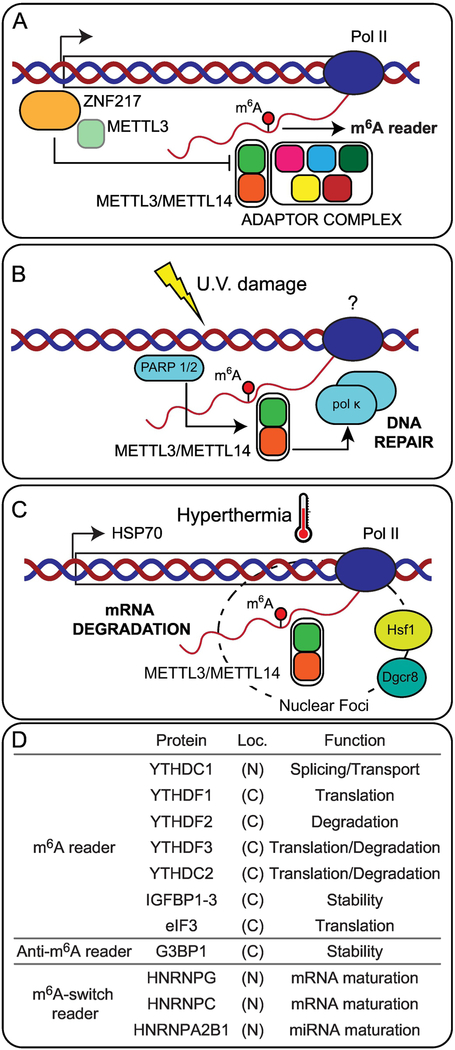
The METTL3/METTL14 proteins have been observed to interact with other cellular proteins. (A) The adaptor complex, which includes zinc finger CCCH domain-containing protein 13 (Zc3h13) Wilms Tumor 1-associated protein (WTAP) Virilizer, Hakai, and RNA binding motif protein 15 (RBM15), facilitates programed deposition of m6A during development. Additionally, the transcription factor zinc finger protein 217 can disrupt the formation of the core complex by sequestering METTL3. (B) Accumulation of m6A also occurs in response to UV damage and promotes recruitment of DNA damage repair factors. (C) Under hyperthermia, recruitment of METLL3/METTL14 to heat shock foci marks transcripts for rapid turnover. (D) Three types of RNA binding proteins that interact with RNA in a m6A-dependent manner have been described: 1) m6A readers, proteins that interact with the modified m6A base; 2) proteins repelled by the presence of m6A; and 3) proteins that interact with RNA after m6A-induced rearrangement of RNA structure. These proteins are present in both the cytoplasm and the nucleus, and determine RNA metabolism.
Figure 3.
Figure 3.. Cancer-induced disruptions of m6A-dependent pathways.
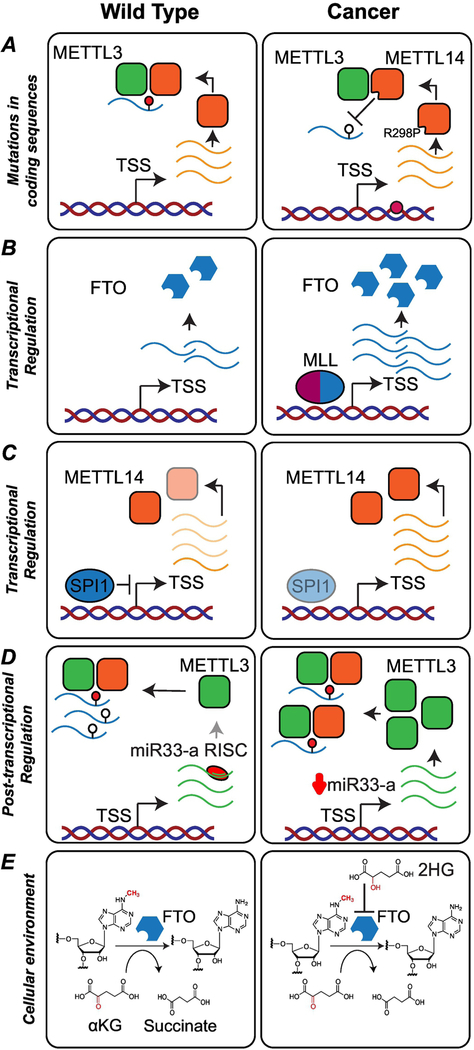
(A) Mutation of a highly conserved arginine in METTL14 (R298P) is frequently observed in endometrial cancer. This mutation diminishes methylation activity by disrupting substrate recognition. (B) In Mixed Lineage Leukemia (MLL)-rearranged acute myeloid leukemia (AML), FTO expression is up-regulated through binding of MLL-fusion proteins to CpG sites in the FTO locus. (C) In individuals with AML, the transcription factor SPI1, a repressor of METTL14, is suppressed, resulting in the upregulation of METTL14 and enhancement of self-renewal and proliferation. (D) Production of METTL3 can be repressed post-transcriptionally by microRNA-mediated gene silencing. In non-small cell lung cancer, miR-33a, a regulator of METTL3, is expressed at low levels, resulting in higher levels of METTL3 protein. (E) Mutations in IDH enzymes lead to the production of the onco-metabolite 2-hydroxyglutarate (2HG). 2HG is structurally similar to αKG, and acts as a competitive inhibitor of the m6A demethylases FTO and ALKBH5.
Figure 4:
Figure 4:. m6A-dependent pathways regulate control of cellular transcription factors.
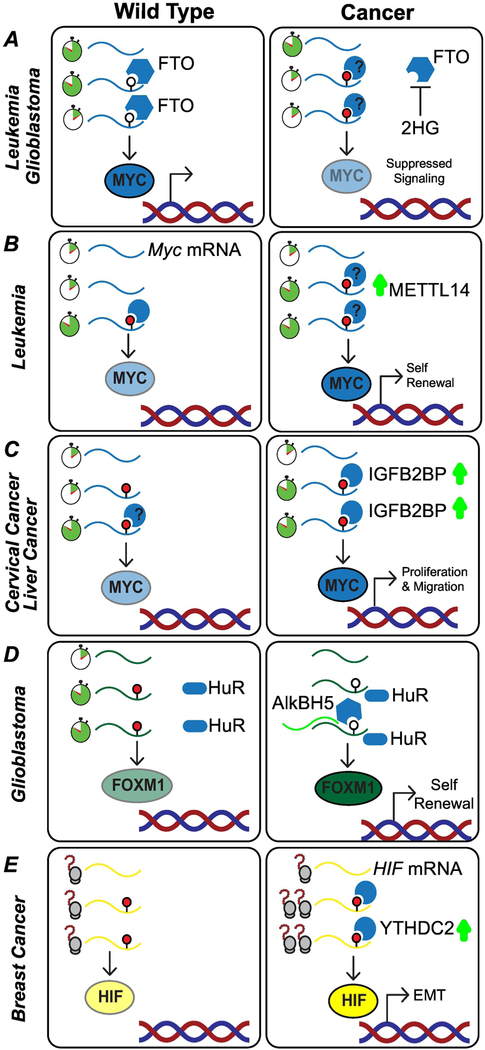
(A) Mutations in IDH lead to the production of the onco-metabolite 2-hydroxyglutarate (2HG). Accumulation of 2HG inhibits the activity of the m6A demethylase FTO, leading to downregulation of MYC and suppressed MYC signaling. (B) Upregulation of METTL14 in individuals with acute myeloid leukemia (AML) leads to increased deposition of m6A. Stabilization of MYC mRNA, through interaction with an unknown reader protein, drives a self-renewal phenotype in the cancer cells; (C) In cervical cancer and hepatocellular carcinoma (HCC) cells, the m6A reader IGFB2BP stabilizes MYC mRNA, leading to increased cellular proliferation; (D) In glioblastoma cells, the lncRNA FOXM1-AS mediates the interaction between HuR and the demethylase ALKBH5, increasing expression of the transcription factor FOXM1 and driving a self-renewal phenotype. (E) Translation of the transcription factor HIF-1α is promoted by the m6A reader YTHDC2. HIF activates the transcription of genes that play a role in angiogenesis and adaptive response.
Figure 5:
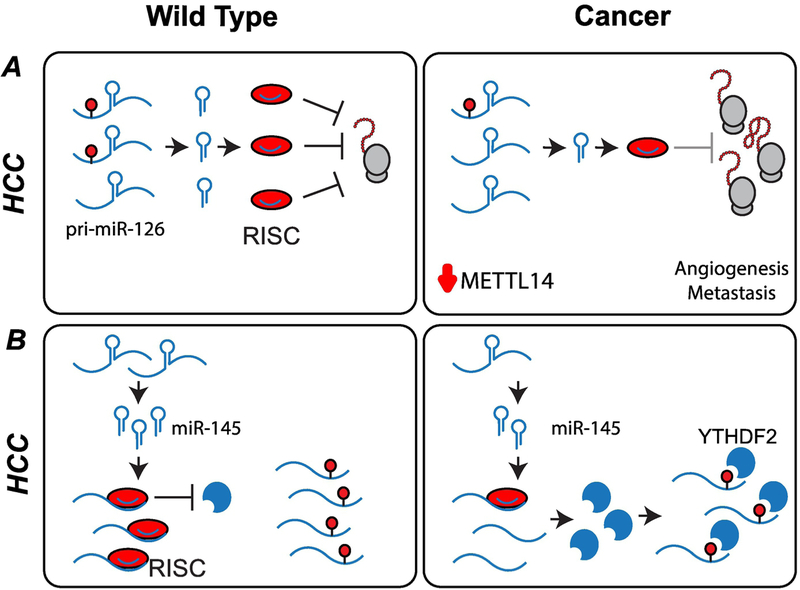
Figure 5:. Post-transcriptional regulation of gene expression by miRNA.
(A) Downregulation of METTL14 in hepatocellular carcinoma (HCC) cells leads to an increase in unprocessed pri-miR-126. Mature miR-126 is associated with metastasis. (B) In HCC cells, lower expression of miR-145 allows for expression of YTHDF2 protein, decreasing the levels of m6A in cells, and increasing cellular proliferation.
Figure 6:
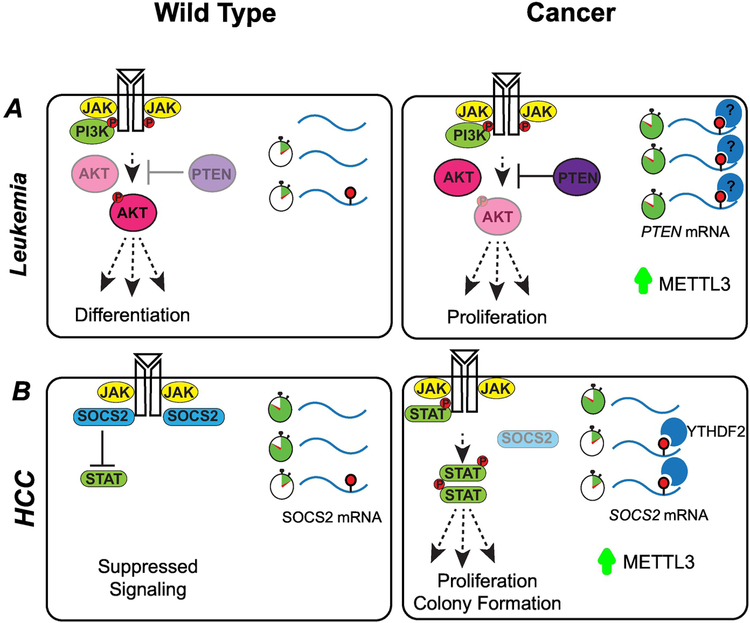
Figure 6:. m6A-dependent pathways influence signaling cascades.
(A) METTL3 is expressed more abundantly in acute myeloid leukemia (AML) cells than healthy hematopoietic stem cells. Upregulation of METTL3 results in increased mRNA methylation and higher expression levels of factors critical for the regulation of apoptosis and differentiation. For example, increased PTEN activity reduces PI3K/AKT pathway signaling, leading to proliferation and maintenance of the hematopoietic stem cell program. (B) In hepatocellular carcinoma (HCC) cells, increased METTL3 results in increased expression of SOCS2, a member of the JAK-STAT signaling pathway. Increased levels of SOCS2 lead to cellular proliferation and carcinogenesis.

References

    1. Boccaletto P, Machnicka MA, Purta E, Piatkowski P, Baginski B, Wirecki TK, et al. MODOMICS: a database of RNA modification pathways. 2017 update. Nucleic Acids Res. 2018. January 4;46(D1):D303–7. - PMC - PubMed
    1. Motorin Y, Helm M. RNA nucleotide methylation. Wiley Interdiscip Rev RNA. 2011. October;2(5):611–31. - PubMed
    1. Xu L, Liu X, Sheng N, Oo KS, Liang J, Chionh YH, et al. Three distinct 3-methylcytidine (m3C) methyltransferases modify tRNA and mRNA in mice and humans. J Biol Chem. 2017. 01;292(35):14695–703. - PMC - PubMed
    1. Squires JE, Patel HR, Nousch M, Sibbritt T, Humphreys DT, Parker BJ, et al. Widespread occurrence of 5-methylcytosine in human coding and non-coding RNA. Nucleic Acids Res. 2012. June;40(11):5023–33. - PMC - PubMed
    1. Amort T, Rieder D, Wille A, Khokhlova-Cubberley D, Riml C, Trixl L, et al. Distinct 5-methylcytosine profiles in poly(A) RNA from mouse embryonic stem cells and brain. Genome Biol. 2017. 05;18(1):1. - PMC - PubMed

Publication types

LinkOut - more resources