. 2018 Nov;178(3):1096-1111.
doi: 10.1104/pp.18.00922. Epub 2018 Oct 8.

Elucidation of the Amygdalin Pathway Reveals the Metabolic Basis of Bitter and Sweet Almonds (Prunus dulcis)

Affiliations

Elucidation of the Amygdalin Pathway Reveals the Metabolic Basis of Bitter and Sweet Almonds (Prunus dulcis)

Sara Thodberg et al. Plant Physiol. 2018 Nov.

Abstract

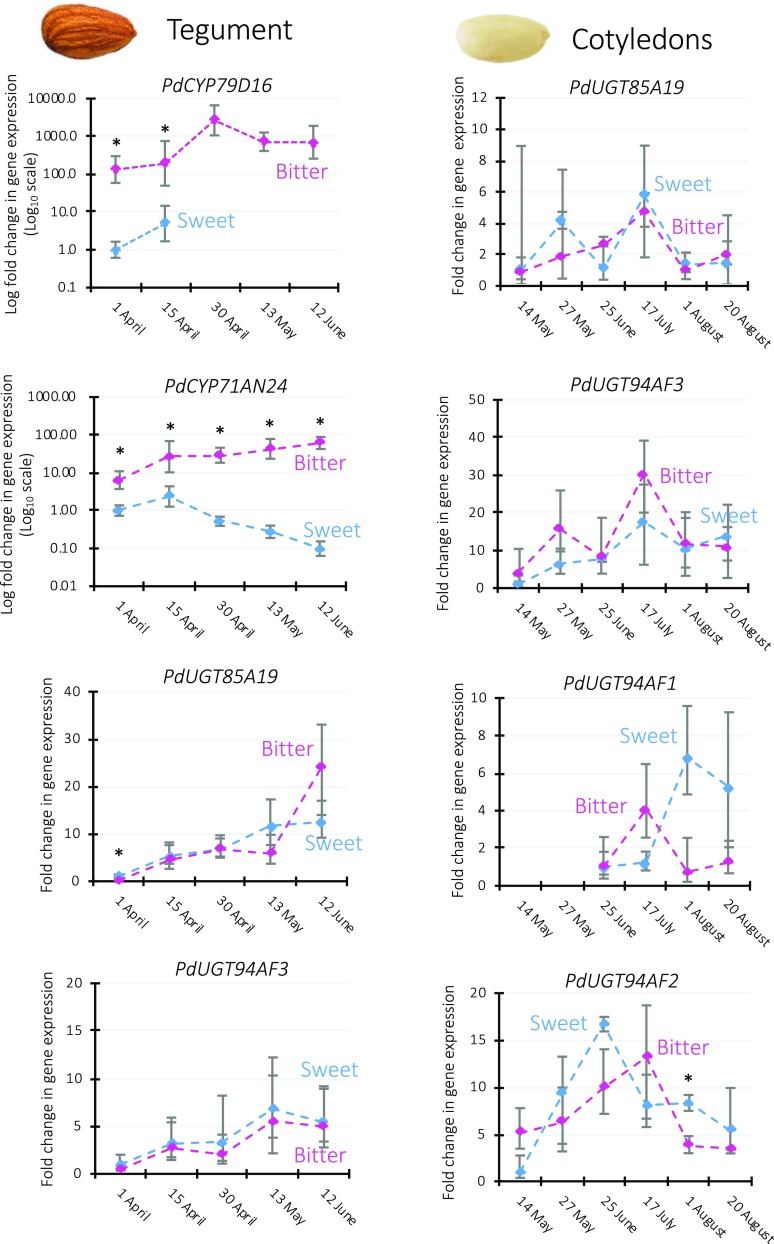
Almond (Prunus dulcis) is the principal Prunus species in which the consumed and thus commercially important part of the fruit is the kernel. As a result of continued selection, the vast majority of almonds have a nonbitter kernel. However, in the field, there are trees carrying bitter kernels, which are toxic to humans and, consequently, need to be removed. The toxicity of bitter almonds is caused by the accumulation of the cyanogenic diglucoside amygdalin, which releases toxic hydrogen cyanide upon hydrolysis. In this study, we identified and characterized the enzymes involved in the amygdalin biosynthetic pathway: PdCYP79D16 and PdCYP71AN24 as the cytochrome P450 (CYP) enzymes catalyzing phenylalanine-to-mandelonitrile conversion, PdUGT94AF3 as an additional monoglucosyl transferase (UGT) catalyzing prunasin formation, and PdUGT94AF1 and PdUGT94AF2 as the two enzymes catalyzing amygdalin formation from prunasin. This was accomplished by constructing a sequence database containing UGTs known, or predicted, to catalyze a β(1→6)-O-glycosylation reaction and a Basic Local Alignment Search Tool search of the draft version of the almond genome versus these sequences. Functional characterization of candidate genes was achieved by transient expression in Nicotiana benthamiana Reverse transcription quantitative polymerase chain reaction demonstrated that the expression of PdCYP79D16 and PdCYP71AN24 was not detectable or only reached minute levels in the sweet almond genotype during fruit development, while it was high and consistent in the bitter genotype. Therefore, the basis for the sweet kernel phenotype is a lack of expression of the genes encoding the two CYPs catalyzing the first steps in amygdalin biosynthesis.


Figures

Figure 1.
Figure 1.
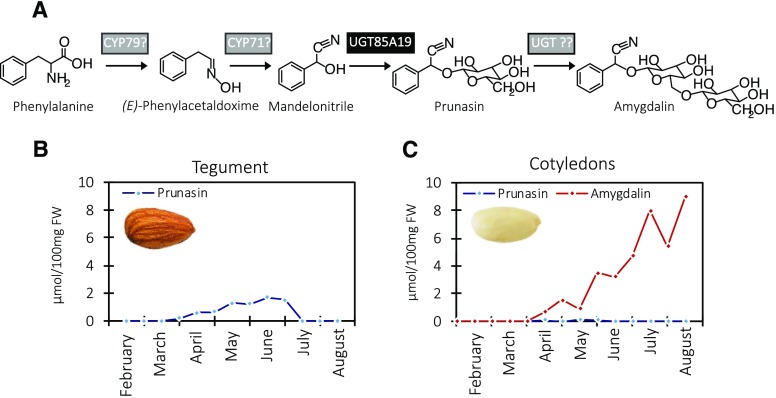
The intermediates in the biosynthesis of prunasin and amygdalin in bitter almonds (A), with product formation in the tegument (B) and cotyledons (C) shown during fruit development. In the first reaction, Phe is converted to mandelonitrile by two CYPs belonging to the CYP79 and CYP71 families. The mandelonitrile is glucosylated by the previously known UGT85A19 enzyme (Franks et al., 2008). Amygdalin is glucosylated further by an unknown UGT. The enzymes identified in this study are shown on a gray background, whereas the previously described UGT85A19 is shown on a black background. Prunasin and amygdalin contents were analyzed by liquid chromatography-mass spectrometry (LC-MS) in tegument (B) and cotyledons (C) during fruit development (February to August, analyzed every second week), which represents the period from flowering to ripening (modified from Sánchez-Pérez et al. [2008]). FW, Fresh weight.
Figure 2.
Figure 2.
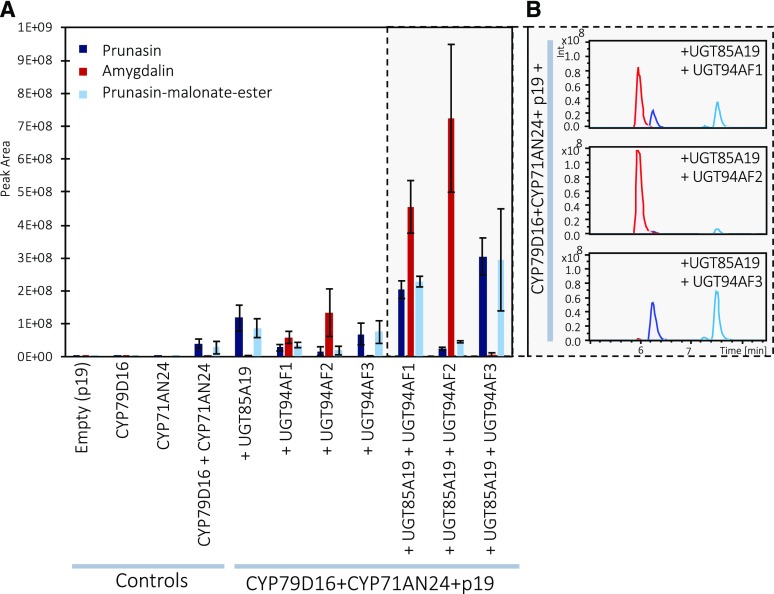
A, Functional characterization of the gene candidates PdCYP79D16, PdCYP71AN24, PdUGT85A19, PdUGT94AF1, PdUGT94AF2, and PdUGT94AF3 by transient expression in N. benthamiana and monitoring of product formation by LC-MS analysis and selected ion monitoring. When PdCYP79D16 and PdCYP71AN24 are coexpressed, small amounts of prunasin and prunasin-malonate ester can be detected, as compared with the control (p19). Amygdalin is detected only when at least three genes are coexpressed. B, Representative LC-MS recordings of the experiments shown on the gray background in A. Data are presented as means of three independent agroinfiltrated leaves ± sd.
Figure 3.
Figure 3.
Relative transcript levels of prunasin and amygdalin biosynthetic genes in the tegument and cotyledons of the sweet genotype Lauranne (blue traces) and the bitter genotype S3067 (purple traces) during fruit development. For each gene, expression levels were normalized to the one displayed by the sweet genotype at the earliest time point. TEFII, RPTII, and UBQ10 were used as housekeeping reference genes. Data are presented as means ± sd of three biological replicates. Note the logarithmic scale applied in the two graphs showing PdCYP79D16 and PdCYP71AN24 in tegument. Asterisks indicate statistically significant genotypic differences at the same time point (Student’s t test, P < 0.01). The expression of PdCYP79D16 was not detected in the sweet tegument at the last three time points, while the expression of PdUGT94AF1 was not detected in the bitter cotyledons at the first two time points. No expression of PdUGT94AF1 and PdUGT94AF2 in tegument and of PdCYP79D16 and PdCYP71AN24 in cotyledons was detectable. For relative expression level comparisons among the enzymes in the same tissue, see Supplemental Figure S5.
Figure 4.
Figure 4.
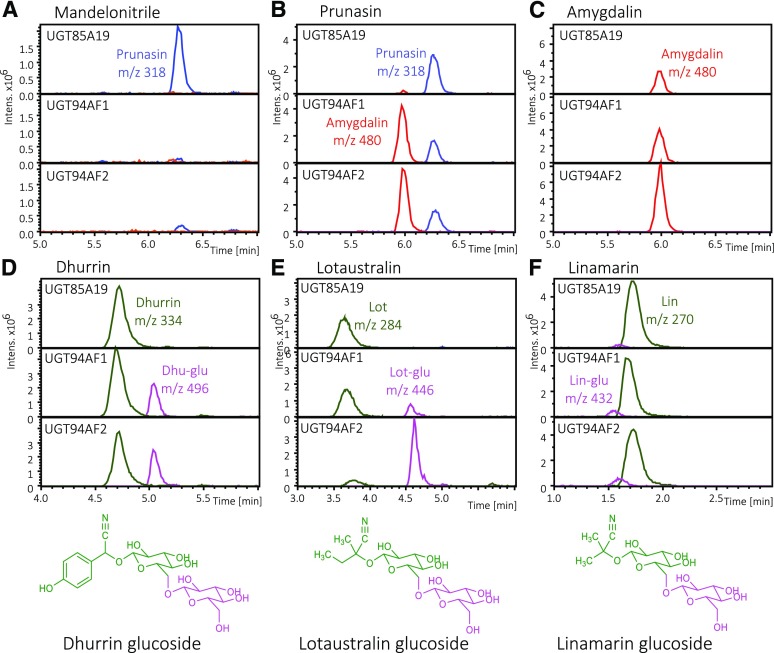
Substrate specificity of PdUGT85A19, PdUGT94AF1, and PdUGT94AF2 as measured by the administration of different substrates to the individual UGTs transiently produced in N. benthamiana, as monitored by LC-MS and extracted ion chromatograms. A to C, Amygdalin, m/z 480, red traces; prunasin, m/z 318, blue traces. D to F, Monoglucosides shown in green traces: dhurrin, m/z 334; lotaustralin, m/z 284; linamarin, m/z 270. Diglucosides shown in purple traces: dhurrin glucoside, m/z 496; lotaustralin glucoside, m/z 446; linamarin glucoside, m/z 432 (Supplemental Fig. S3).
Figure 5.
Figure 5.
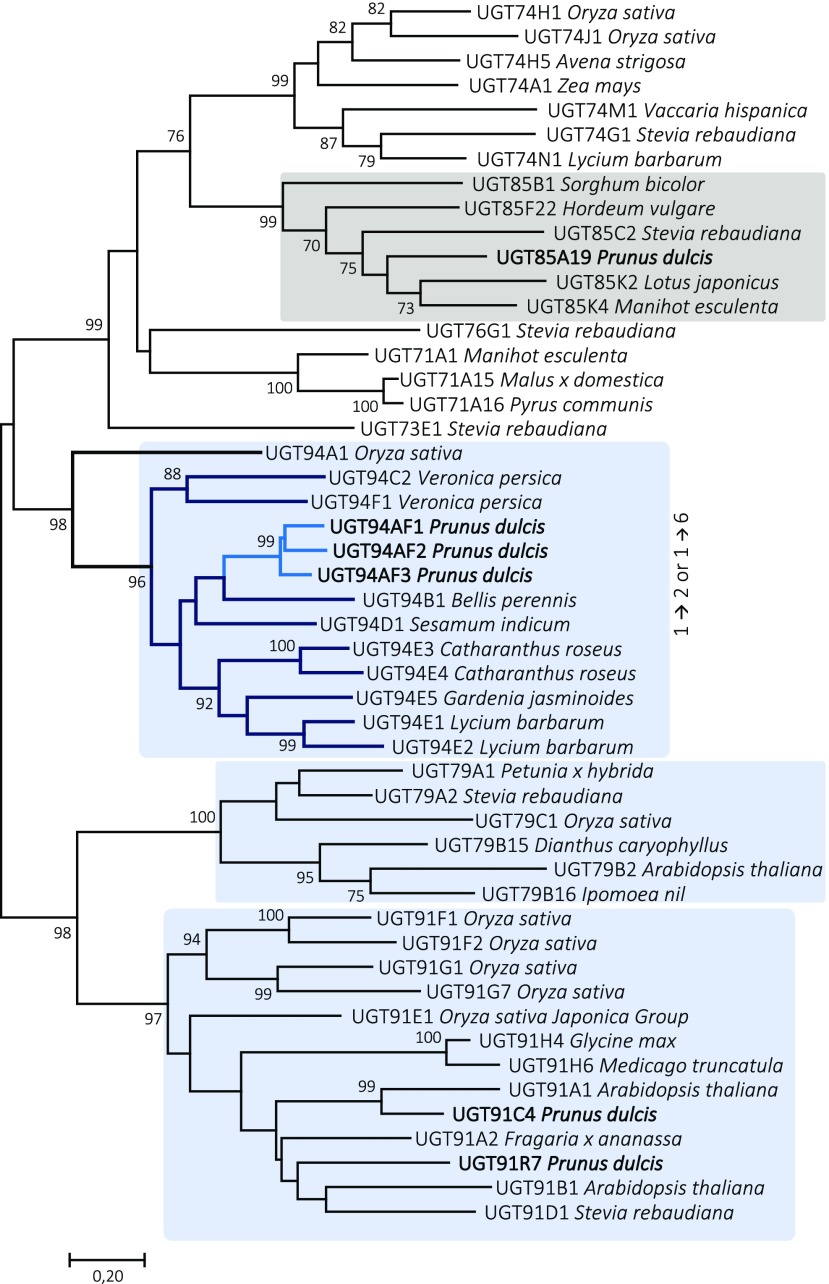
Phylogenetic neighbor-joining tree of 50 UGTs known to catalyze glycosylation of the Glc moiety in different classes of monoglucosides from different plant species. Based on the UGT gene data set, the derived UGT protein sequences were used to implement a multiple sequence alignment using the program ClustalV in MEGA7. The output files were used to construct the evolutionary history using the neighbor-joining method with 1,000 replications, where bootstrap values at the nodes are listed in percentage of the replications. UGT families known to harbor members catalyzing β1→2 or β1→6 bond formation are boxed in light blue. The UGT85 family catalyzing mandelonitrile glycosylation UGTs is shown in gray. The tree is a representation of the database utilized in the initial UGT search. A complete table including accession numbers is found in Supplemental Table S6.
Figure 6.
Figure 6.
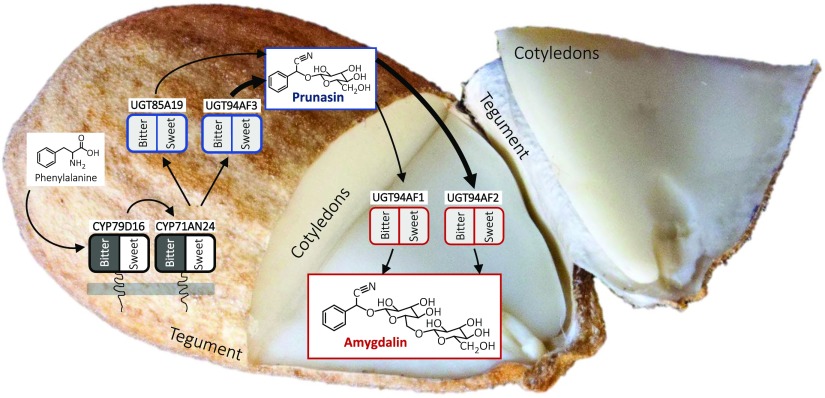
The amygdalin biosynthetic pathway and its compartmentalization in almond. In the tegument, Phe is transformed into prunasin by the action of two P450s and UGTs. The expression levels of the two P450s PdCYP79D16 and PdCYP71AN24 are different between sweet (white background, no expression) and bitter (black background, very high expression). The expression of the UGT-encoding genes is not significantly different in the sweet and bitter phenotypes. Following transport to the cotyledons, prunasin is converted into amygdalin by the action of diglucosyltransferases encoded by PdUGT94AF1 or PdUGT94AF2. These two genes also are not differentially expressed in the cotyledons. The expression levels of PdUGT94AF3 and PdUGT94AF2 are higher than those of PdUGT85A19 and PdUGT94AF1, respectively (Supplemental Fig. S5), which is represented by thicker arrows. Thus, the sweet kernel trait reflects the lack of expression of PdCYP79D16 and PdCYP71AN24.

Comment in

References

    1. Andersen MD, Busk PK, Svendsen I, Møller BL (2000) Cytochromes P-450 from cassava (Manihot esculenta Crantz) catalyzing the first steps in the biosynthesis of the cyanogenic glucosides linamarin and lotaustralin: cloning, functional expression in Pichia pastoris, and substrate specificity of the isolated recombinant enzymes. J Biol Chem 275: 1966–1975 - PubMed
    1. Bak S, Kahn RA, Nielsen HL, Møller BL, Halkier BA (1998a) Cloning of three A-type cytochromes P450, CYP71E1, CYP98, and CYP99 from Sorghum bicolor (L.) Moench by a PCR approach and identification by expression in Escherichia coli of CYP71E1 as a multifunctional cytochrome P450 in the biosynthesis of the cyanogenic glucoside dhurrin. Plant Mol Biol 36: 393–405 - PubMed
    1. Bak S, Nielsen HL, Halkier BA (1998b) The presence of CYP79 homologues in glucosinolate-producing plants shows evolutionary conservation of the enzymes in the conversion of amino acid to aldoxime in the biosynthesis of cyanogenic glucosides and glucosinolates. Plant Mol Biol 38: 725–734 - PubMed
    1. Bak S, Olsen CE, Halkier BA, Møller BL (2000) Transgenic tobacco and Arabidopsis plants expressing the two multifunctional sorghum cytochrome P450 enzymes, CYP79A1 and CYP71E1, are cyanogenic and accumulate metabolites derived from intermediates in dhurrin biosynthesis. Plant Physiol 123: 1437–1448 - PMC - PubMed
    1. Bassard JE, Møller BL, Laursen T (2017) Assembly of dynamic P450-mediated metabolons: order versus chaos. Curr Mol Biol Rep 3: 37–51 - PMC - PubMed

Publication types

MeSH terms