


Low Praziquantel Treatment Coverage for Schistosoma mansoni in Mayuge District, Uganda, Due to the Absence of Treatment Opportunities, Rather Than Systematic Non-Compliance
- PMID: 30297642
- PMCID: PMC6306755
- DOI: 10.3390/tropicalmed3040111
Low Praziquantel Treatment Coverage for Schistosoma mansoni in Mayuge District, Uganda, Due to the Absence of Treatment Opportunities, Rather Than Systematic Non-Compliance
Abstract
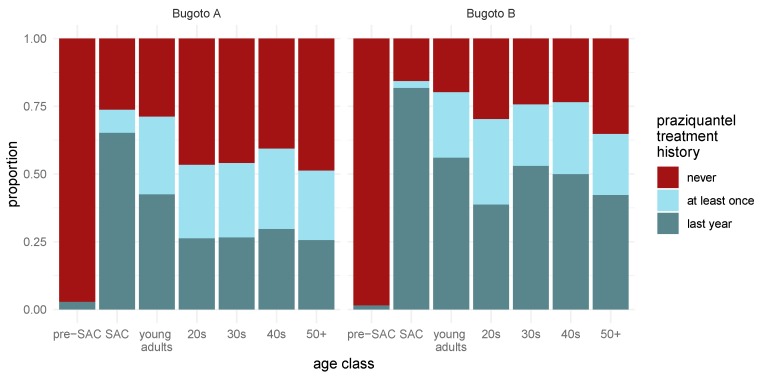
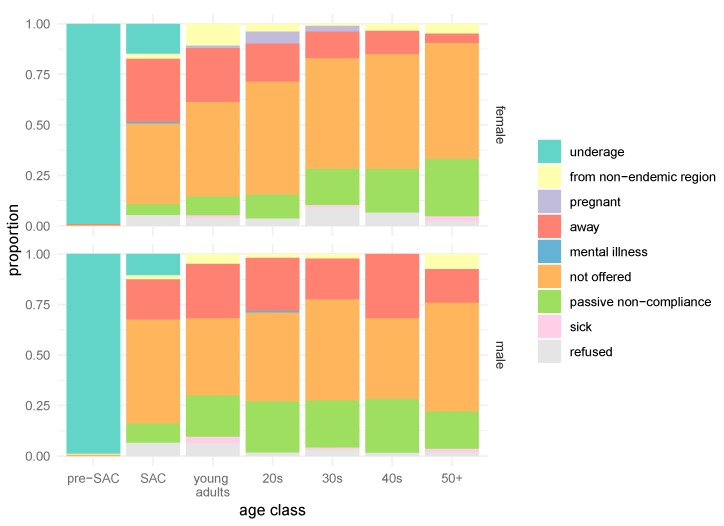
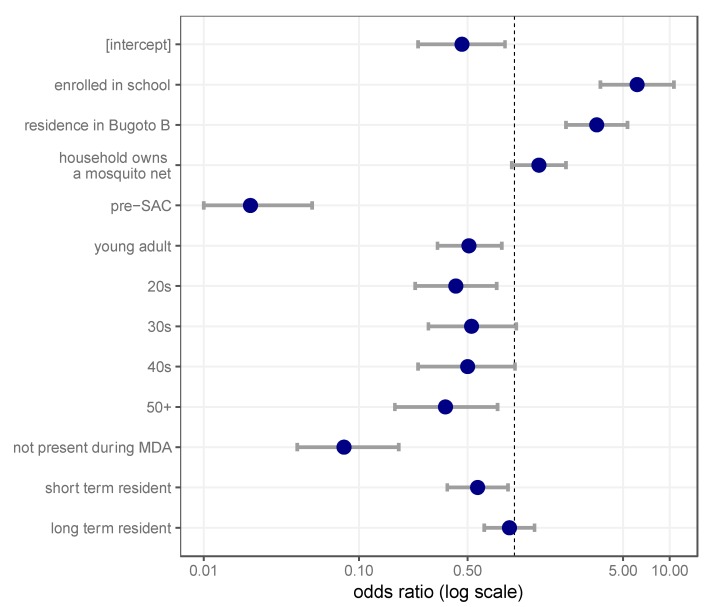
The World Health Organization (WHO) recommends praziquantel mass drug administration (MDA) to control schistosomiasis in endemic regions. We aimed to quantify recent and lifetime praziquantel coverage, and reasons for non-treatment, at an individual level to guide policy recommendations to help Uganda reach WHO goals. Cross-sectional household surveys (n = 681) encompassing 3208 individuals (adults and children) were conducted in 2017 in Bugoto A and B, Mayuge District, Uganda. Participants were asked if they had received praziquantel during the recent MDA (October 2016) and whether they had ever received praziquantel in their lifetime. A multivariate logistic regression analysis with socio-economic and individual characteristics as covariates was used to determine factors associated with praziquantel uptake. In the MDA eligible population (≥5 years of age), the most recent MDA coverage was 48.8%. Across individuals' lifetimes, 31.8% of eligible and 49.5% of the entire population reported having never taken praziquantel. Factors that improved individuals' odds of taking praziquantel included school enrolment, residence in Bugoto B and increasing years of village-residency. Not being offered (49.2%) and being away during treatment (21.4%) were the most frequent reasons for not taking the 2016 praziquantel MDA. Contrary to expectations, chronically-untreated individuals were rarely systematic non-compliers, but more commonly not offered treatment.
Keywords: MDA coverage; Mayuge; S. mansoni; Uganda; praziquantel; systematic non-compliance; treatment-opportunities.
Conflict of interest statement
The authors declare no conflict of interest. The funders had no role in the design of the study; in the collection, analyses or interpretation of data; in the writing of the manuscript; nor in the decision to publish the results.
Figures
References
-
- WHO . Schistosomiasis: Progress Report 2001–2011, Strategic Plan 2012–2020. WHO; Geneva, Switzerland: 2013.
-
- Savioli L., Albonico M., Colley D.G., Correa-Oliveira R., Fenwick A., Green W., Kabatereine N., Kabore A., Katz N., Klohe K., et al. Building a global schistosomiasis alliance: An opportunity to join forces to fight inequality and rural poverty. Infect. Dis. Poverty. 2017;6:65. doi: 10.1186/s40249-017-0280-8. - DOI - PMC - PubMed
-
- Hotez P.J., Alvarado M., Basanez M.G., Bolliger I., Bourne R., Boussinesq M., Brooker S.J., Brown A.S., Buckle G., Budke C.M., et al. The Global Burden of Disease Study 2010: Interpretation and implications for the neglected tropical diseases. PLoS Negl. Trop. Dis. 2014;8:e2865. doi: 10.1371/journal.pntd.0002865. - DOI - PMC - PubMed
Grants and funding
LinkOut - more resources
Full Text Sources
