Comparative Study
. 2018 Oct;119(7):901-907.
doi: 10.1038/s41416-018-0248-x. Epub 2018 Oct 9.

Risk of diabetes after para-aortic radiation for testicular cancer

Affiliations
Comparative Study

Risk of diabetes after para-aortic radiation for testicular cancer

Harmke J Groot et al. Br J Cancer. 2018 Oct.

Abstract

Background: While the risk of diabetes is increased following radiation exposure to the pancreas among childhood cancer survivors, its association among testicular cancer (TC) survivors has not been investigated.

Methods: Diabetes risk was studied in 2998 1-year TC survivors treated before 50 years of age with orchidectomy with/without radiotherapy between 1976 and 2007. Diabetes incidence was compared with general population rates. Treatment-specific risk of diabetes was assessed using a case-cohort design.

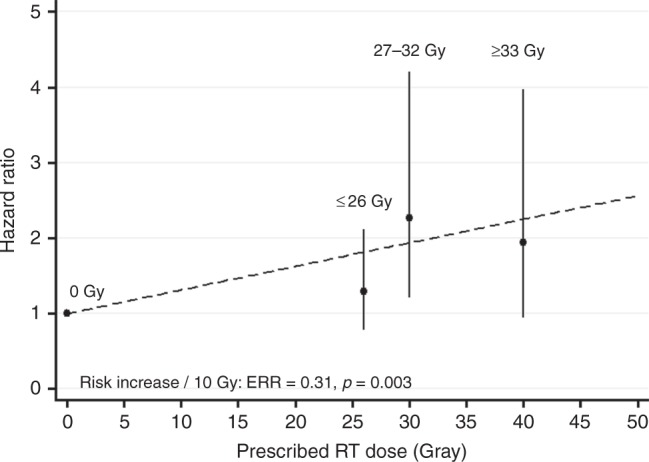
Results: With a median follow-up of 13.4 years, 161 TC survivors were diagnosed with diabetes. Diabetes risk was not increased compared to general population rates (standardised incidence ratios (SIR): 0.9; 95% confidence interval (95% CI): 0.7-1.1). Adjusted for age, para-aortic radiotherapy was associated with a 1.66-fold (95% CI: 1.05-2.62) increased diabetes risk compared to no radiotherapy. The excess hazard increased with 0.31 with every 10 Gy increase in the prescribed radiation dose (95% CI: 0.11-0.51, P = 0.003, adjusted for age and BMI); restricted to irradiated patients the excess hazard increased with 0.33 (95% CI: -0.14 to 0.81, P = 0.169) with every 10 Gy increase in radiation dose.

Conclusion: Compared to surgery only, para-aortic irradiation is associated with increased diabetes risk among TC survivors.


Conflict of interest statement

The authors declare no competing interests.

Figures
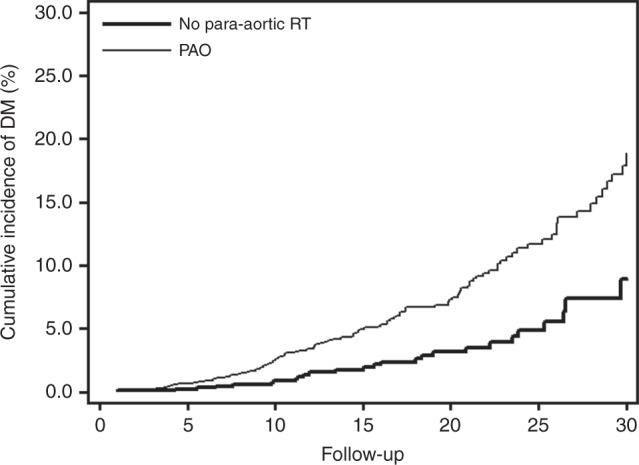
Fig. 1
Fig. 1
Incidence of diabetes among testicular cancer survivors treated with para-aortic radiotherapy compared to orchidectomy only. PAO para-aortic irradiation. Diabetes incidence was significantly increased after para-aortic radiotherapy (P < 0.001)
Fig. 2
Fig. 2
Risk of diabetes by prescribed para-aortic radiation dose among testicular cancer survivors. HRs for diabetes risk for prescribed dose categories are plotted at the mean dose within each category (26 Gy for ≤26GY, 30 Gy for 27–32 Gy and 40 Gy for ≥33 Gy). Vertical lines represent the 95% CI for each category of dose. The HRs for determining the excess risk increase per 10 Gray (ERR) were derived from a model with adjustment for age and BMI continuously. The excess risk was estimated based on the following dose categories: 10–24 Gy, 25 Gy, 26 Gy, 27–30 Gy, 31–39 Gy and ≥40 Gy, with median doses of 21, 25, 26, 30, 33, 40 and 50 Gy

References

    1. de Vathaire F, et al. Radiation dose to the pancreas and risk of diabetes mellitus in childhood cancer survivors: a retrospective cohort study. Lancet Oncol. 2012;13:1002–1010. doi: 10.1016/S1470-2045(12)70323-6. - DOI - PubMed
    1. Meacham LR, et al. Diabetes mellitus in long-term survivors of childhood cancer. Increased risk associated with radiation therapy: a report for the childhood cancer survivor study. Arch. Intern. Med. 2009;169:1381–1388. doi: 10.1001/archinternmed.2009.209. - DOI - PMC - PubMed
    1. Meacham LR, et al. Cardiovascular risk factors in adult survivors of pediatric cancer--a report from the childhood cancer survivor study. Cancer Epidemiol. Biomark. Prev. 2010;19:170–181. doi: 10.1158/1055-9965.EPI-09-0555. - DOI - PMC - PubMed
    1. van Nimwegen FA, et al. Risk of diabetes mellitus in long-term survivors of Hodgkin lymphoma. J. Clin. Oncol. 2014;32:3257–3263. doi: 10.1200/JCO.2013.54.4379. - DOI - PubMed
    1. Hauptmann M, et al. Increased pancreatic cancer risk following radiotherapy for testicular cancer. Br. J. Cancer. 2016;115:901–908. doi: 10.1038/bjc.2016.272. - DOI - PMC - PubMed

Publication types