. 2018 Oct 8;9(1):4160.
doi: 10.1038/s41467-018-06537-y.

An efficient and multiple target transgenic RNAi technique with low toxicity in Drosophila

Affiliations

An efficient and multiple target transgenic RNAi technique with low toxicity in Drosophila

Huan-Huan Qiao et al. Nat Commun. .

Abstract

Being relatively simple and practical, Drosophila transgenic RNAi is the technique of top priority choice to quickly study genes with pleiotropic functions. However, drawbacks have emerged over time, such as high level of false positive and negative results. To overcome these shortcomings and increase efficiency, specificity and versatility, we develop a next generation transgenic RNAi system. With this system, the leaky expression of the basal promoter is significantly reduced, as well as the heterozygous ratio of transgenic RNAi flies. In addition, it has been first achieved to precisely and efficiently modulate highly expressed genes. Furthermore, we increase versatility which can simultaneously knock down multiple genes in one step. A case illustration is provided of how this system can be used to study the synthetic developmental effect of histone acetyltransferases. Finally, we have generated a collection of transgenic RNAi lines for those genes that are highly homologous to human disease genes.


Conflict of interest statement

The authors declare no competing interests.

Figures

Fig. 1
Fig. 1
The pNP system works efficiently in soma and germline. a Examples of pNP-induced wing phenotypes using the MS1096-Gal4 or C96-Gal4. Scale bars, 500 μm. b Knock down of white, light or hh in the eye driven by ey-Gal4. Scale bars, 200 μm. c Dark field images of ovary phenotype, with knock down of piwi and bam controlled by nos-Gal4. Scale bars, 300 μm. d Fertility rates of control, pNP-piwi and pNP-bam female flies using the nos-Gal4 driver (n = 10, mean ± s.d.). Data are evaluated with one-tailed Student’s t-test (*p < 0.05, **p < 0.01, ***p < 0.001)
Fig. 2
Fig. 2
Significantly reduced leaky expression from basal promoter. a Relative luciferase expression levels at different developmental stages of pVALIUM20-luciferase and pNP-luciferase flies without the Gal4 driver (n = 5, mean ± s.d.). b Relative luciferase expression levels in different tissues of pVALIUM20-luciferase and pNP-luciferase flies at larval stage without the Gal4 driver (n = 3, mean ± s.d.). c Immunostaining of polytene chromosome from pVALIUM20-Hp1a and pNP-Hp1a without the induction of Gal4. DNA was visualized with DAPI and HP1a was stained with mouse monoclonal anti-HP1a (HP1a C1A9). Dotted circles indicate chromocenter. Scale bars, 20 μm. d Quantification of the relative HP1a intensity at chromocenter of polytene chromosome in pVALIUM20-Hp1a or pNP-Hp1a without the Gal4 driver (n = 10, mean ± s.d.). Data are evaluated with one-tailed Student’s t-test. e Relative expression of HP1a in control, pVALIUM20-Hp1a or pNP-Hp1a salivary gland without the driving of Gal4 (n = 3, mean ± s.d.). Data are evaluated using one-tailed Student’s t-test. f The heterozygous percentage of pVALIUM20 system based transgenic lines and pNP system based transgenic lines
Fig. 3
Fig. 3
The pNP system is superior to the pVALIUM20 system. a Knock down of E2F1 in the eye using the pVALIUM20 system or the pNP system with the same shRNA driven by ey-Gal4. Scale bars, 200 μm. b RNAi of Upf1 in the wing using MS1096-Gal4. Scale bars, 500 μm. c Targeting of aTub67C with the pVALIUM20 system or the pNP system driven by Nub-Gal4. Scale bars, 500 μm. d Knock down of egg in the germline controlled by nos-Gal4. Scale bars, 300 μm. e Fertility rates of control, pVALIUM20-egg and pNP-egg female flies using the nos-Gal4 driver (n = 10, mean ± s.d.). Data are evaluated with one-tailed Student’s t-test. f qRT-PCR analysis of the RNAi efficiency of E2F1, Upf1, aTub67C, and egg, respectively (n = 3, mean ± s.d.). Data are evaluated using one-tailed Student’s t-test (*p < 0.05, **p < 0.01, ***p < 0.001)
Fig. 4
Fig. 4
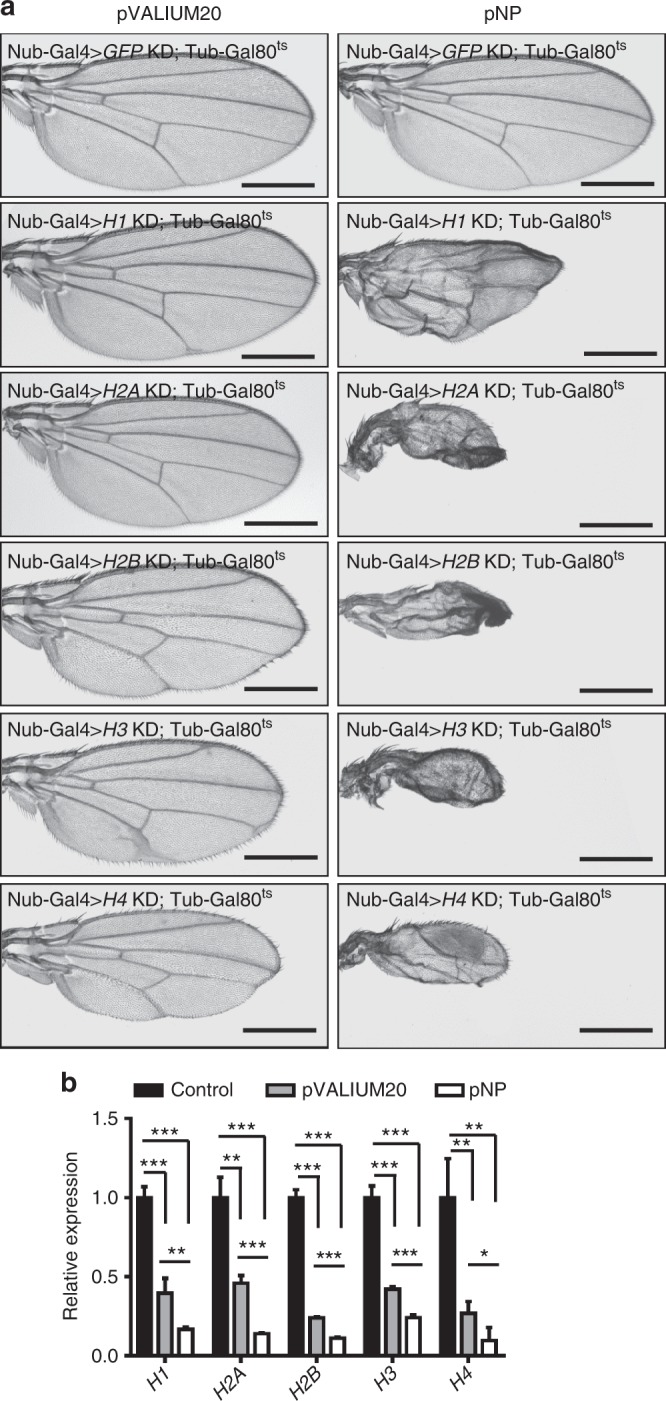
The pNP system could efficiently modulate high expression genes. a The Nub-Gal4; tub-Gal80ts system was used for conditional knock down of histones in the pNP and pVALIUM20 systems, with the flies first incubated at 18 °C and then shifted to 29 °C at third larval stage. Scale bars, 500 μm. b The act-Gal4; tub-Gal80ts system was used for qRT-PCR analysis of the RNAi efficiency, targeting H1, H2A, H2B, H3, and H4 (n = 3, mean ± s.d.). Data are evaluated using one-tailed Student’s t-test (*p < 0.05, **p < 0.01, ***p < 0.001)
Fig. 5
Fig. 5
The pNP system can simultaneously target multiple genes. a RNAi against white caused complete loss of red pigment in eye; also note that knock down of notch in eye using GMR-Gal4 caused lethality. Scale bars, 200 μm. b Compared with control, pNP-N, pNP-W-N and pNP-N-W driven by C96-Gal4 all showed similar Notch wing defect phenotypes. Scale bars, 500 μm. c Disruption of Ci driven by Nub-Gal4 produced anterior fusion of L3 and L4 veins of the wing, while knock down of E2F1 caused small wing with anterior fusion of L2 and L3 veins. The combined phenotype of anterior fusion of L2, L3, L4 veins and small wing showed in pNP-Ci-E2F1 and pNP-E2F1-Ci flies. Scale bars, 500 μm. d, e Traditional genetic combination of pNP-Ci and pNP-E2F1 exhibited a much weaker phenotype. Only a small proportion of pNP-Ci; pNP-E2F1 flies showed both Ci KD and E2F1 KD phenotype; most of them generated either Ci KD or E2F1 KD, while there were even some similar with wild-type phenotype. Scale bars, 500 μm
Fig. 6
Fig. 6
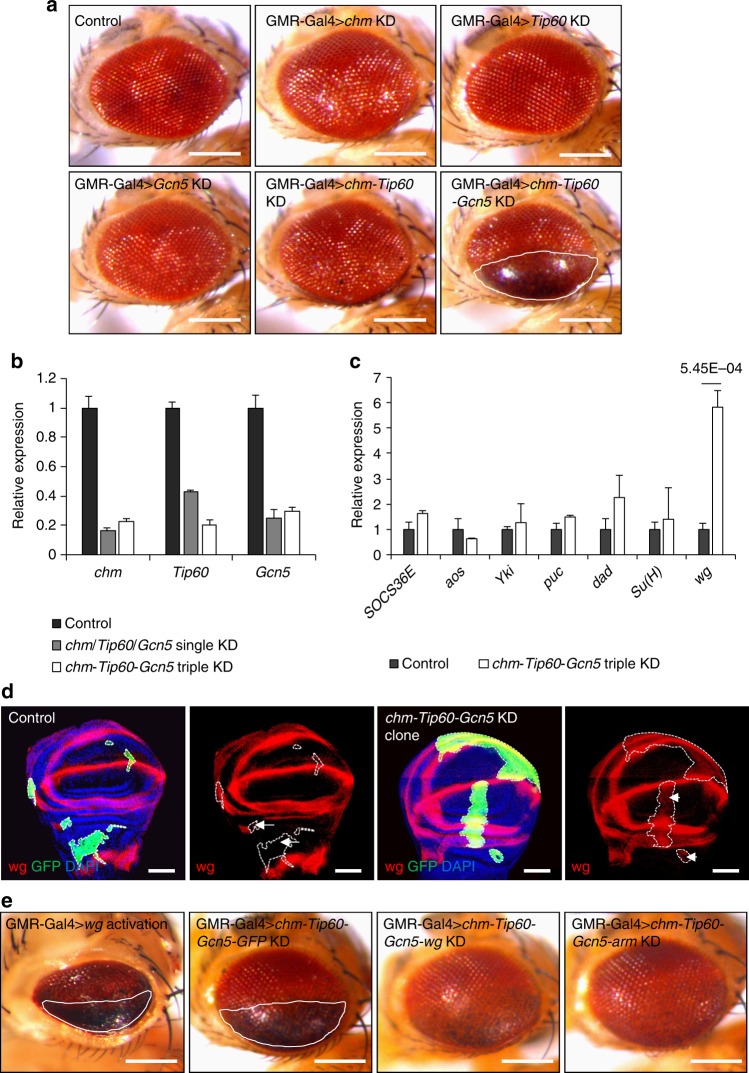
Histone acetyltransferases regulate eye development through Wnt signaling pathways. a chm, Tip60, Gcn5 single knock down or chm-Tip60 double knock down exhibited wild-type phenotype driven by GMR-Gal4, while simultaneous knock down of chm-Tip60-Gcn5 using the pNP system produced severe eye defects. Scale bars, 200 μm. b qRT-PCR results show that chm, Tip60, Gcn5 are all reduced to comparable level in single gene knockdown or triple genes knockdown flies. (n = 3, mean ± s.d.). c Wnt signaling pathway was significantly up-regulated as represented by Wg via qRT-PCR assay (n = 3, mean ± s.d.). Data are evaluated using one-tailed Student’s t-test. d Immunostaining result showed up-regulated Wg in GFP-marked chm-Tip60-Gcn5 KD clones. Dotted lines showed the GFP marked clone. Compared with control (indicated by long tail arrows), Wg signals were significantly increased in chm-Tip60-Gcn5 KD clone (indicated by short tail arrows). Scale bars, 50 μm. e Transcriptional activation of wg produced similar eye phenotype as chm-Tip60-Gcn5 KD flies. Knockdown of wg or arm at the background of chm-Tip60-Gcn5 triple RNAi clearly rescued the eye phenotype. Scale bars, 200 μm

References

    1. Dietzl G, et al. A genome-wide transgenic RNAi library for conditional gene inactivation in Drosophila. Nature. 2007;448:151–156. doi: 10.1038/nature05954. - DOI - PubMed
    1. Ni JQ, et al. A Drosophila resource of transgenic RNAi lines for neurogenetics. Genetics. 2009;182:1089–1100. doi: 10.1534/genetics.109.103630. - DOI - PMC - PubMed
    1. Perrimon N, Ni JQ, Perkins L. In vivo RNAi: today and tomorrow. Cold Spring Harb. Perspect. Biol. 2010;2:a003640. doi: 10.1101/cshperspect.a003640. - DOI - PMC - PubMed
    1. Ni JQ, et al. A genome-scale shRNA resource for transgenic RNAi in Drosophila. Nat. Methods. 2011;8:405–407. doi: 10.1038/nmeth.1592. - DOI - PMC - PubMed
    1. Ni JQ, et al. Vector and parameters for targeted transgenic RNA interference in Drosophila melanogaster. Nat. Methods. 2008;5:49–51. doi: 10.1038/nmeth1146. - DOI - PMC - PubMed

Publication types

Substances

LinkOut - more resources