. 2018 Nov;24(11):1732-1742.
doi: 10.1038/s41591-018-0200-x. Epub 2018 Oct 8.

Structure-guided combination therapy to potently improve the function of mutant CFTRs

Affiliations

Structure-guided combination therapy to potently improve the function of mutant CFTRs

Guido Veit et al. Nat Med. 2018 Nov.

Abstract

Available corrector drugs are unable to effectively rescue the folding defects of CFTR-ΔF508 (or CFTR-F508del), the most common disease-causing mutation of the cystic fibrosis transmembrane conductance regulator, a plasma membrane (PM) anion channel, and thus to substantially ameliorate clinical phenotypes of cystic fibrosis (CF). To overcome the corrector efficacy ceiling, here we show that compounds targeting distinct structural defects of CFTR can synergistically rescue mutant expression and function at the PM. High-throughput cell-based screens and mechanistic analysis identified three small-molecule series that target defects at nucleotide-binding domain (NBD1), NBD2 and their membrane-spanning domain (MSD) interfaces. Although individually these compounds marginally improve ΔF508-CFTR folding efficiency, function and stability, their combinations lead to ~50-100% of wild-type-level correction in immortalized and primary human airway epithelia and in mouse nasal epithelia. Likewise, corrector combinations were effective against rare missense mutations in various CFTR domains, probably acting via structural allostery, suggesting a mechanistic framework for their broad application.


Conflict of interest statement

Competing financial interests

C.L., W.L., K.M., S.G., P.A.M., F.J.K., E.A., A.J.O., P.M. and W.G.B. are employees of the Genomics Institute of the Novartis Research Foundation. I.S.-G. has been principal investigator in Vertex initiated clinical trials, received a Vertex Pharmaceuticals Innovation Award and served as a scientific advisory board member for Vertex Pharmaceuticals. G.L.L. is a member of the Scientific Advisory Board of Proteostasis Therapeutics Inc. All other authors declare no competing financial or non-financial interests.

Figures
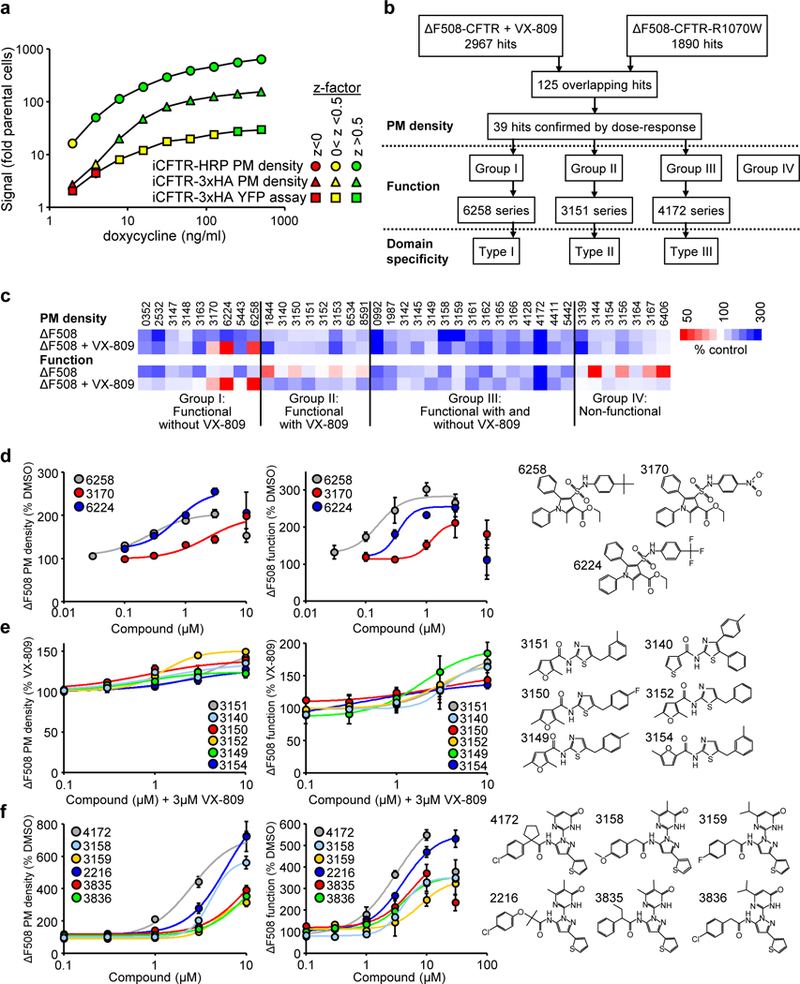
Figure 1
Figure 1
Identification of small-molecule ΔF508-CFTR correctors by high-throughput screening. (a) Comparison of the sensitivity and robustness of the plasma membrane (PM) density or functional HTS assays of HRP- or 3HA-tagged CFTR (n = 3). WT-CFTR expression in CFBE41o- was induced by increasing doxycycline concentrations. CFTR PM density and function were determined as shown in Supplementary Fig. 1a-c. Results are depicted as fold change to parental cell background. The z-factor ranges are color coded. (b) Flow chart of the screening and corrector mechanism identification process. (c) Heat map of corrector effect (10 μM, 24 hours, 37°C) on the PM density and function of ΔF508-CFTR in CFBE41o- alone or in combination with 3 μM VX-809. The underlying data are depicted as dose-response curves or bar plots in Supplementary Fig. 1d-h (n = 2–57). (d-f) PM density and function dose-response (left and middle) and structures (right) of the 6258 corrector series (d), 3151 corrector series (e), and 4172 corrector series (f). The ΔF508-CFTR PM density and function were determined by PM-ELISA and YFP quenching assay, respectively (n = 3). Data in a and d-f are means ± SEM of the indicated number of independent experiments.
Figure 2
Figure 2
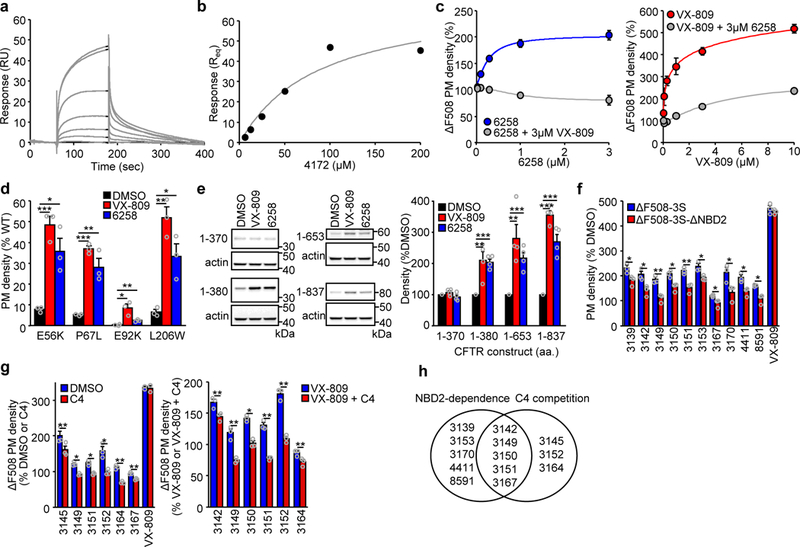
Corrector mechanism of action. (a,b) Representative surface plasmon resonance (SPR) sensorgram (a) and binding isotherm (b) for the association of 4172 (0–200 μM) to immobilized ΔF508-NBD1–1S. (c) Competing effect of VX-809 (3 μM) on the 6258 dose-dependent elevation of the ΔF508-CFTR PM density (left panel, n = 3). Inhibition of the VX-809 dose-dependent ΔF508-CFTR PM correction in presence of 3 μM 6258 (right panel, n = 3). (d) PM density correction of the N-terminal tail (E56K, P67L) and MSD1 (E92K, L206W) CFTR folding mutants by VX-809 or 6258 (3 μM, 24 hours) in CFBE41o- (n = 3). (e) Representative immunoblot (left panel) and quantification of the expression level by densitometry (right panel) of indicated N-terminal CFTR fragments expressed in HEK293 cells with or without VX-809 or 6258 (3 μM, 24 hours) treatment. The fragments 1–653 and 1–837 contained the ΔF508 mutation. All fragments were detected with anti-CFTR antibody MM13–4 (n = 4). Uncropped immunoblots are presented in Supplementary Figure 11. (f) The effect of indicated correctors (10 μM, 24 hours) on the PM density of ΔF508-CFTR-3S (containing the solubilizing mutations F494N, Q637R, F492S) or ΔF508-CFTR-3S lacking the NBD2 domain (ΔNBD2) in CFBE41o- relative to untreated cells (n = 3). (g) Relative effect of C4 competition (10 μM, 24 hours) on the PM density of ΔF508-CFTR in CFBE41o- treated with the indicated correctors (10 μM) alone (left panel, n = 3) or in combination with 3 μM VX-809 (right panel, n = 3). (h) Venn-diagram clustering of compounds that rescue effect required NBD2 and/or was attenuated by C4. Data in c-g are means ± SEM of the indicated number of independent experiments. *P < 0.05, **P < 0.01, ***P < 0.001 by unpaired two-tailed Student’s t-test. The precise P-values are listed in Supplementary Table 4.
Figure 3
Figure 3
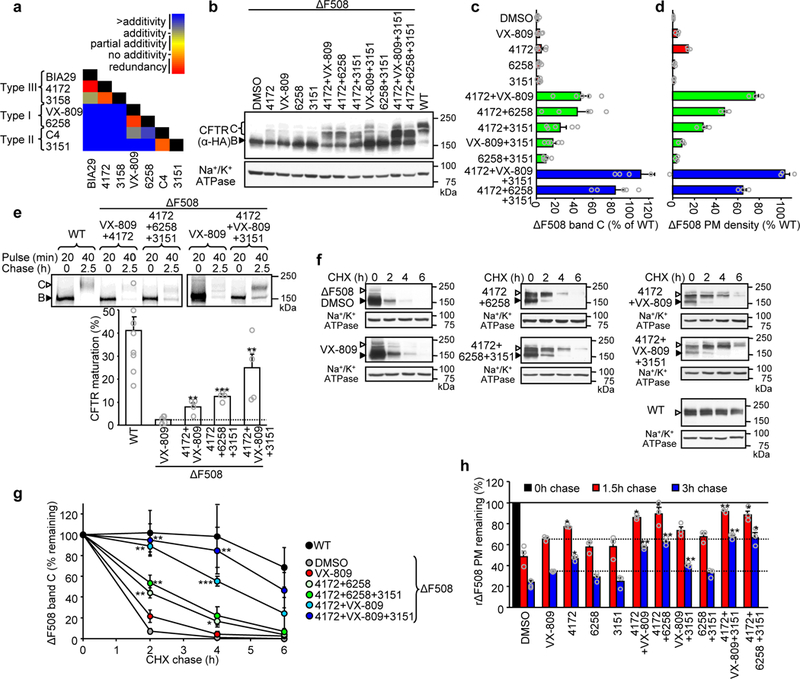
Structure-guided combination of corrector compounds restores ΔF508-CFTR biogenesis and stability. (a) Combinatorial profiling of compound pair effect on ΔF508-CFTR PM density in comparison to their theoretical additivity (n = 3). The primary PM density data are shown in Supplementary Fig. 3b. (b-d). Effect of indicated single correctors or corrector combinations (4172, 3151– 10 μM; VX-809, 6258 – 3 μM, 24 hours, 37°C) on the expression pattern of ΔF508-CFTR in CFBE41o- determined by quantitative immunoblotting (b) and densitometry (c, n = 5) or measured by PM ELISA (d, n = 3). ΔF508-CFTR values were normalized with CFTR mRNA abundance (Supplementary Fig. 3c) and are expressed as percentage of WT-CFTR control. (e) Determination of ER folding efficiency of WT-CFTR (n = 9) or ΔF508-CFTR in the presence of VX-809 (3 μM, 24 hours, n = 5) or indicated corrector combinations (n = 5 for 4172+VX-809+3151; n = 4 for 4172+VX-809 and 4172+6258+3151) by metabolic pulse chase technique and phosphoimage analysis. The folding efficiency was calculated as the percentage of pulse-labeled, immature core-glycosylated CFTR (B-band, filled arrowhead) conversion into the complex-glycosylated form (C-band, open arrowhead). (f-g) Stability of WT-CFTR or ΔF508-CFTR in CFBE41o- cells upon treatment with VX-809 or compound combinations was determined by quantitative immunoblotting with CHX chase (representative immunoblots of n = 3 independent experiments). The remaining complex-glycosylated (open arrowhead) form was quantified by densitometry and is expressed as percent of the initial amount (panel g, n = 3). (h) The effect of individual compounds or their combinations on the PM stability of low-temperature rescued (48 hours, 26°C) ΔF508-CFTR after 1.5 and 3 hour chase at 37°C (n = 3). Data in c-e and g-h are means ± SEM of the indicated number of independent experiments. *P < 0.05, **P < 0.01, ***P < 0.001 by unpaired two-tailed Student’s t-test in comparison to VX-809 treated samples. The precise P-values are listed in Supplementary Table 4. The uncropped versions of the immunoblots in b and f and of the autoradiographs in e are shown in Supplementary Figure 11.
Figure 4
Figure 4
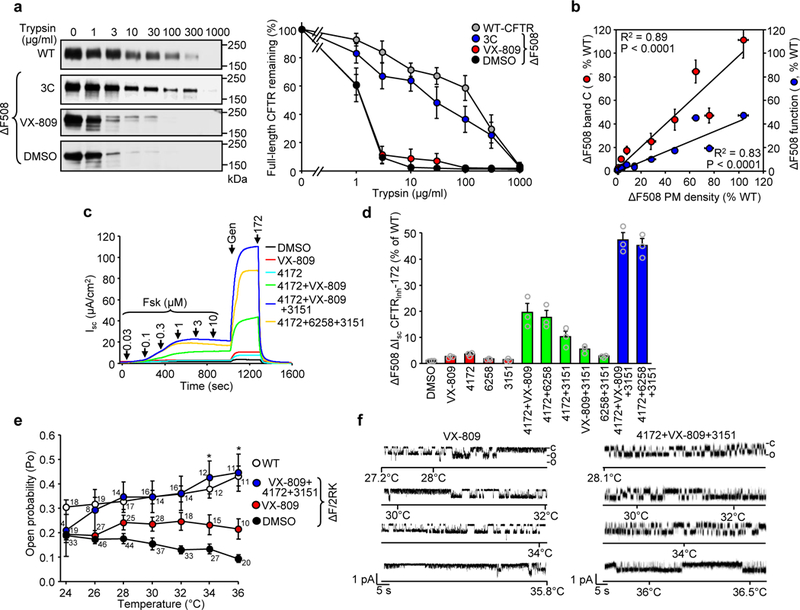
Corrector combinations rescue the ΔF508-CFTR folding and functional defects. (a) The WT- or ΔF508-CFTR conformation in isolated microsomes was probed by limited trypsinolysis and immunoblotting (left panel). Microsomes isolated from BHK-21 cells, treated with DMSO, VX-809 or 4172+VX-809+3151 corrector combination (3C), were exposed to increasing concentrations of trypsin and the remaining full-length CFTR was quantified by immunoblotting. Complex-glycosylated WT- or ΔF508-CFTR was expressed as the percentage of the initial amount (right panel, n = 4). (b) Correlation between the PM density (n = 3) and band C abundance (n = 5) or activation (Fsk + Gen, n = 3) of ΔF508-CFTR after treatment with single correctors or corrector combinations as determined in Fig. 3c,d and panel (d), respectively. The Pearson correlation coefficient and the associated P-value are shown. (c,d) Effect of indicated single correctors or corrector combinations on the short-circuit current (Isc) of ΔF508-CFTR in CFBE41o-. Representative traces are shown in c. ΔF508-CFTR function (n = 3) normalized with CFTR RNA abundance (Supplementary Fig. 3c) is expressed as percentage of WT function in d. (e,f) The effect of VX-809 or 3C on thermal inactivation of ΔF508-CFTR-2RK reconstituted into an artificial phospholipid bilayer. The Po of protein kinase A–activated CFTRs was analyzed at the indicated temperatures (e), WT (total recording time for each point 16–23 min, n = 11–19, exact number of independent records for each temperature is indicated in the graph), ΔF508–2RK (38–48 min, n = 20–46), ΔF508–2RK + VX809 (6–27 min, n = 10–26), and ΔF508–2RK + 3C (4–18 min, n = 4–16). Significance between the VX-809 and 3C treated channel Po was calculated by two-sided Mann-Whitney U test. *P = 0.04 at 34°C and 0.03 at 36°C. The Po values of untreated ΔF508-CFTR-2RK and WT-CFTR are shown for comparison. Representative channel activities for ΔF508-CFTR-2RK after VX-809 (two channels) or 3C (single channel) treatment during the temperature ramp are shown in f. The channel open (o) and closed (c) states are indicated. Data in a-b, d and e are means ± SEM of the indicated number of independent experiments.
Figure 5
Figure 5
Corrector combinations rescue the ΔF508-CFTR function in human bronchial and nasal as well as mouse nasal epithelia. (a) Effect of indicated single correctors or corrector combinations on the Isc of primary human bronchial epithelia with CFTRΔF508/ΔF508 genotype (CF-HBE). (b) Quantification of the Fsk- and gen-stimulated current (ΔIsc Fsk + Gen, upper panel) in CF-HBE of five individuals homozygous for ΔF508 after single or combination of corrector treatment, expressed as percentage of WT-CFTR currents in WT-HBE from five donors. The fraction of potentiator independent Fsk-stimulated current is depicted in the lower panel. *P < 0.05, **P < 0.01 by paired two-tailed Student’s t-test in comparison to VX-809 (the precise P-values are listed in Supplementary Table 4). (c,d) Effect of VX-809 or 3C on the Isc of human CF nasal epithelia (CF-HNE) isolated from seventeen individuals with CFTRΔF508/ΔF508 genotype. Quantification of the CFTRinh-172 inhibited current is depicted in d. 3C (Fsk) shows 3C corrected Isc stimulated with forskolin alone (cells from 12 individuals) and cVX-770, indicating chronic (37˚C, 24 hours, 1 μM, cells from 5 individuals) treatment with VX-770. *P < 0.05, **P < 0.01 by unpaired two-tailed Student’s t-test. (e) Correlation between the functional correction in CF-HBE (n = cells from 5 individuals) and CF-HNE (n = cells from 17 individuals). The Pearson correlation coefficient and the associated P-value are shown. (f,g) Nasal potential difference (Vt) measurements in ΔF508 Cftrtm1EUR mice. Representative Vt recordings before (f, left panel) and after treatments with 3C (f, right panel). After perfusion of nasal epithelium with Cl--containing solution (Cl-) Vt changes were monitored after sequential addition of 100 μM amiloride (Amil), low Cl- + Fsk (10 μM) and 5 μM CFTRinh-172. Summary of the ΔVt results for Low Cl- + Fsk and CFTRinh-172 for 8 mice in 3 independent experiments are shown in g. The mean values are indicated. (h) NPD results in ΔF508 Cftrtm1EUR mice (n = 8 animals) in comparison to WT-CFTR mice (n = 42 animals for basline and Δamiloride; n = 17 animals for Δlow Cl- + Fsk and Δ CFTRinh-172). ns, not significant, *P <0.05 by two-sided Wilcoxon signed-rank test (g-h). Data in b, d-e and h are means ± SEM. The precise P-values are listed in Supplementary Table 4.
Figure 6
Figure 6
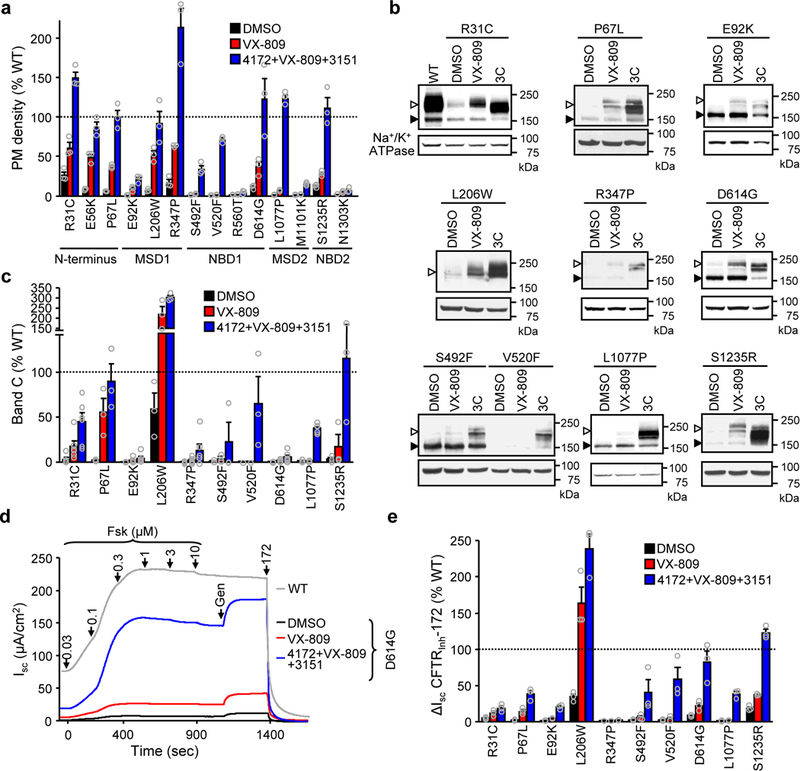
Rescue of rare CF folding mutants by allosteric corrector combination. (a) PM density of the indicated CFTR2 mutants alone and after VX-809 or 3C treatment expressed as percentage of WT-CFTR in CFBE41o- (n = 3). The domain localizations of the mutations are indicated. (b,c) Effect of VX-809 or 3C treatment on the expression pattern of CFTR2 mutants in CFBE41o- determined by immunoblot (b) and densitometric quantification (c, n = 6 for R31C, E92K, R347P, D614G, L1077P; n = 3 for P67L, L206W, S492F, V520F, S1235R). Uncropped immunoblots are presented in Supplementary Figure 11. (d,e) Effect of VX-809 or 3C on the Isc of CFTR2 mutants in CFBE41o-. Representative traces are shown in d. Mutant function (n = 3), expressed as percentage of WT function, is depicted in e. Data in a, c and e were normalized with mutant CFTR2 mRNA abundance (Supplementary Fig. 8a) and are means ± SEM of the indicated number of independent experiments.

References

    1. Veit G, et al. From CFTR biology toward combinatorial pharmacotherapy: expanded classification of cystic fibrosis mutations. Molecular biology of the cell 27, 424–433 (2016). - PMC - PubMed
    1. Sosnay PR, et al. Defining the disease liability of variants in the cystic fibrosis transmembrane conductance regulator gene. Nat Genet 45, 1160–1167 (2013). - PMC - PubMed
    1. Cutting GR Cystic fibrosis genetics: from molecular understanding to clinical application. Nat Rev Genet 16, 45–56 (2015). - PMC - PubMed
    1. Liu F, Zhang Z, Csanady L, Gadsby DC & Chen J Molecular Structure of the Human CFTR Ion Channel. Cell 169, 85–95 e88 (2017). - PubMed
    1. Hunt JF, Wang C & Ford RC Cystic fibrosis transmembrane conductance regulator (ABCC7) structure. Cold Spring Harb Perspect Med 3, a009514 (2013). - PMC - PubMed

Methods-only References

    1. Veit G, et al. Proinflammatory cytokine secretion is suppressed by TMEM16A or CFTR channel activity in human cystic fibrosis bronchial epithelia. Mol Biol Cell 23, 4188–4202 (2012). - PMC - PubMed
    1. Liu X, et al. ROCK inhibitor and feeder cells induce the conditional reprogramming of epithelial cells. The American journal of pathology 180, 599–607 (2012). - PMC - PubMed
    1. Neuberger T, Burton B, Clark H & Van Goor F Use of primary cultures of human bronchial epithelial cells isolated from cystic fibrosis patients for the pre-clinical testing of CFTR modulators. Methods Mol Biol 741, 39–54 (2011). - PubMed
    1. van Doorninck JH, et al. A mouse model for the cystic fibrosis delta F508 mutation. EMBO J 14, 4403–4411 (1995). - PMC - PubMed
    1. Namkung W, Thiagarajah JR, Phuan PW & Verkman AS Inhibition of Ca2+-activated Cl- channels by gallotannins as a possible molecular basis for health benefits of red wine and green tea. FASEB J 24, 4178–4186 (2010). - PMC - PubMed

Publication types

MeSH terms

Substances