


Psychiatric Disorders in Refugees and Internally Displaced Persons After Forced Displacement: A Systematic Review
- PMID: 30298022
- PMCID: PMC6160546
- DOI: 10.3389/fpsyt.2018.00433
Psychiatric Disorders in Refugees and Internally Displaced Persons After Forced Displacement: A Systematic Review
Abstract
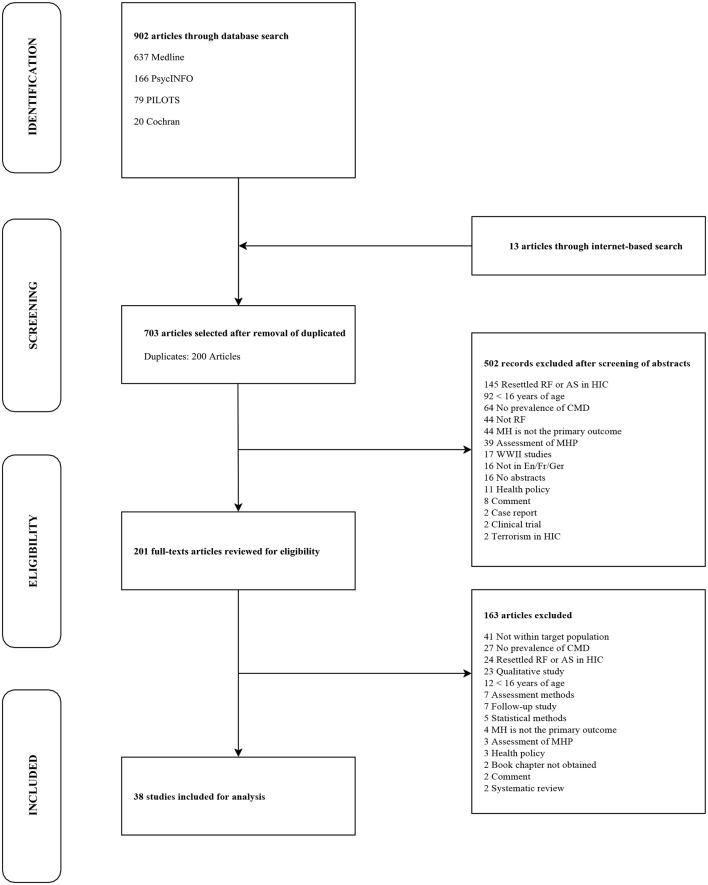
Background: Protracted armed conflicts not only shape political, legal, and socio-economic structures, but also have a lasting impact on people's human migration. In 2017, the United Nations High Commissioner for Refugees reported an unprecedented number of 65.6 million individuals who were displaced worldwide as a result of armed conflicts. To date, however, little is known about these people's mental health status. Therefore, we conducted a systematic review of the prevalence of psychiatric disorders among forcibly displaced populations in settings of armed conflicts. Methods: We undertook a database search using Medline, PsycINFO, PILOTS, and the Cochrane Library, using the following keywords and their appropriate synonyms to identify relevant articles for possible inclusion: "mental health," "refugees," "internally displaced people," "survey," and "war." This search was limited to original articles, systematic reviews, and meta-analyses published after 1980. We reviewed studies with prevalence rates of common psychiatric disorders-mood and anxiety disorders, psychotic disorders, personality disorders, substance abuse, and suicidality-among adult internally displaced persons (IDPs) and refugees afflicted by armed conflicts. Results: The search initially yielded 915 articles. Of these references 38 studies were eligible and provided data for a total of 39,518 adult IDPs and refugees from 21 countries. The highest prevalence were for reported for post-traumatic stress disorder (3-88%), depression (5-80%), and anxiety disorders (1-81%) with large variation. Only 12 original articles reported about other mental disorders. Conclusions: These results show a substantial lack of data concerning the wider extent of psychiatric disability among people living in protracted displacement situations. Ambitious assessment programs are needed to support the implementation of sustainable global mental health policies in war-torn countries. Finally, there is an urgent need for large-scale interventions that address psychiatric disorders in refugees and internally displaced persons after displacement.
Keywords: epidemiology; internally displaced people; mental health; psychiatric disorders; refugees; systematic review; war.
Figures
References
-
- Orend B. War. In: Zalta EN, editor. The Stanford Encyclopedia of Philosophy. Fall (2008). Available online at: https://plato.stanford.edu/archives/fall2008/entries/war/
-
- Allansson M, Melander E, Themnér L. Organized violence, 1989–2016. J Peace Res. (2017) 54:574–87. 10.1177/0022343317718773 - DOI
-
- UNHCR Global trends UNHCR 2016 2017. Available online at: http://www.unhcr.org/5943e8a34.pdf (Accessed December 20, 2016).
LinkOut - more resources
Full Text Sources
Medical
