


Dietary Behavior: An Interdisciplinary Conceptual Analysis and Taxonomy
- PMID: 30298030
- PMCID: PMC6160746
- DOI: 10.3389/fpsyg.2018.01689
Dietary Behavior: An Interdisciplinary Conceptual Analysis and Taxonomy
Abstract
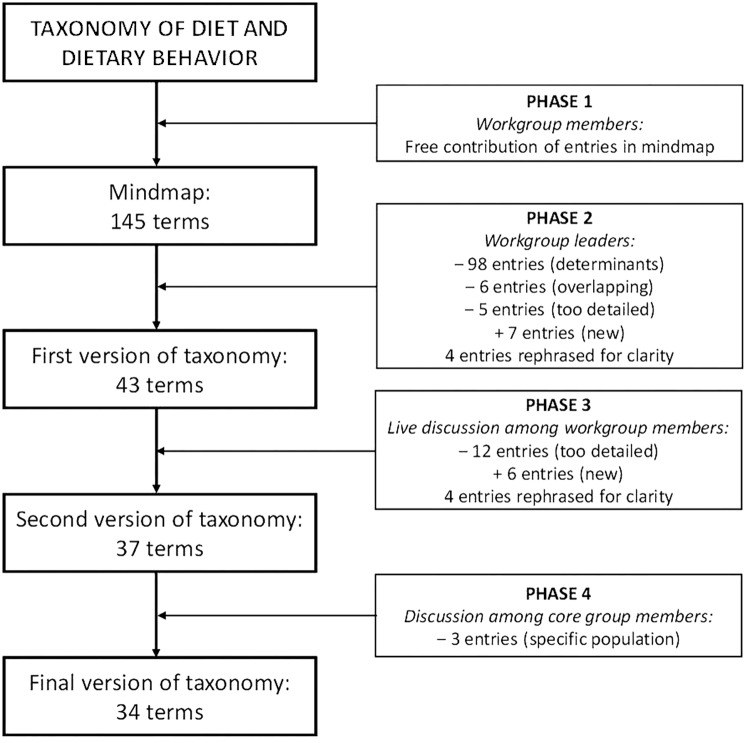
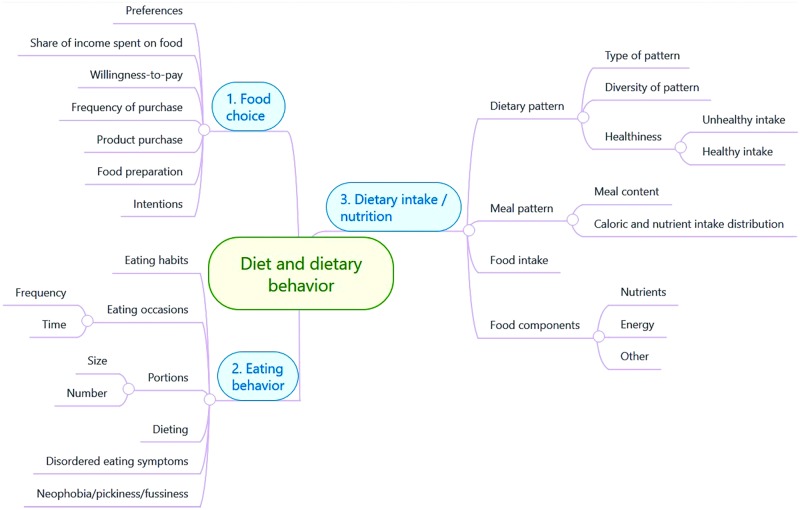
Background: Dietary behavior encompasses many aspects, terms for which are used inconsistently across different disciplines and research traditions. This hampers communication and comparison across disciplines and impedes the development of a cumulative science. We describe the conceptual analysis of the fuzzy umbrella concept "dietary behavior" and present the development of an interdisciplinary taxonomy of dietary behavior. Methods: A four-phase multi-method approach was employed. Input was provided by 76 scholars involved in an international research project focusing on the determinants of dietary behavior. Input was collected from the scholars via an online mind mapping procedure. After structuring, condensing, and categorizing this input into a compact taxonomy, the result was presented to all scholars, discussed extensively, and adapted. A second revision round was then conducted among a core working group. Results: A total of 145 distinct entries were made in the original mind mapping procedure. The subsequent steps allowed us to reduce and condense the taxonomy into a final product consisting of 34 terms organized into three main categories: Food Choice, Eating Behavior, and Dietary Intake/Nutrition. In a live discussion session attended by 50 of the scholars involved in the development of the taxonomy, it was judged to adequately reflect their input and to be a valid and useful starting point for interdisciplinary understanding and collaboration. Conclusion: The current taxonomy can be used as a tool to facilitate understanding and cooperation between different disciplines investigating dietary behavior, which may contribute to a more successful approach to tackling the complex public health challenges faced by the field. The taxonomy need not be viewed as a final product, but can continue to grow in depth and width as additional experts provide their input.
Keywords: cumulative science; diet; dietary intake; eating behavior; food choice; nutrition; ontology; taxonomy.
Figures
References
-
- Bernheim B. D., Rangel A. (2009). Beyond revealed preference: choice-theoretic foundations for behavioral welfare economics. Quart. J. Econ. 124 51–104. 10.3386/w13737 - DOI
LinkOut - more resources
Full Text Sources
