


Progestogen for preventing miscarriage in women with recurrent miscarriage of unclear etiology
- PMID: 30298541
- PMCID: PMC6516817
- DOI: 10.1002/14651858.CD003511.pub4
Progestogen for preventing miscarriage in women with recurrent miscarriage of unclear etiology
Update in
-
Progestogen for preventing miscarriage in women with recurrent miscarriage of unclear etiology.Cochrane Database Syst Rev. 2019 Nov 20;2019(11):CD003511. doi: 10.1002/14651858.CD003511.pub5. Cochrane Database Syst Rev. 2019. Update in: Cochrane Database Syst Rev. 2025 Jun 11;6:CD003511. doi: 10.1002/14651858.CD003511.pub6. PMID: 31745982 Free PMC article. Updated.
Abstract
Background: Progesterone, a female sex hormone, is known to induce secretory changes in the lining of the uterus essential for successful implantation of a fertilized egg. It has been suggested that a causative factor in many cases of miscarriage may be inadequate secretion of progesterone. Therefore, clinicians use progestogens (drugs that interact with the progesterone receptors), beginning in the first trimester of pregnancy, in an attempt to prevent spontaneous miscarriage. This is an update of a review, last published in 2013.
Objectives: To assess the efficacy and safety of progestogens as a preventative therapy against recurrent miscarriage.
Search methods: For this update, we searched Cochrane Pregnancy and Childbirth's Trials Register, ClinicalTrials.gov, the WHO International Clinical Trials Registry Platform (ICTRP) (6 July 2017) and reference lists from relevant articles, attempting to contact trial authors where necessary, and contacted experts in the field for unpublished works.
Selection criteria: Randomized or quasi-randomized controlled trials comparing progestogens with placebo or no treatment given in an effort to prevent miscarriage.
Data collection and analysis: Two review authors independently assessed trials for inclusion and risk of bias, extracted data and checked them for accuracy. Two reviewers assessed the quality of the evidence using the GRADE approach.
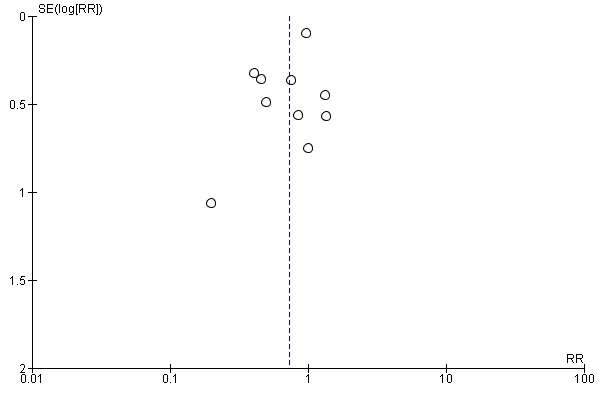
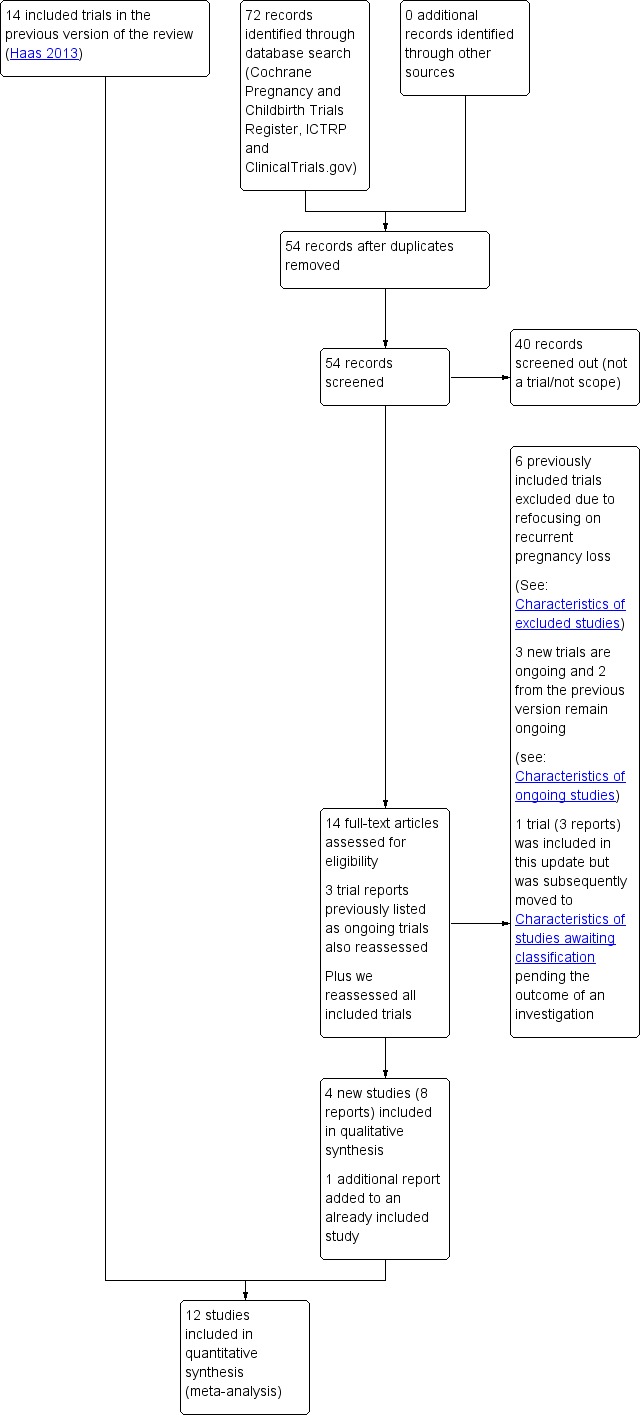
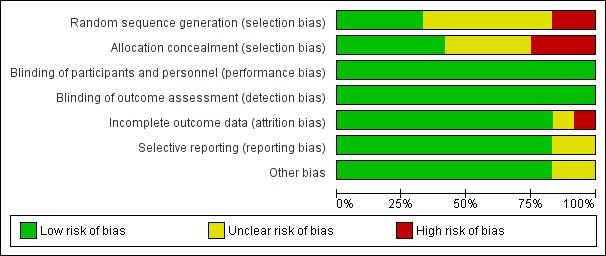
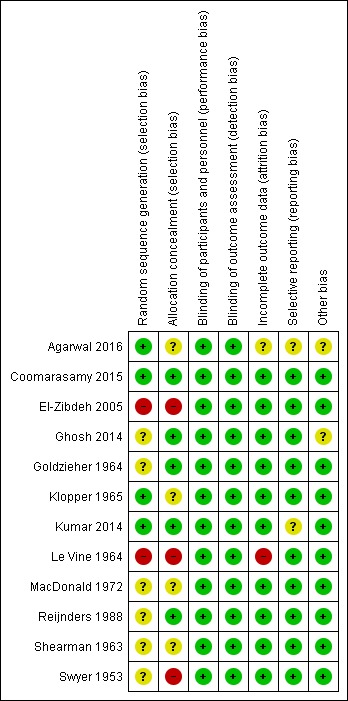
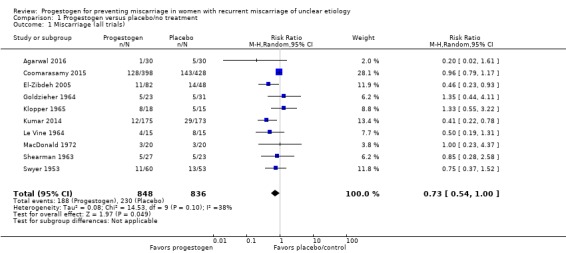
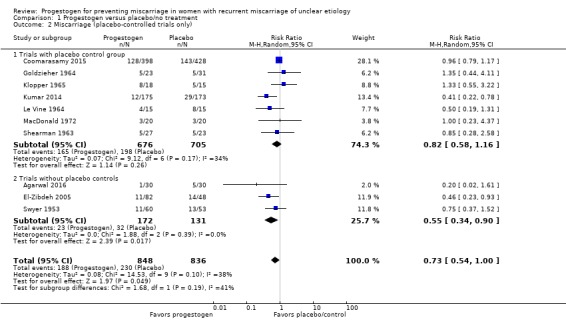
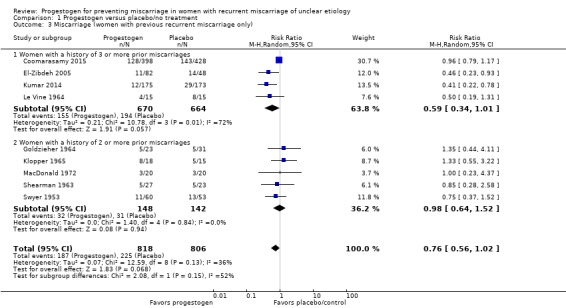
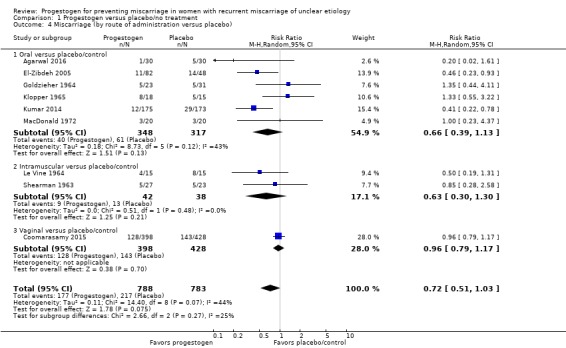
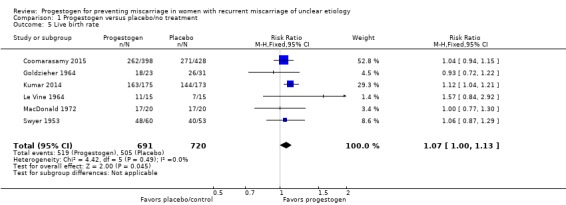
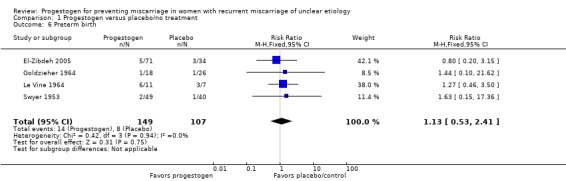
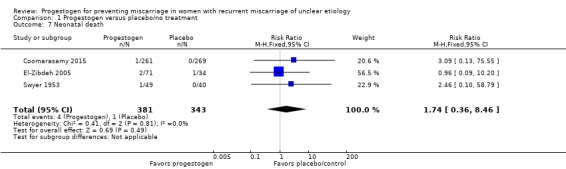
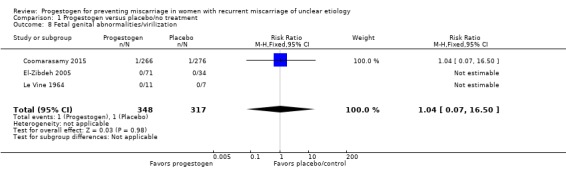
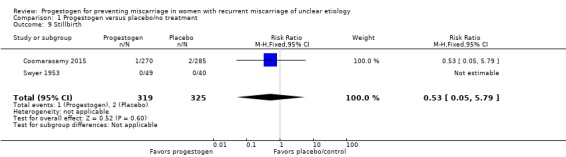
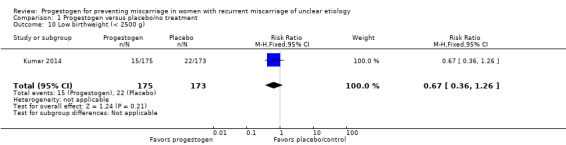
Main results: Thirteen trials (2556 women) met the inclusion criteria. Nine of the included trials compared treatment with placebo and the remaining four trials compared progestogen administration with no treatment. The trials were a mix of multicenter and single-center trials, conducted in Egypt, India, Jordan, UK and USA. In six trials women had had three or more consecutive miscarriages and in seven trials women had suffered two or more consecutive miscarriages. Routes, dosage and duration of progestogen treatment varied across the trials. The majority of trials were at low risk of bias for most domains. Eleven trials (2359 women) contributed data to the analyses.The meta-analysis of all women, suggests that there is probably a reduction in the number of miscarriages for women given progestogen supplementation compared to placebo/controls (average risk ratio (RR) 0.69, 95% confidence interval (CI) 0.51 to 0.92, 11 trials, 2359 women, moderate-quality evidence). A subgroup analysis comparing placebo-controlled versus non-placebo-controlled trials and different routes of administration showed no differences between subgroups for miscarriage. However, there appears to be a subgroup difference for miscarriage between women with three or more prior miscarriages compared to women with two or more miscarriages, with a more pronounced effect in women with three or more prior miscarriages. However, it should be noted that there was high heterogeneity in the subgroup of women with three or more prior miscarriages.None of the trials reported on any secondary maternal outcomes, including severity of morning sickness, thromboembolic events, depression, admission to a special care unit, or subsequent fertility.There was probably a slight benefit for women receiving progestogen seen in the outcome of live birth rate (RR 1.11, 95% CI 1.00 to 1.24, 7 trials, 2086 women, moderate-quality evidence). While the rate of preterm birth is probably reduced for women receiving progestogen, this outcome was mainly driven by one trial and thus should be interpreted with great caution (RR 0.59, 95% CI 0.39 to 0.89, 5 trials, 811 women, moderate-quality evidence). No clear differences were seen for women receiving progestogen for the other secondary outcomes of neonatal death or fetal genital abnormalities. A possible reduction in stillbirth was seen, but again this outcome was driven mainly by one trial and should be interpreted with caution (RR 0.38, 95% CI 0.24 to 0.58, 3 trials, 1199 women). There may be little or no difference in the rate of low birthweight and trials did not report on the secondary child outcomes of teratogenic effects or admission to a special care unit.
Authors' conclusions: For women with unexplained recurrent miscarriages, supplementation with progestogen therapy probably reduces the rate of miscarriage in subsequent pregnancies.
Conflict of interest statement
David M Haas: none known
Taylor J Hathaway: none known
Patrick S Ramsey: I serve as an officer in Section 5 of District XI of the American College and Congress of Obstetricians and Gynecologists. I received compensation for this general work with ACOG but have not engaged in any specific work relevant to the topic of this review. I also serve on the Data Safety Monitoring Board for the KV Pharmaceutical RCT designed to evaluate the efficacy of 17‐hydroxyprogesterone caproate to prevent preterm birth. I received compensation for service as the DSMB chair from an independent data management organization and not from the pharmaceutical company.
Figures
Update of
-
Progestogen for preventing miscarriage.Cochrane Database Syst Rev. 2013 Oct 31;(10):CD003511. doi: 10.1002/14651858.CD003511.pub3. Cochrane Database Syst Rev. 2013. Update in: Cochrane Database Syst Rev. 2018 Oct 08;10:CD003511. doi: 10.1002/14651858.CD003511.pub4. PMID: 24173668 Updated.
References
References to studies included in this review
-
- CTRI/2016/09/007278. Role of inflammatory markers in recurrent pregnancy loss and effect of oral micronized therapy on these cases. ctri.nic.in/Clinicaltrials/pmaindet2.php?trialid=14740 (first received 16 September 2016).
-
- Coomarasamy A, Williams H, Truchanowicz E, Seed PT, Small R, Quenby S, et al. A randomized trial of progesterone in women with recurrent miscarriages. New England Journal of Medicine 2015;373(22):2141‐8. - PubMed
- Coomarasamy A, Williams H, Truchanowicz E, Seed PT, Small R, Quenby S, et al. PROMISE: first‐trimester progesterone therapy in women with a history of unexplained recurrent miscarriages ‐ a randomised, double‐blind, placebo‐controlled, international multicentre trial and economic evaluation. Health Technology Assessment 2016;20(41):7‐91. - PMC - PubMed
- ISRCTN92644181. First trimester progesterone therapy in women with a history of unexplained recurrent miscarriages: a randomised double‐blind placebo‐controlled multi‐centre trial (The PROMISE [PROgesterone in recurrent MIScarriagE] Trial). controlled‐trials.com/ISRCTN92644181 (first received 17 March 2009). - PMC - PubMed
-
- Zibdeh M. Randomized clinical trial comparing the efficacy of dydrogesterone and human chorionic gonadotropin. Climacteric 2002;5(Suppl 1):136.
- Zibdeh M. Randomized study comparing the efficacy of reducing spontaneous abortion following treatment with progesterone and human chorionic gonadotropin (hCG). Fertility and Sterility 1998;70(3 Suppl 1):S77‐S78.
- El‐Zibdeh MY. Dydrogesterone in the reduction of recurrent spontaneous abortion. Journal of Steroid Biochemistry & Molecular Biology 2005;97(5):431‐4. - PubMed
-
- CTRI/2013/02/003406. Assessment of sub‐endometrial blood flow parameters following dydrogesterone and micronized vaginal progesterone administration in women with idiopathic recurrent spontaneous miscarriage. ctri.nic.in/Clinicaltrials/pmaindet2.php?trialid=5847 (first received 18 February 2013). - PubMed
- Chakravarty BN, Ganesh A, Chowdhuri K, Shyam T, Ghosh S, Chattopadhyay R. Assessment of endometrial vascularity following dydrogesterone and micronized progesterone administration in idiopathic recurrent miscarriage‐a preliminary study. Human Reproduction 2012;27(Suppl 2):P089.
- Ghosh S, Chattopadhyay R, Goswami S, Chaudhury K, Chakravarty B, Ganesh A. Assessment of sub‐endometrial blood flow parameters following dydrogesterone and micronized vaginal progesterone administration in women with idiopathic recurrent miscarriage: a pilot study. Journal of Obstetrics & Gynaecology Research 2014;40(7):1871‐6. - PubMed
-
- Goldzieher JW. Double‐blind trial of a progestin in habitual abortion. JAMA 1964;188(7):651‐4. - PubMed
References to studies excluded from this review
-
- Berle P, Budenz M, Michaelis J. Is hormonal therapy still justified in imminent abortion?. Zeitschrift fur Geburtshilfe und Perinatologie 1980;184:353‐8. - PubMed
-
- Brenner W, Hendricks C. Effect of medroxyprogesterone acetate upon the duration and characteristics of human gestation labour. American Journal of Obstetrics and Gynecology 1962;83(8):1094‐8. - PubMed
-
- Check J, Wu C‐H, Adelson H. Decreased abortion in HMG‐induced pregnancies. International Journal of Fertility 1985;30(3):45‐7. - PubMed
-
- Check J, Chase J, Nowroozi K, Wu C, Adelson H. Progesterone therapy to decrease first‐trimester spontaneous abortions in previous aborters. International Journal of Fertility 1987;32(3):192‐9. - PubMed
-
- Check J, Chase J, Wu C, Adelson H, Teichman M, Rankin A. The efficacy of progesterone in achieving successful pregnancy: prophylactic use during luteal phase in anovulatory women. International Journal of Fertility 1987;32(2):135‐8. - PubMed
References to studies awaiting assessment
-
- Ismail A, Nasr A, Amin A, Al‐Inany H. Peri‐conceptional progesterone treatment in women with unexplained recurrent miscarriage, a randomized double‐blind controlled trial. Human Reproduction 2015;30:i194, abstract no: P‐167.
- Ismail AM, Abbas AM, Ali MK, Amin AF. Peri‐conceptional progesterone treatment in women with unexplained recurrent miscarriage: a randomized double‐blind placebo‐controlled trial. Journal of Maternal‐Fetal & Neonatal Medicine 23 January 2017 [Epub ahead of print]. - PubMed
- NCT01670929. Pr‐conceptional progesterone for unexplained recurrent miscarriage. clinicaltrials.gov/ct2/show/record/NCT01670929 (first received 17 August 2012).
References to ongoing studies
-
- ACTRN12611000401954. Does using progesterone reduce the miscarriage rate in high risk pregnancies? Pregnancy Maintenance Trial (PMTrial). www.anzctr.org.au/Trial/Registration/TrialReview.aspx?ACTRN=12611000401954 18 April 2011.
-
- IRCT2013100114853N1. Effect of concomitant administration of vaginal progesterone and vitamin D3 in the treatment of unexplained recurrent abortion in pregnant women. en.search.irct.ir/view/15255 (first received 30 October 2013).
-
- NCT00193674. Oral dydrogesterone treatment during the first trimester of pregnancy in women with recurrent miscarriage: a double‐blind, prospectively randomized, placebo‐controlled, parallel group trial. clinicaltrials.gov/ct2/show/NCT00193674 (first received 11 Septamber 2005). - PubMed
-
- NCT02706470. A randomized, controlled trial of cyclosporin a for women with unexplained recurrent miscarriage. clinicaltrials.gov/ct2/show/record/NCT02706470 (first received 12 March 2016).
-
- Walch K, Hefler L, Nagele F. Oral dydrogesterone treatment during the first trimester of pregnancy: the prevention of miscarriage study (PROMIS). A double‐blind, prospectively randomized, placebo‐controlled, parallel group trial. Journal of Maternal‐Fetal & Neonatal Medicine 2005;18(4):265‐9. - PubMed
Additional references
-
- Atkin LC, Arcelus M, Fernandez A, Tolbert K. La Psicologia en el Ambito Perinatal. Mexico D.F: INPER, 1988.
-
- Briggs GG, Freeman RK, Yaffe SJ. Drugs in Pregnancy and Lactation. 9th Edition. Philadelphia: Lippincott Williams & Wilkins, 2011.
-
- Burgoyne PS, Holland K, Stephens R. Incidence of numerical chromosome anomalies in human pregnancy estimation from induced and spontaneous abortion data. Human Reproduction 1991;6(4):555‐65. - PubMed
References to other published versions of this review
Publication types
MeSH terms
Substances
LinkOut - more resources
Full Text Sources
Medical
Miscellaneous
