Review
. 2018 Nov;99(5):1120-1127.
doi: 10.4269/ajtmh.18-0303.

Taking Sharper Pictures of Malaria with CAMERAs: Combined Antibodies to Measure Exposure Recency Assays

Affiliations
Review

Taking Sharper Pictures of Malaria with CAMERAs: Combined Antibodies to Measure Exposure Recency Assays

Bryan Greenhouse et al. Am J Trop Med Hyg. 2018 Nov.

Abstract

Antibodies directed against malaria parasites are easy and inexpensive to measure but remain an underused surveillance tool because of a lack of consensus on what to measure and how to interpret results. High-throughput screening of antibodies from well-characterized cohorts offers a means to substantially improve existing assays by rationally choosing the most informative sets of responses and analytical methods. Recent data suggest that high-resolution information on malaria exposure can be obtained from a small number of samples by measuring a handful of properly chosen antibody responses. In this review, we discuss how standardized multi-antibody assays can be developed and efficiently integrated into existing surveillance activities, with potential to greatly augment the breadth and quality of information available to direct and monitor malaria control and elimination efforts.


Figures
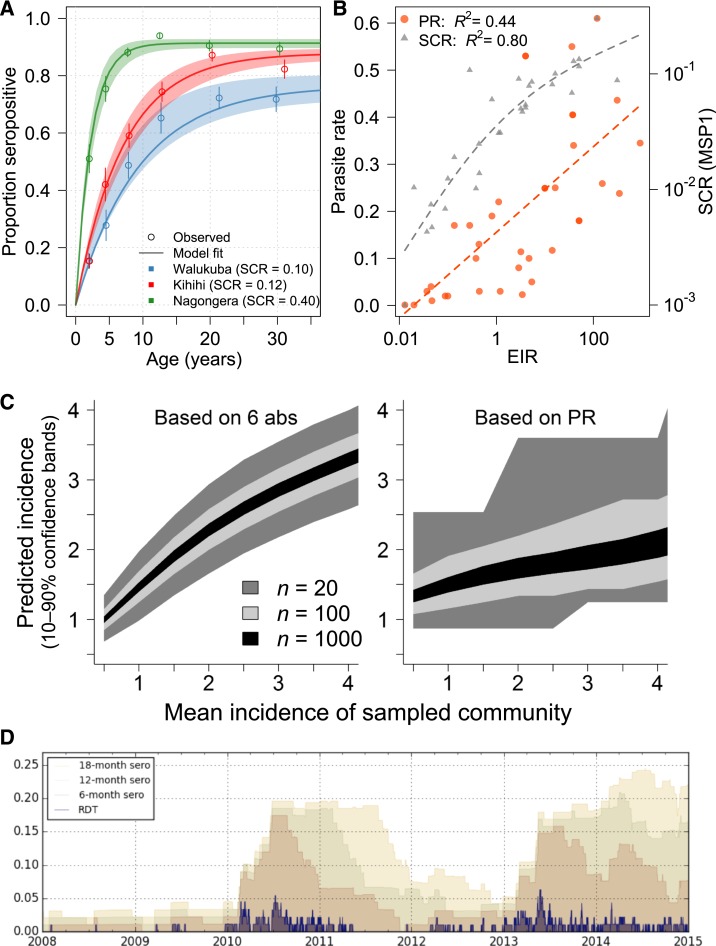
Figure 1.
Figure 1.
Established and next-generation methods for evaluating malaria transmission via antibodies provide higher resolution than parasite prevalence. (A) The seroconversion rate (SCR) for a population can be calculated from age-stratified prevalence of antibody responses, often with a long half-life. Data shown here are responses to apical membrane antigen 1 from three cross-sectional surveys in Uganda. (B) Paired SCR and parasite rate (PR) data from multiple sites,– demonstrate that SCR (using merozoite surface protein 1, MSP-1) has a tighter association with transmission, as measured by the annual entomologic inoculation rate (EIR). (C) Using six antibodies identified as informative about recent exposure, predictions of P. falciparum exposure in a community can be obtained from relatively small surveys, in contrast to PR data obtained from the same surveys. (D) A simulation of a small village (N = 100) with seasonal, low transmission illustrates how ongoing transmission can be detected consistently from an antibody test measuring recent exposure, but less reliably from rapid diagnostic test (RDT). This figure appears in color at www.ajtmh.org.
Figure 2.
Figure 2.
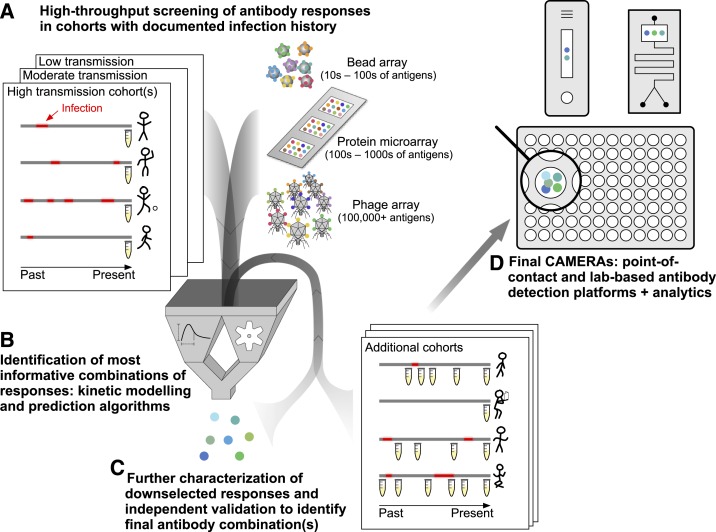
Approach to designing combined antibodies to measure exposure recency assays (CAMERAs). (A) Samples from detailed cohorts, where accurate data on individuals’ prior malaria infections are available, are critical for providing a gold standard to identify informative antibody responses. Cohorts should represent the range of ages and epidemiologic settings where CAMERAs will ultimately be used. Various platforms are available for high-throughput screening of antibody responses, with tradeoffs based on cost, number of analytes that can be screened, precision, and dynamic range. (B) Down selection of the most informative combinations of responses (i.e., considered jointly) is accomplished via parametric modeling of antibody kinetics and/or any number of machine learning prediction algorithms. Both of these analytical approaches have advantages, and combining both may be optimal. (C) Top “hits” identified in comprehensive screens require validation in distinct individuals and cohorts. Given the smaller number of responses evaluated, it may be feasible to evaluate much larger numbers of samples including longitudinal sampling from individuals over time. (D) Final CAMERAs can be designed as point-of-contact (e.g., based on lateral flow or microfluidics) or laboratory-based assays, depending on the use case. The analytics for deriving epidemiologically relevant metrics from antibody responses will be integral to the assay. This figure appears in color at www.ajtmh.org.
Figure 3.
Figure 3.
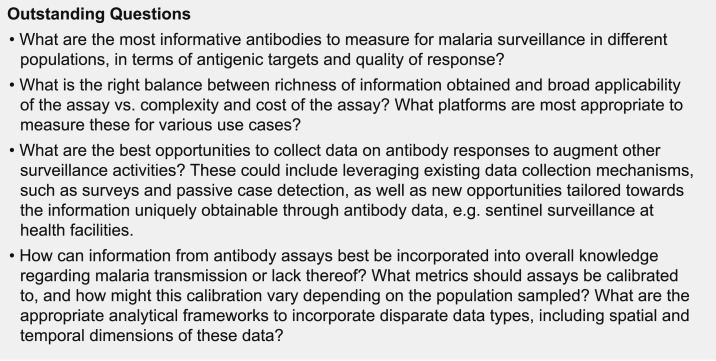
Outstanding questions for developing and using combined antibodies to measure exposure recency assays (CAMERAs).

References

    1. Tusting LS, Bousema T, Smith DL, Drakeley C, 2014. Chapter three—measuring changes in Plasmodium falciparum transmission: precision, accuracy and costs of metrics. Rollinson D, ed. Advances in Parasitology, Vol. 84. Academic Press, 151–208. Available at: http://www.sciencedirect.com/science/article/pii/B978012800099100003X. Accessed August 11, 2014. - PMC - PubMed
    1. Lindblade KA, Steinhardt L, Samuels A, Kachur SP, Slutsker L, 2013. The silent threat: asymptomatic parasitemia and malaria transmission. Expert Rev Anti Infect Ther 11: 623–639. - PubMed

    1. Gething PW, Patil AP, Smith DL, Guerra CA, Elyazar IR, Johnston GL, Tatem AJ, Hay SI, 2011. A new world malaria map: Plasmodium falciparum endemicity in 2010. Malar J 10: 378. - PMC - PubMed
    1. Hay SI, Smith DL, Snow RW, 2008. Measuring malaria endemicity from intense to interrupted transmission. Lancet Infect Dis 8: 369–378. - PMC - PubMed
    1. Metcalf CJE, Farrar J, Cutts FT, Basta NE, Graham AL, Lessler J, Ferguson NM, Burke DS, Grenfell BT, 2016. Use of serological surveys to generate key insights into the changing global landscape of infectious disease. Lancet Lond Engl 388: 728–730. - PMC - PubMed

Publication types