


Twenty-Four-Hour Diet recall and Diet records compared with 24-hour urinary excretion to predict an individual's sodium consumption: A Systematic Review
- PMID: 30298972
- PMCID: PMC8031271
- DOI: 10.1111/jch.13391
Twenty-Four-Hour Diet recall and Diet records compared with 24-hour urinary excretion to predict an individual's sodium consumption: A Systematic Review
Abstract
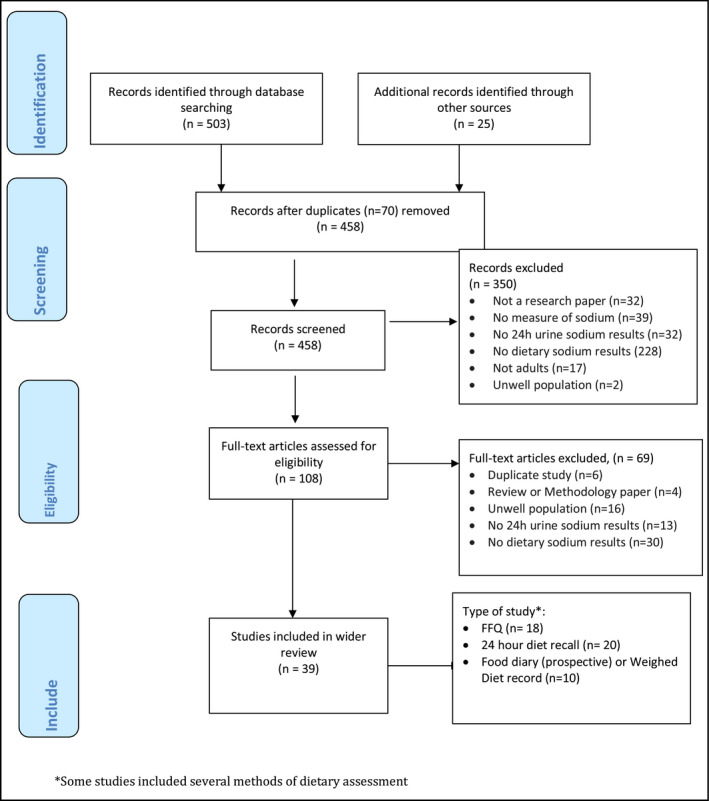
This systematic literature review aimed to investigate whether 24 hour diet recall and diet records are reliable and valid ways to measure usual dietary sodium intake compared with 24 hour urinary assessment. We searched electronic databases Medline, Embase, Cinahl, Lilacs, Google Scholar and the Cochrane Library using pre-defined terms Studies were eligible for inclusion if they assessed adult humans in free-living settings, and if they included dietary assessment and 24 hours urinary collection for assessment of sodium intake in the same participants. Studies that included populations with an active disease state that might interfere with normal sodium metabolism were excluded. Results of 20 studies using 24 hour diet recall recall (including 14 validation studies) and 10 studies using food records (including six validation studies) are included in this review. Correlations between estimates from dietary assessment and urinary excretion ranged from 0.16 to 0.72 for 24 hour diet recall, and 0.11 to 0.49 for food diaries. Bland-Altman analysis in two studies of 24 hour diet recall showed poor agreement with 24 hours urinary sodium excretion. These results show that 24 hour diet recall and diet records inaccurately measure dietary sodium intake in individuals compared with the gold standard 24 hours urinary excretion. Validation studies of dietary assessment methods should include multiple days of assessment and 24 hours urine collection, use relevant food composition databases and Bland-Altman methods of analysis.
Keywords: diet surveys; dietary sodium; urine specimen collection.
©2018 Wiley Periodicals, Inc.
Conflict of interest statement
NC is a member of World Action on Salt and Health (a dietary salt reduction organization) and is a paid consultant to the Novartis Foundation, which involves travel expenses and personal fees for site visits, a one‐time contract (2016) to develop a survey, and was a paid member of an advisory board for Midmark in 2017. The other authors have no conflict of interests to disclose.
Figures
References
-
- World Health . Organization. Follow‐up to the Political Declaration of the High‐level Meeting of the General Assembly on the Prevention and control of Non‐communicable Diseases: Sixty‐sixth World Health Assembly (WHA66.10). Geneva, Switzerland: World Health Organization, 2013.
-
- Baranowski T. 24‐Hour Recall and Diet Record Methods. In: Willett WC, ed. Nutritional Epidemiology. Oxford: Oxford University Press; 2013.
Publication types
MeSH terms
Substances
LinkOut - more resources
Full Text Sources
Medical
