


doi: 10.1093/cid/ciy669.
How Clean Is the Linen at My Hospital? The Mucorales on Unclean Linen Discovery Study of Large United States Transplant and Cancer Centers
Affiliations
- PMID: 30299481
- PMCID: PMC6765054
- DOI: 10.1093/cid/ciy669
Item in Clipboard
How Clean Is the Linen at My Hospital? The Mucorales on Unclean Linen Discovery Study of Large United States Transplant and Cancer Centers
Clin Infect Dis.
.
Abstract
Mucormycosis outbreaks have been linked to contaminated linen. We performed fungal cultures on freshly-laundered linens at 15 transplant and cancer hospitals. At 33% of hospitals, the linens were visibly unclean. At 20%, Mucorales were recovered from >10% of linens. Studies are needed to understand the clinical significance of our findings.
Keywords: Mucorales; Rhizopus; Syncephalastrum; healthcare linens; microbiologic surveillance.
Published by Oxford University Press for the Infectious Diseases Society of America 2018.
Figures
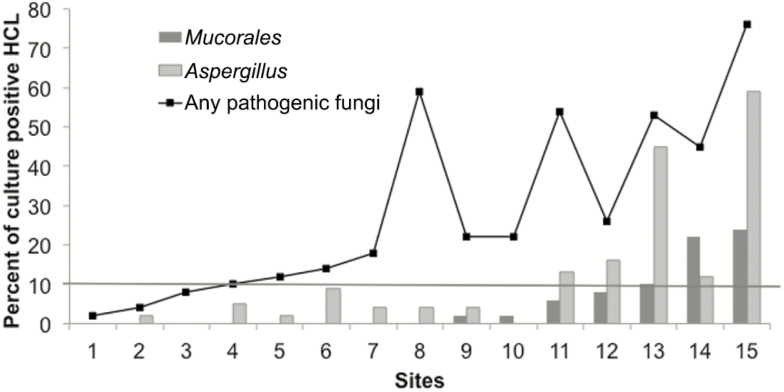
Percentages of healthcare linens (HCLs) that were culture positive for Mucorales, Aspergillus, and other pathogenic molds. Culture results by hospital. Percentages of HCLs that were culture positive for Mucorales, Aspergillus, and any pathogenic mold (defined as Mucorales, Aspergillus spp., Fusarium, and dematiaceous molds) are shown (y-axis). Centers are ordered on the x-axis by the ascending percentage of HCL contaminated with Mucorales. The threshold for defining hygienically-clean HCL was 10%, which was exceeded for Mucorales at 15% (3/20) of hospitals (indicated by the horizontal line). Mucorales were recovered from HCL at 47% (7/15) of hospitals and from 5% (37/745) of all HCLs. Mucorales included Rhizopus spp. (R. stolonifer, R. oryzae, and R. microsporus) and Syncephalastrum. In addition to Mucorales, pathogenic molds included Aspergillus (12%, 87/745), dematiaceous molds (11%, 82/745), and Fusarium (3%, 22/745). There were 26% (192/745) of HCLs that grew other molds of low pathogenic potential, including sterile mycelium (7%, 55/745) and Penicillium (3%, 23/745). Abbreviation: HCL, healthcare linen.
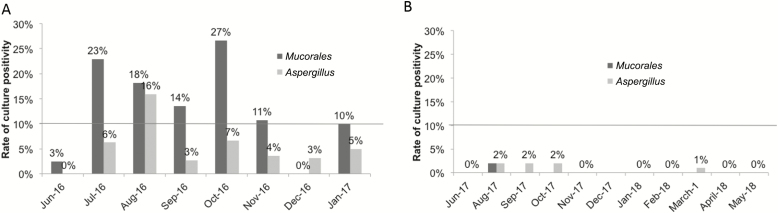
Percentages of healthcare linens (HCLs) that were culture positive for Mucorales, Aspergillus, and other pathogenic molds during a longitudinal study at 1 hospital. Monthly testing was performed over 2 time periods: A, June 2016–January 2017 and B, June 2017–January 2018. No sampling was performed in July or December 2017. Culture data from the first time period were shared with the off-site laundry, which performed environmental remediation between February and May 2017. The hospital was also included in the multicenter study (represented as Center 3 in Figure 1), using data from June 2017. The horizontal line represents the 10% culture positivity cut-off to define HCL as hygienically clean.
References
-
- Roden MM, Zaoutis TE, Buchanan WL, et al. Epidemiology and outcome of zygomycosis: a review of 929 reported cases. Clin Infect Dis 2005; 41:634–53. - PubMed
-
- Davoudi S, Graviss LS, Kontoyiannis DP. Healthcare-associated outbreaks due to Mucorales and other uncommon fungi. Eur J Clin Invest 2015; 45:767–73. - PubMed
-
- Duffy J, Harris J, Gade L, et al. Mucormycosis outbreak associated with hospital linens. Pediatr Infect Dis J 2014; 33:472–6. - PubMed
-
- Cheng VCC, Chen JHK, Wong SCY, et al. Hospital outbreak of pulmonary and cutaneous zygomycosis due to contaminated linen items from substandard laundry. Clin Infect Dis 2016; 62:714–21. - PubMed
