


Temporal Trends Associated With the Rise in Alcoholic Liver Disease-related Liver Transplantation in the United States
- PMID: 30300285
- PMCID: PMC6709987
- DOI: 10.1097/TP.0000000000002471
Temporal Trends Associated With the Rise in Alcoholic Liver Disease-related Liver Transplantation in the United States
Abstract
Background: In the United States, alcoholic liver disease (ALD) has recently become the leading indication for liver transplantation.
Methods: Using the United Network for Organ Sharing registry, we examined temporal trends in adult liver transplant waitlist (WL) registrants and recipients with chronic liver disease (CLD) due to ALD from 2007 to 2016.
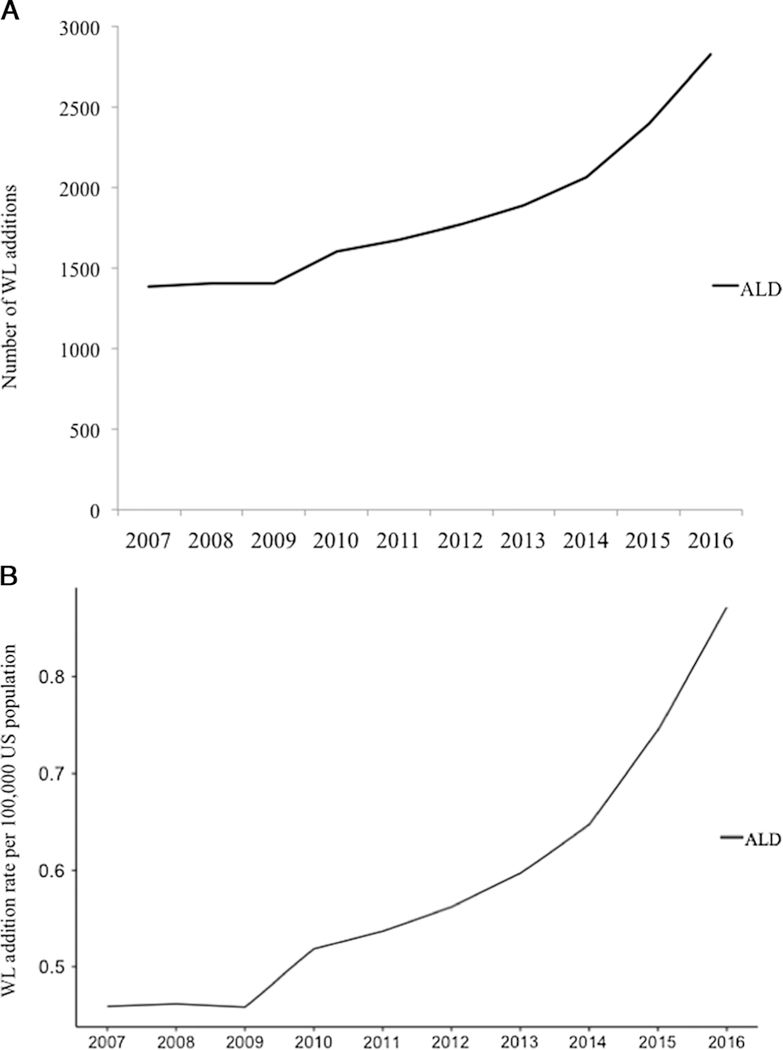
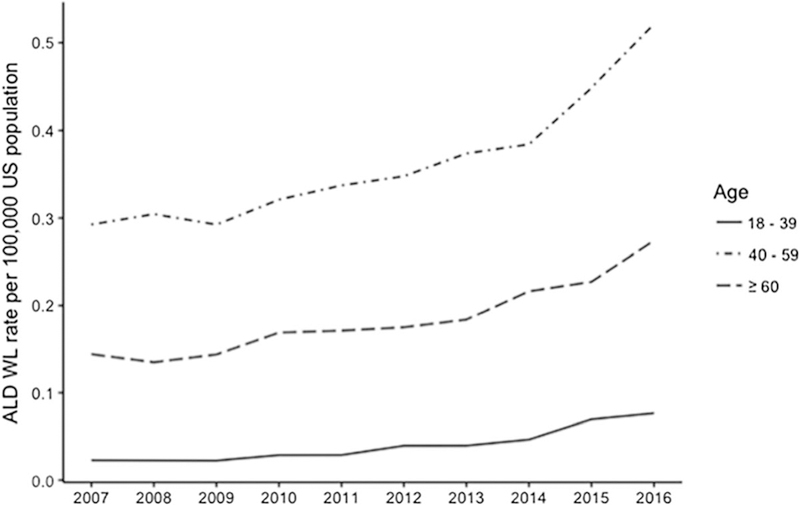
Results: From 2007 to 2016, ALD accounted for 20.4% (18 399) of all CLD WL additions. The age-standardized ALD WL addition rate was 0.459 per 100 000 US population in 2007; nearly doubled to 0.872 per 100 000 US population in 2016 and increased with an average annual percent change of 47.56% (95% confidence interval, 30.33% to 64.72%).The ALD WL addition rate increased over twofold among young (18-39 years) and middle-aged (40-59 years) adults during the study period. Young adult ALD WL additions presented with a higher severity of liver disease including Model for End-Stage Liver Disease score compared to middle aged and older adults (≥60 years). The number of annual ALD WL deaths readily rose from 2014 to 2016, despite an overall annual decline in all CLD WL deaths. Severe hepatic encephalopathy, low body mass index (<18.5) and diabetes mellitus were significant predictors for 1-year WL mortality.
Conclusions: Alcoholic liver disease-related WL registrations and liver transplantation have increased over the past decade with a disproportionate increase in young and middle-aged adults. These subpopulations within the ALD cohort need to be evaluated in future studies to improve our understanding of factors associated with these alarming trends.
Conflict of interest statement
The authors declare no funding or conflicts of interest.
Figures


References
-
- Cholankeril G, Wong RJ, Hu M, et al. Liver transplantation for nonalcoholic Steatohepatitis in the US: temporal trends and outcomes. Dig Dis Sci. 2017;62:2915–2922. - PubMed
-
- Wong RJ, Aguilar M, Cheung R, et al. Nonalcoholic steatohepatitis is the second leading etiology of liver disease among adults awaiting liver transplantation in the United States. Gastroenterology. 2015;148:547–555. - PubMed
Publication types
MeSH terms
Grants and funding
LinkOut - more resources
Full Text Sources
Medical
Miscellaneous
