


Measures matter: A scoping review of maternal and newborn indicators
- PMID: 30300361
- PMCID: PMC6177145
- DOI: 10.1371/journal.pone.0204763
Measures matter: A scoping review of maternal and newborn indicators
Abstract
Background: A variety of global-level monitoring initiatives have recommended indicators for tracking progress in maternal and newborn health. As a first step supporting the work of WHO's Mother and Newborn Information for Tracking Outcomes and Results (MoNITOR) Technical Advisory Group, we aimed to compile and synthesize recommended indicators in order to document the landscape of maternal and newborn measurement and monitoring.
Methods: We conducted a scoping review of indicators proposed by global multi-stakeholder groups to suggest next steps to further support maternal and newborn measurement and monitoring. Indicators pertaining to pregnancy, childbirth, and postpartum/postnatal and newborn care were extracted and included in the indicator compilation, together with key indicator metadata. We examined patterns and relationships across the compiled indicators.
Results: We identified 140 indicators linked to maternal and newborn health topics across the continuum of service provision. Fifty-five indicators relate to inputs and processes, 30 indicators relate to outputs, outcomes comprise 37 indicators in the database, and 18 impact indicators. A quarter of indicators proposed by global groups is either under development/discussion or is considered "aspirational", highlighting the currently evolving monitoring landscape. Although considerable efforts have been made to harmonize indicator recommendations, there are still relatively few indicators shared across key monitoring initiatives and some of those that are shared may have definitional variation.
Conclusion: Rapid, wide-ranging work by a number of multi-stakeholder groups has resulted in a substantial number of indicators, many of which partially overlap and many are not supported with adequate documentation or guidance. The volume of indicators, coupled with the number of initiatives promoting different indicator lists, highlight the need for strengthened coordination and technical leadership to harmonize recommendations for improved measurement and monitoring of data related to maternal and newborn heath.
Conflict of interest statement
The authors have declared that no competing interests exist.
Figures

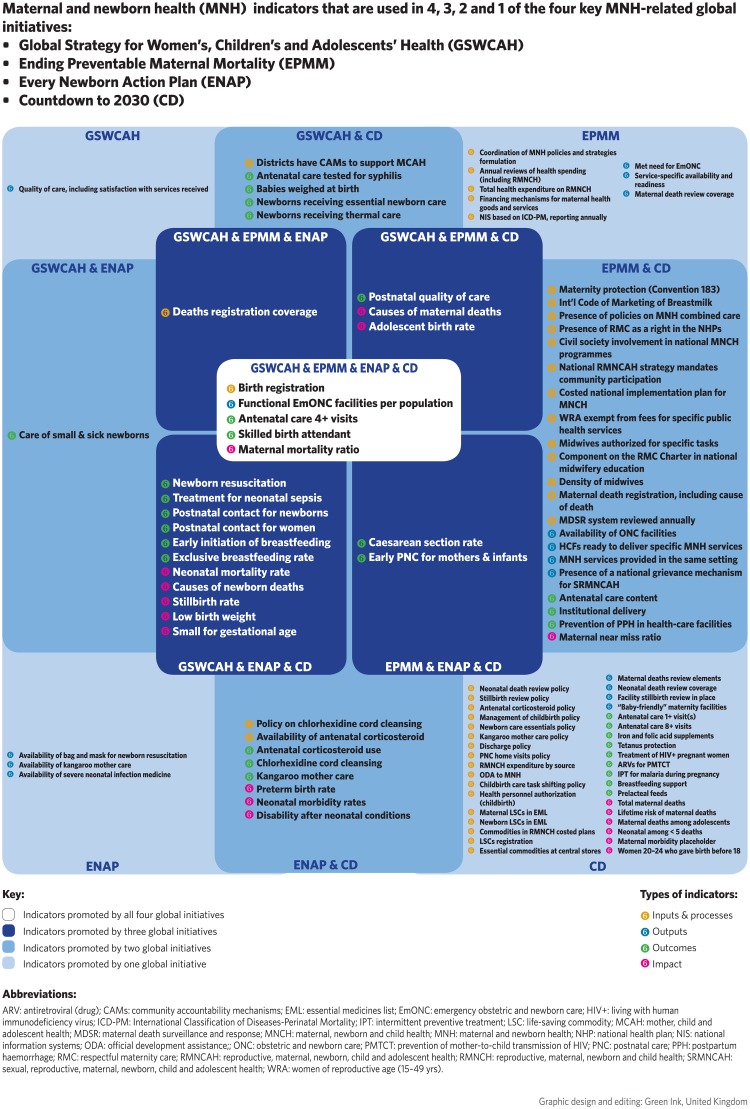
Global Strategy for Women’s, Children’s and Adolescents’ Health (GSWCAH)
Ending Preventable Maternal Mortality (EPMM)
Every Newborn Action Plan (ENAP)
Countdown to 2030 (CD).
References
-
- United Nations. Sustainable Development Goals New York: United Nations Department of Economic and Social Affairs; [cited 2017 November 30]. https://sustainabledevelopment.un.org/index.html.
-
- Every Woman Every Child. Global strategy for women’s, children’s and adolescents’ health 2016–2030 2015 [cited 2017 21 October]. http://globalstrategy.everywomaneverychild.org/.
-
- Every Newborn: an action plan to end preventable deaths. Geneva: World Health Organization; 2014.
-
- Strategies towards ending preventable maternal mortality (EPMM). Geneva: World Health Organization; 2015.
-
- Global Financing Facility in support of Every Woman Every Child (GFF) Washington, DC: World Bank Group; 2016. [cited 2017 21 October]. http://globalfinancingfacility.org/.
Publication types
MeSH terms
Grants and funding
LinkOut - more resources
Full Text Sources
Research Materials
