


High prevalence of spa type t571 among methicillin-susceptible Staphylococcus aureus from bacteremic patients in a French University Hospital
- PMID: 30300375
- PMCID: PMC6177137
- DOI: 10.1371/journal.pone.0204977
High prevalence of spa type t571 among methicillin-susceptible Staphylococcus aureus from bacteremic patients in a French University Hospital
Abstract
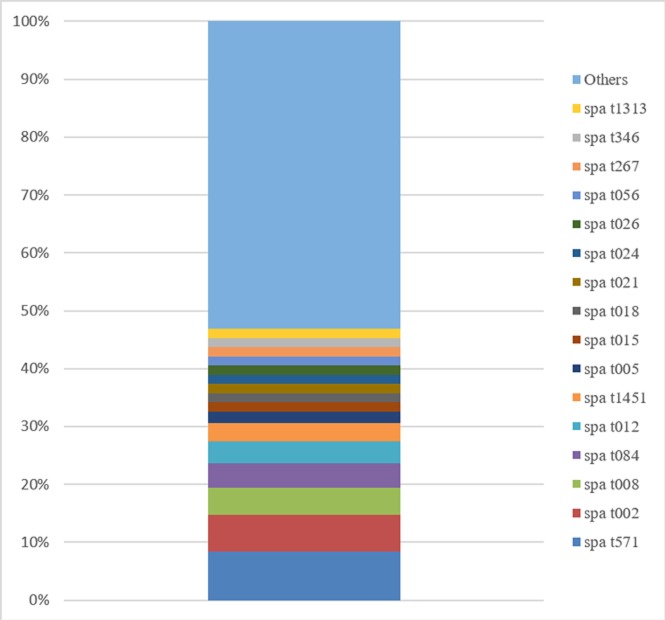
Staphylococcus aureus bacteremia is one of the most frequent severe bacterial infections worldwide, with an associated mortality of about 20-40% in developed countries. In 2013, we noted an increase in this infection in the teaching hospital in Grenoble, France, compared to 2012. The mean incidence of S. aureus bacteremia was 0.28 per 1,000 patient-days in 2012 and 0.35 per 1,000 patient-days in 2013. This trend was confirmed in 2014 (0.35 per 1,000 patient-days). In the present work we aimed to study the population of patients presenting with S. aureus bacteremia in 2013 and to genotype the corresponding S. aureus strains in order to identify a successful and/or virulent genotype to design a specific infection control program. One hundred ninety-one S. aureus isolates (including 9 methicillin-resistant) out of 199 corresponding cases of bacteremia were characterized with the spa typing method. Among 108 spa types, t571, t002, t008 and t084 were the most prevalent. Although not widely prevalent, t571 was the most frequently identified clone (8.4% of all isolates). Spa type t571 has been described in previous studies as belonging to the clonal complex CC398, which is consistent with the recent emergence of methicillin-susceptible S. aureus CC398 reported in blood cultures in Europe.
Conflict of interest statement
The authors have declared that no competing interests exist.
Figures
References
-
- Laupland KB, Lyytikäinen O, Søgaard M, Kennedy KJ, Knudsen JD, Ostergaard C, et al. The changing epidemiology of Staphylococcus aureus bloodstream infection: a multinational population-based surveillance study. Clin Microbiol Infect Dis. 2013;19:465–71. - PubMed
-
- Asgeirsson H, Gudlaugsson O, Kristinsson KG, Heiddal S, Kristjansson M. Staphylococcus aureus bacteraemia in Iceland, 1995–2008: changing incidence and mortality. Clin Microbiol Infect Dis. 2011;17:513–8. - PubMed
MeSH terms
Substances
LinkOut - more resources
Full Text Sources
Medical
