Review
. 2018 Oct 6;11(4):100.
doi: 10.3390/ph11040100.

TRP Channels as Drug Targets to Relieve Itch

Affiliations
Review

TRP Channels as Drug Targets to Relieve Itch

Zili Xie et al. Pharmaceuticals (Basel). .

Abstract

Although acute itch has a protective role by removing irritants to avoid further damage, chronic itch is debilitating, significantly impacting quality of life. Over the past two decades, a considerable amount of stimulating research has been carried out to delineate mechanisms of itch at the molecular, cellular, and circuit levels. There is growing evidence that transient receptor potential (TRP) channels play important roles in itch signaling. The purpose of this review is to summarize our current knowledge about the role of TRP channels in the generation of itch under both physiological and pathological conditions, thereby identifying them as potential drug targets for effective anti-itch therapies.

Keywords: TRP channels; TRPA1; TRPC4; TRPM8; TRPV1; TRPV3; TRPV4; agonists; antagonists; itch; pain.


Conflict of interest statement

The authors declare no conflict of interest.

Figures
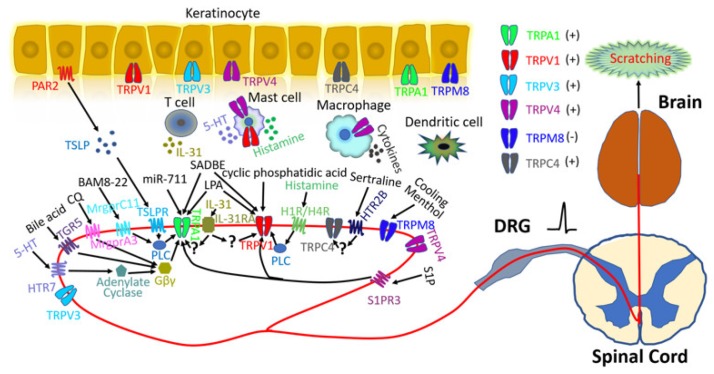
Figure 1
Figure 1
Transient receptor potential (TRP) channels and itch signaling. Six TRP channels are implicated in itch signaling, including TRPA1, TRPV1, TRPV3, TRPV4, TRPM8, and TRPC4. All itch-related TRP channels are expressed in keratinocytes and/or primary sensory neurons. TRPA1 is required for itch evoked by chloroquine (CQ), bovine adrenal medulla 8–22 peptide (BAM8-22), 5-hydroxytryptamine (5-HT), bile acid, and thymic stromal lymphopoietin (TSLP) which can be released from keratinocytes through protease-activated receptor 2 (PAR2) activation. These pruritogens bind to their respective G protein-coupled receptors (GPCRs): Mas-related G protein-coupled receptor member A3 (MrgprA3), MrgprC11, 5-hydroxytryptamine receptor 7(HTR7), G protein-coupled bile acid receptor Gpbar1 (TGR5), and thymic stromal lymphopoietin receptor (TSLPR). Phospholipase C (PLC) and Gβγ signaling downstream from these receptors contribute to TRPA1 activation. TRPA1 also mediates miR-711-induced itch through direct activation. TRPV1 is required for histamine-evoked itch, whereby histamine receptor 1 (H1R) and histamine receptor 4 (H4R) activate TRPV1 through the PLC signaling pathway. TRPV1 also participates in cyclic phosphatidic acid-induced itch through direct activation. Both TRPA1 and TRPV1 are involved in squaric acid dibutylester (SADBE)- and lysophosphatidic acid (LPA)-induced itch through direct activation. In addition, both TRPA1 and TRPV1 are required for interleukin-31 (IL-31)- and sphingosine 1-phosphate (S1P)-related itch, but the detailed mechanisms remain unresolved. Mutations of amino acid residues in TRPV3 have been associated with Olmsted syndrome (OS), suggesting a potential role in itch signaling. Emerging data implicate TRPV4 in both histaminergic and non-histaminergic itch, but results from different research groups are controversial [27,28,29]. HTR2B and TRPC4 are involved in selective serotonin reuptake inhibitor (SSRI)-evoked pruritus. Unlike other TRP channels, TRPM8 activation inhibits itch and is required for cooling- and menthol-mediated itch inhibition.

References

    1. Paus R., Schmelz M., Biro T., Steinhoff M. Frontiers in pruritus research: Scratching the brain for more effective itch therapy. J. Clin. Investig. 2006;116:1174–1186. doi: 10.1172/JCI28553. - DOI - PMC - PubMed
    1. Akiyama T., Carstens E. Neural processing of itch. Neuroscience. 2013;250:697–714. doi: 10.1016/j.neuroscience.2013.07.035. - DOI - PMC - PubMed
    1. Wang H., Yosipovitch G. New insights into the pathophysiology and treatment of chronic itch in patients with end-stage renal disease, chronic liver disease, and lymphoma. Int. J. Dermatol. 2010;49:1–11. doi: 10.1111/j.1365-4632.2009.04249.x. - DOI - PMC - PubMed
    1. Boguniewicz M., Leung D.Y. Atopic dermatitis: A disease of altered skin barrier and immune dysregulation. Immunol. Rev. 2011;242:233–246. doi: 10.1111/j.1600-065X.2011.01027.x. - DOI - PMC - PubMed
    1. Bunchorntavakul C., Reddy K.R. Pruritus in chronic cholestatic liver disease. Clin. Liver Dis. 2012;16:331–346. doi: 10.1016/j.cld.2012.03.010. - DOI - PubMed
