Review
. 2018 Nov;19(11):643-654.
doi: 10.1038/s41583-018-0072-6.

The neural mechanisms and circuitry of the pair bond

Affiliations
Review

The neural mechanisms and circuitry of the pair bond

Hasse Walum et al. Nat Rev Neurosci. 2018 Nov.

Abstract

Love is one of our most powerful emotions, inspiring some of the greatest art, literature and conquests of human history. Although aspects of love are surely unique to our species, human romantic relationships are displays of a mating system characterized by pair bonding, likely built on ancient foundational neural mechanisms governing individual recognition, social reward, territorial behaviour and maternal nurturing. Studies in monogamous prairie voles and mice have revealed precise neural mechanisms regulating processes essential for the pair bond. Here, we discuss current viewpoints on the biology underlying pair bond formation, its maintenance and associated behaviours from neural and evolutionary perspectives.


Conflict of interest statement

Competing interests

The authors declare no competing interests.

Figures
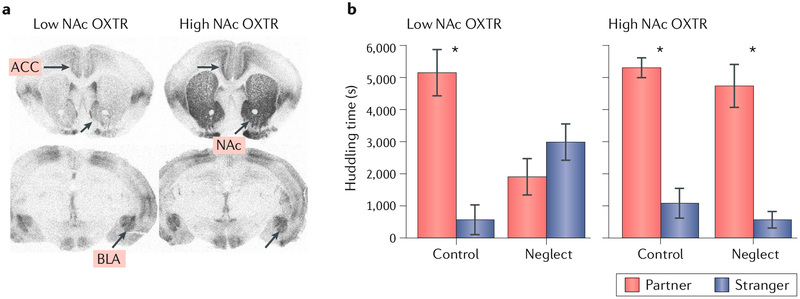
Fig. 1 |
Fig. 1 |. Individual variation in oxytocin receptor expression in the nucleus accumbens confers resilience to neonatal neglect
, a | The distribution of and variation in oxytocin receptors (OXTRs) in rostral (top row) and caudal (bottom row) brain regions of two prairie voles. Note the robust individual variation in OXTR density in the nucleus accumbens (NAc), with less variation in other areas, such as the basolateral amygdala (BLA). The density of OXTR in the NAc is robustly predicted by genetic variation in non-coding regions of the Oxtr gene, b | High NAc OXTR density confers resilience to a neglect paradigm involving neonatal social isolation. The histograms show that when animals with low NAc OXTR density are exposed to neonatal neglect, they then fail as adults to form a preference for spending time with their cohabiting partner (huddling time) compared with a nove ‘stranger’; control animals with low NAc OXTR expression that have not experienced neonatal neglect display strong partner preferences. By contrast, the huddling time preferences of adult voles with high NAc OXTR with regard to their partners are unaffected by neonatal neglect. ACC, anterior cingulate cortex. Part b adapted from REF, CC-BY-4.0.
Fig. 2 |
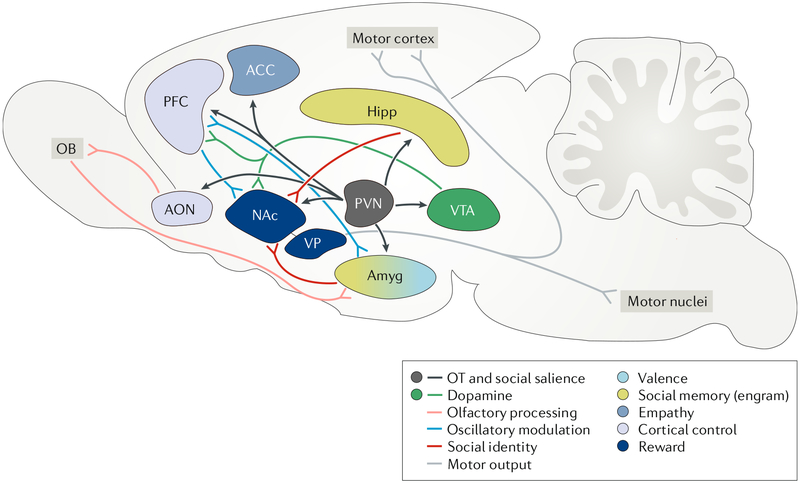
Fig. 2 |. A neural model of pair bond formation.
During mating, the olfactory bulb (OB) processes olfactory information representing the identity of the partner, and oxytocin (OT)-sensitive neurons in the anterior olfactory nucleus (AON) improve thesignal-to-noise ratio of the OB output. Neural traces enabling individual discrimination are conveyed to the amygdala (Amyg), which forms a social memory of the partner and assigns valence to the cues. Social engrams, groups of neurons activated by an individual, form in the hippocampus (Hipp) and possibly in the Amyg and project to the nucleus accumbens (NAc). The ventral teg mental area (VTA) releases dopamine in the NAc and prefrontal cortex (PFC), activating the reward system. OT released from paraventricular nucleus (PVN) neurons acts across the networkto improve the salience and flow of social information across the network. The PFC coordinates oscillations of the NAc and possibly the Amyg to facilitate the flow of social information and synaptic plasticity, linking the neural representation of partner identity with reward. Partner cues become inherently rewarding, and NAc activation disinhibits the ventral pallidum (VP), leading to the initiation of partner-directed behaviours via motor output. OT signalling in the anterior cingulate cortex (ACC) drives consoling behaviour towards the distressed partner.
Fig. 3 |
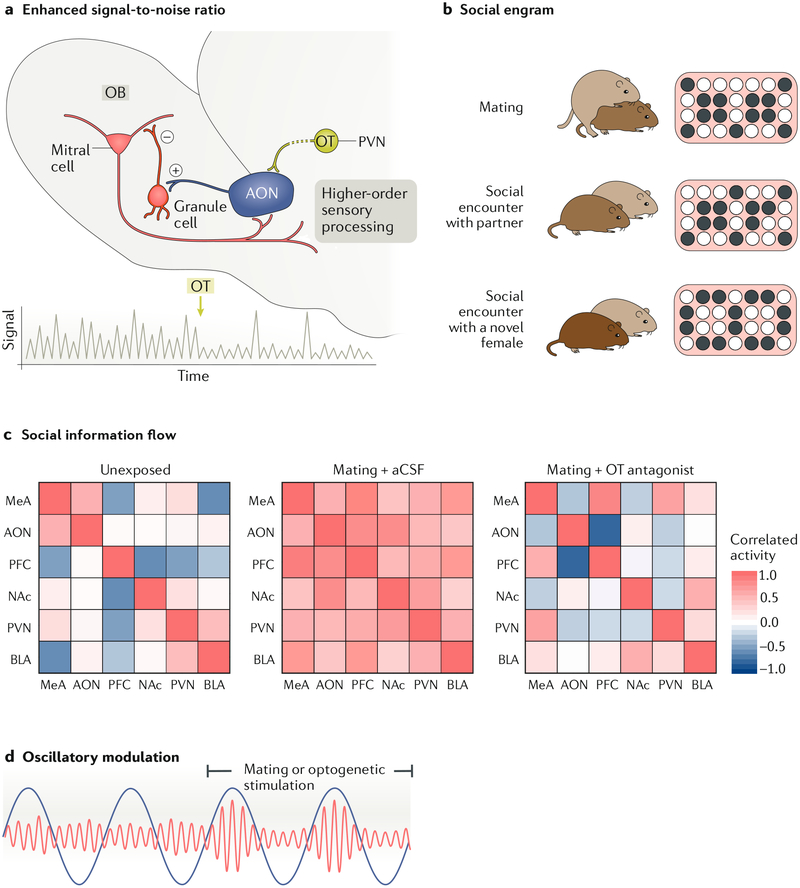
Fig. 3 |. Schematics illustrating selected processes proposed to be involved in pair bonding on the basis of our model.
a | Oxytocin (OT) improves the signai-to-noise ratio during the detection of social signals in the olfactory bulb (OB). OT released from terminals of neurons in the paraventricular nucleus (PVN) increases the excitatory drive of excitatory neurons (indicated by the plus sign) in the cortical anterior olfactory nucleus (AON), which activates inhibitory granule cells (indicated by the minus sign) in the OB, thereby reducing noise produced by the mitral projection neurons. The trace below illustrates the increase in the signal-to-noise ratio in mitral cells, which then project to higher-order sensory processing centres, such as the amygdala, b | Social engrams (populations of neurons that respond collectively to an individual) have been identified in the hippocampus and project to the nucleus accumbens (NAc). The schematic illustrates social engrams in the male brain (right), with circles representing neurons within a brain region and black circles specifically representing neurons activated by different social encounters. Note the high similarity in activity patterns during mating with the partner (top) and later social encounter with the partner (centre) but the different pattern seen during exposure to a novel female (bottom), c | Fleat maps showing correlated activity between brain regions in the social neural network (red is more correlated). The left panelshows little coordinated activity in a male’s brain when placed alone in a home cage (unexposed). Mating (under control conditions with infusion of artificial cerebrospinal fluid (aCSF)) results in robust coordinated activity across the network (middle heat map), but this coordinated activity is diminished when OT antagonists are infused into the brain, d | Schematic illustrating howtheta oscillatory activity from the medial prefrontal cortex (PFC) (blue line) entrains gamma oscillations within the NAc (red line), particularly during mating. We propose that the rhythmically controlled peaks in the accumbens gamma amplitude are moments of maximal sensitivity to neural input. If the PFC similarly controls oscillations of areas conveying social information, such as engrams (sender), the signal can be coordinated to reach the NAc at a peak of sensitivity, leading to synaptic plasticity. BLA, basolateral amygdala; MeA, medial amygdala. Part a adapted with permission from REF., Elsevier. Part c adapted with permission from REF., Elsevier.
Fig. 4 |
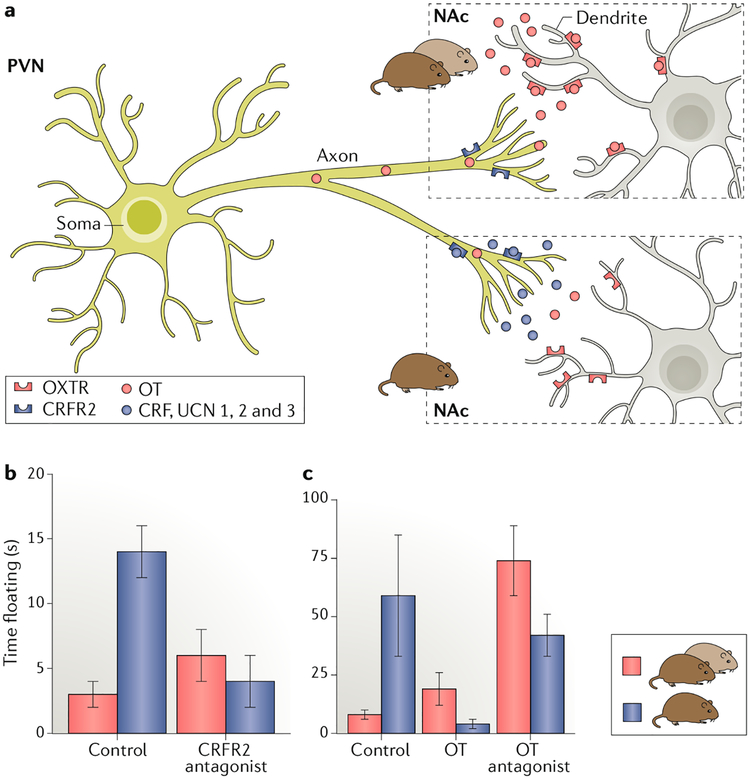
Fig. 4 |. The corticotropin-releasing factor system and oxytocin interact to maintain the pair bond
, a | Effect of loss of the partner on the corticotropin-reieasing factor (CRF) and oxytocin (OT) signalling in the nucleus accumbens (NAc). Separation from the partner results in decreased OT synthesis in the paraventricular nucleus (PVN) and a reduction of OT receptors (OXTRs) in the NAc. Upon separation from the partner, CRF or the related urocortins (UCN 1,2 and 3) are released in the NAc, binding to CRF type 2 receptors (CRFR2) on OT terminals and inhibiting OT release. Thus, separation from the partner leads to decreased OT signalling through multiple mechanisms, b |The forced swim test is a behavioural assay in which an increased amount of time spent passively floating indicates a depressive-like state. Male voles paired with their partner spent little time floating, but this time increased upon separation from their partner. This social-loss-induced behaviour was eliminated by local infusion of the CRFR2 antagonist into the NAc.c | Infusion of OT into the NAc also eliminates the increase in passive floating in the forced swim test. Infusion of the OT antagonist into the NAc increases the floating behaviour in males even when they remain paired. Thus, the withdrawal of OT signalling following separation may maintain bonds by creating an aversive emotionalstate. Part b adapted from REF., Springer Nature Limited. Part c adapted with permission from REF, Elsevier.

References

    1. Raghanti MA et al. A neurochemical hypothesis for the origin of hominids. Proc. Natl Acad. Sci. USA 115, E1108–E1116 (2018). - PMC - PubMed
    1. Young LJ Being human: love: neuroscience reveals all. Nature 457, 148 (2009). - PubMed
    1. Bull CM Monogamy in lizards. Behav. Processes 51, 7–20 (2000). - PubMed
    1. Whiteman EA & Cote IM Monogamy in marine fishes. Biol. Rev. Camb. Philos. Soc 79, 351–375 (2004). - PubMed
    1. Dunn PO, Whittingham LA & Pitcher TE Mating systems, sperm competition, and the evolution of sexual dimorphism in birds. Evolution 55, 161–175 (2001). - PubMed

Publication types