. 2018 Oct 1:3:40.
doi: 10.1038/s41541-018-0076-2. eCollection 2018.

AS03-adjuvanted H5N1 vaccine promotes antibody diversity and affinity maturation, NAI titers, cross-clade H5N1 neutralization, but not H1N1 cross-subtype neutralization

Collaborators, Affiliations

AS03-adjuvanted H5N1 vaccine promotes antibody diversity and affinity maturation, NAI titers, cross-clade H5N1 neutralization, but not H1N1 cross-subtype neutralization

Surender Khurana et al. NPJ Vaccines. .

Abstract

Immune responses to inactivated vaccines against avian influenza are poor due in part to lack of immune memory. Adjuvants significantly increased virus neutralizing titers. We performed comprehensive analyses of polyclonal antibody responses following FDA-approved adjuvanted H5N1-A/Indonesia vaccine, administered in presence or absence of AS03. Using Whole Genome Fragment Phage Display Libraries, we observed that AS03 induced antibody epitope diversity to viral hemagglutinin (HA) and neuraminidase compared with unadjuvanted vaccine. Furthermore, AS03 promoted significant antibody affinity maturation to properly folded H5-HA1 (but not to HA2) domain, which correlated with neutralization titers against both vaccine and heterologous H5N1 strains. However, no increase in heterosubtypic cross-neutralization of Group1-H1N1 seasonal strains was observed. AS03-H5N1 vaccine also induced higher neuraminidase inhibition antibody titers. This study provides insight into the differential impacts of AS03 adjuvant on H5N1 vaccine-induced antibody responses that may help optimize vaccine platforms for future vaccines with improved protection against seasonal and pandemic influenza strains.


Conflict of interest statement

The authors declare no competing interests.

Figures
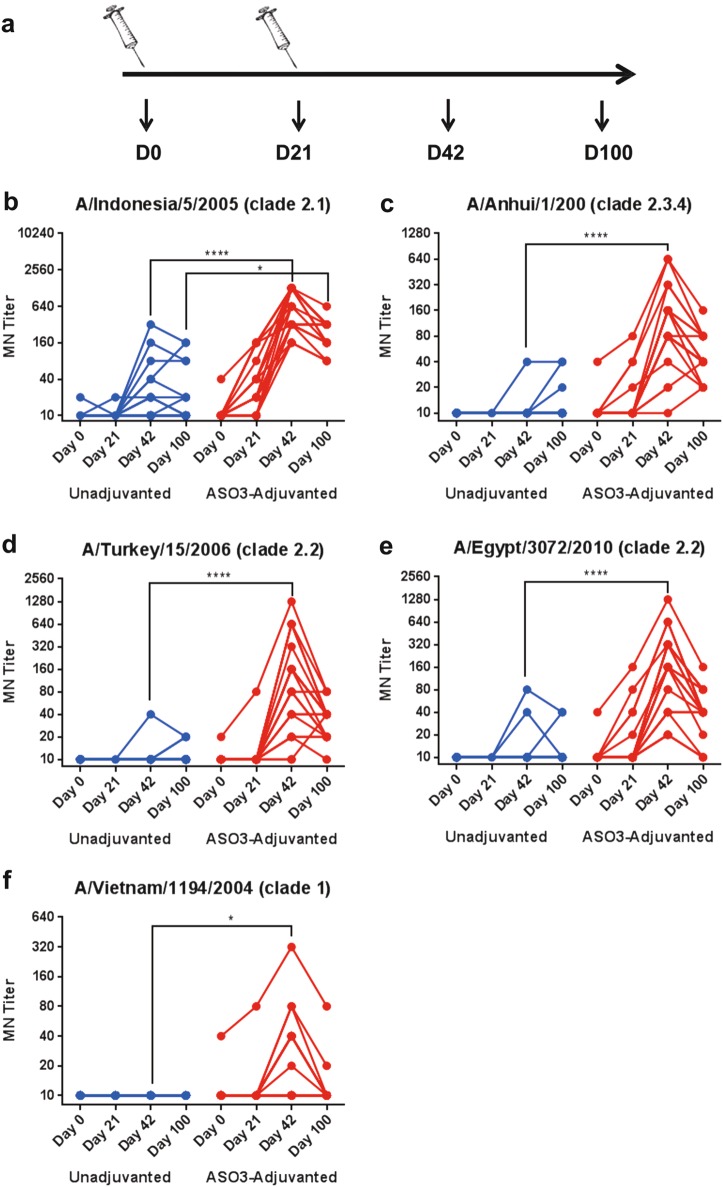
Fig. 1
Fig. 1
Endpoint microneutralization titers following vaccination of adults with H5N1 with and without AS03 adjuvant against diverse H5N1 strains. a Schematic design of the heterologous H5N1 prime-boost vaccine immunization is shown. The number of individuals in each group: Unadjuvanted = 20; AS03-adjuvanted = 22. b−f End-point microneutralization titers of the individuals against various H5N1 virus strains at day 0 (prevaccination), day 21 (post first vaccination), day 42 (post second vaccination) and day 100 postvaccination are shown for AS03-adjuvanted group (in red) and unadjuvanted group (in blue) against b homologous H5N1 A/Indonesia/5/2005 (clade 2.1) vaccine strain, c A/Anhui/1/2005 (clade 2.3.4). d A/Turkey/15/2006 (clade 2.2), e A/Egypt/3072/2010 (clade 2.2), and f A/Vietnam/1194/2004 (clade 1). The pairwise comparison of endpoint neutralization titers that were statistically significant with p values of <0.05 (*), or <0.005 (**), or <0.0005 (***), or <0.0001 (****) are shown
Fig. 2
Fig. 2
Elucidation of antibody repertoires elicited in humans following vaccination with unadjuvanted and adjuvanted subunit H5N1-A/Indonesia vaccine. a Distribution of phage clones after affinity selection on post-H5N1 vaccination sera. b Schematic alignment of the peptides recognized by post-second vaccination sera in the NIAID sponsored trial, identified by panning with H5N1-GFPDL A/Indonesia/5/2005. Amino acid designation is based on the HA + NA protein sequence (Fig. S1). Bars with arrows indicate identified inserts in the 5′-3′ orientation in HA1 (red bars), HA2 (blue bars), and NA (black bars). Only clones with frequency of ≥2 are shown. Yellow bars indicate inserts spanning the receptor binding domain (RBD) in HA1. The pie charts represent the ratio of frequency of clones selected in HA1 (red) vs. HA2 (blue) domain by various vaccine groups are depicted. The thickness of bars represents the frequency of phages containing each insert. All bars shown represent phages that were affinity selected at least twice
Fig. 3
Fig. 3
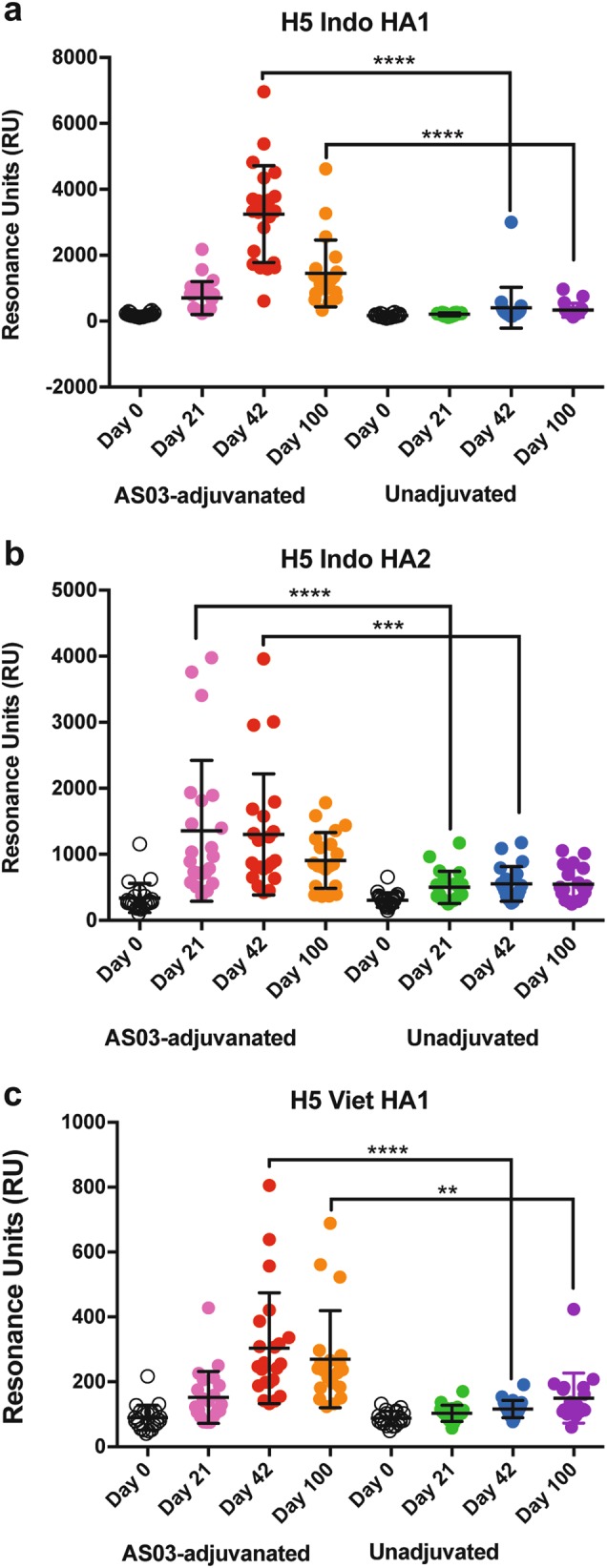
Binding of post-H5N1 vaccination human sera to properly folded HA1 and HA2 domains. ac Steady-state equilibrium analysis of human vaccine sera at day 0 (prevaccination), day 21 (post first vaccination), day 42 (post second vaccination) and day 100 postvaccination are shown for AS03-adjuvanted group and unadjuvanted group against properly folded homologous H5-A/Indonesia/5/05 (Clade 2.1) HA1 (a) and HA2 (b) domains and heterologous H5N1-A/Vietnam/1203/2004 (Clade 1) HA1 domain (c) were measured using SPR. Recombinant HA1 and HA2 domains were immobilized on a sensor chip through the free amine group. Binding of the antibodies to the immobilized protein is shown as resonance unit (RU) values. Mean with standard deviation (SD) is also shown. The pairwise comparison of serum polyclonal antibody binding titers that were statistically significant with p values of <0.05 (*), or <0.005 (**), or <0.0005 (***), or <0.0001 (****) are shown
Fig. 4
Fig. 4
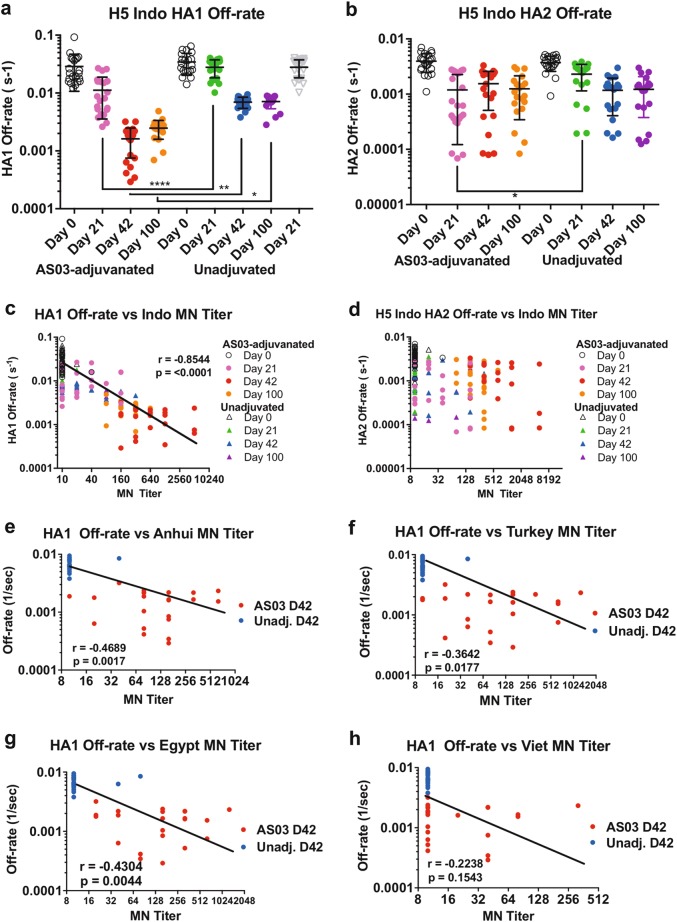
Kinetics of antibody affinity maturation following vaccination with adjuvanted and unadjuvanted H5N1 subunit vaccine. Sequential SPR analysis of vaccine sera (pre-, post first and post second vaccination with unadjuvanted or AS03-adjuvanted H5N1 vaccine) with properly folded homologous H5-A/Indonesia/5/05 HA1 (a) and HA2 (b) domains. Ten-fold and 100-fold diluted individual serum from each participant in vaccine trial at prevaccination (day 0) and at 21 days after each immunization, as well as at day 100 were evaluated. Serum antibody off-rate constants were determined as described in the Material and Methods. Mean with standard deviation (SD) is also shown. The pairwise comparison of polyclonal antibody off-rates that were statistically significant with p values of <0.05 (*), or <0.005 (**), or <0.0005 (***), or <0.0001 (****) are shown. c, d Correlation between in vitro neutralizing titers against homologous H5N1-A/Indonesia/5/05 and anti-HA1 antibody affinity (c) and anti-HA2 binding affinity (d) in human sera before and after H5N1 vaccination is shown. eh Correlation statistics of the off-rate constants and peak MN titers on day 42 (post second vaccine) for heterologous H5N1 strains are shown and found to be highly significant for e A/Anhui/1/2005 (clade 2.3.4), f A/Turkey/15/2006 (clade 2.2), g A/Egypt/3072/2010 (clade 2.2), with p < 0.05 but not for highly divergent h A/Vietnam/1194/2004 (clade 1) virus
Fig. 5
Fig. 5
No increase in neutralization titers against Group 1 seasonal H1N1 strains following vaccination with AS03-adjuvanted H5N1 vaccine in adults. To ascertain the generation of stem-specific neutralizing antibodies that will cross neutralize Groups 1 H1N1 strains following vaccination with AS03-adjuvanted H5N1 vaccine, a modified microneutralization assay was performed (as described in the Materials and Methods) with serum samples from day 0 (prevaccination) and day 7 post first vaccination (demonstrated to have peak HA2 stem cross-reactive titers following heterologous H5N1 vaccination). No significantly higher fold change (day 7/day 0) in neutralization titers were observed for any of the Gp 1 H1N1 (A/New Caledonia/22/99, A/Solomon Islands/3/06, A/Brisbane/59/07, A/California/07/2009), or Gp 2 H3N2 (A/Switzerland/9715293/2013) viruses following vaccination AS03-adjuvanted H5N1 (a) or unadjuvanted H5N1 vaccine (b). Mean with standard deviation (SD) is also shown
Fig. 6
Fig. 6
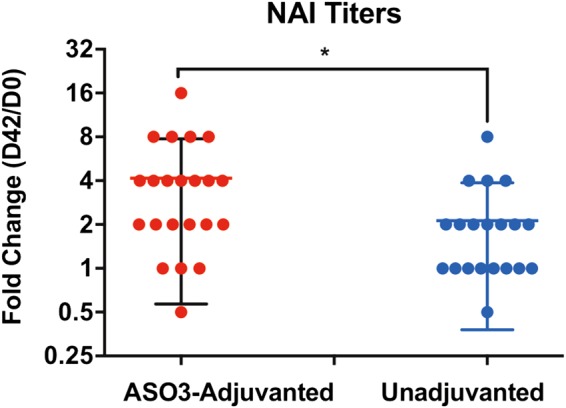
AS03 adjuvant promotes H5N1 neuraminidase-inhibiting antibodies. Neuraminidase enzymatic activity inhibition (NAI) titers for prevaccination (day 0) and post second vaccination (day 42) human sera were measured as described in the Material and Methods. The pairwise comparison of sera from AS03-adjuvanted vaccine recipients gave significantly higher fold change in NAI titers compared to unadjuvanted H5N1 vaccines with p values of <0.05, respectively. Mean with standard deviation (SD) is also shown

References

    1. Zeng H, et al. Highly pathogenic avian influenza H5N1 viruses elicit an attenuated type i interferon response in polarized human bronchial epithelial cells. J. Virol. 2007;81:12439–12449. doi: 10.1128/JVI.01134-07. - DOI - PMC - PubMed
    1. Zitzow LA, et al. Pathogenesis of avian influenza A (H5N1) viruses in ferrets. J. Virol. 2002;76:4420–4429. doi: 10.1128/JVI.76.9.4420-4429.2002. - DOI - PMC - PubMed
    1. Wang X, et al. Epidemiology of avian influenza A H7N9 virus in human beings across five epidemics in mainland China, 2013−17: an epidemiological study of laboratory-confirmed case series. Lancet Infect. Dis. 2017;17:822–832. doi: 10.1016/S1473-3099(17)30323-7. - DOI - PMC - PubMed
    1. Zhang F, et al. Human infections with recently-emerging highly pathogenic H7N9 avian influenza virus in China. J. Infect. 2017;75:71–75. doi: 10.1016/j.jinf.2017.04.001. - DOI - PubMed
    1. Ke C, et al. Human infection with highly pathogenic avian influenza A (H7N9) virus, China. Emerg. Infect. Dis. 2017;23:1332–1340. doi: 10.3201/eid2308.170600. - DOI - PMC - PubMed