Review
. 2018 Sep 13:2018:9091216.
doi: 10.1155/2018/9091216. eCollection 2018.

Current Innovations in Peripheral Nerve Stimulation

Affiliations
Review

Current Innovations in Peripheral Nerve Stimulation

Raghavendra Nayak et al. Pain Res Treat. .

Abstract

Peripheral nerve stimulation has been used in the treatment of several chronic pain conditions including pain due to peripheral nerve dysfunctions, complex regional pain syndrome, and cranial neuralgias. It has been shown to be effective for chronic, intractable pain that is refractory to conventional therapies such as physical therapy, medications, transcutaneous electrical stimulations, and nerve blocks. Recently, a new generation of peripheral nerve stimulation devices has been developed; these allow external pulse generators to transmit impulses wirelessly to the implanted electrode, and their implantation is significantly less invasive. In this review, we discuss the history, pathophysiology, indications, implantation process, and outcomes of employing peripheral nerve stimulation to treat chronic pain conditions.


Figures
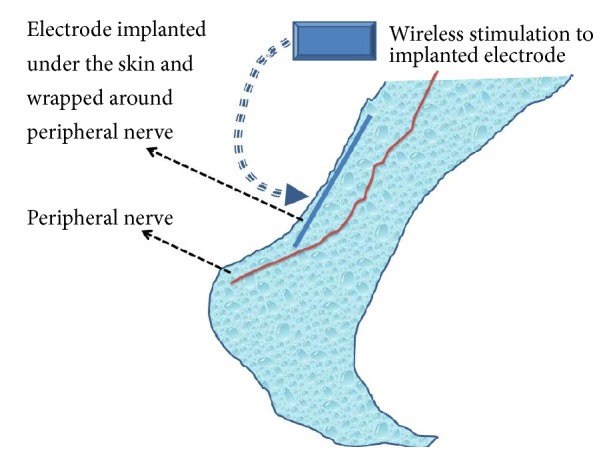
Figure 1
Figure 1
Schematic presentation of wireless peripheral nerve stimulation. An extremely small, insulated electrical lead is inserted adjacent to peripheral nerve through a 14G Tuoy needle under ultrasound guidance [25, 35]. The lead insertion is similar to perineural catheter placement. No additional equipment is required to be inserted into patient's body. The procedure is rapid and relatively less traumatic. The external pulse generators, which are wearable in belts, fabric, jewelry, etc., provide power to the implanted wireless leads. The technique eliminates need for an implantable pulse generator (IPG) and tunneling of the electrodes to IPG, thereby reducing the expense of these therapies. The electrical energy is transmitted from external pulse generator to the implanted leads, inducing action potentials in nearby neurons.

References

    1. Melzack R., Wall P. D. Pain mechanisms: a new theory. Science. 1965;150(3699):971–979. doi: 10.1126/science.150.3699.971. - DOI - PubMed
    1. Wall P. D., Swert W. H. Temporary abolition of pain in man. Science. 1967;155(3758):108–109. doi: 10.1126/science.155.3758.108. - DOI - PubMed
    1. Goroszeniuk T., Pang D., Shetty A., Eldabe S., O'Keeffe D., Racz G. Percutaneous peripheral neuromodulation lead insertion using a novel stimulating coudé needle. Neuromodulation: Technology at the Neural Interface. 2014;17(5):506–509. doi: 10.1111/ner.12126. - DOI - PubMed
    1. Racz G. B., Browne T., Lewis R., Jr. Peripheral stimulator implant for treatment of causalgia caused by electrical burns. Texas Medicine. 1988;84(11):45–50. - PubMed
    1. Law J. D., Swett J., Kirsch W. M. Retrospective analysis of 22 patients with chronic pain treated by peripheral nerve stimulation. Journal of Neurosurgery. 1980;52(4):482–485. doi: 10.3171/jns.1980.52.4.0482. - DOI - PubMed

LinkOut - more resources