


The role of tissue and serum carcinoembryonic antigen in stages I to III of colorectal cancer-A retrospective cohort study
- PMID: 30302946
- PMCID: PMC6246925
- DOI: 10.1002/cam4.1814
The role of tissue and serum carcinoembryonic antigen in stages I to III of colorectal cancer-A retrospective cohort study
Abstract
Purpose: Tissue carcinoembryonic antigen (t-CEA) and serum carcinoembryonic antigen (s-CEA) expression profiles are the most useful tumor markers for the diagnosis and evaluation of colorectal cancer (CRC) worldwide; however, their roles in CRC progression remain controversial. This study aimed to compare the prognostic values of both s-CEA and t-CEA in CRC.
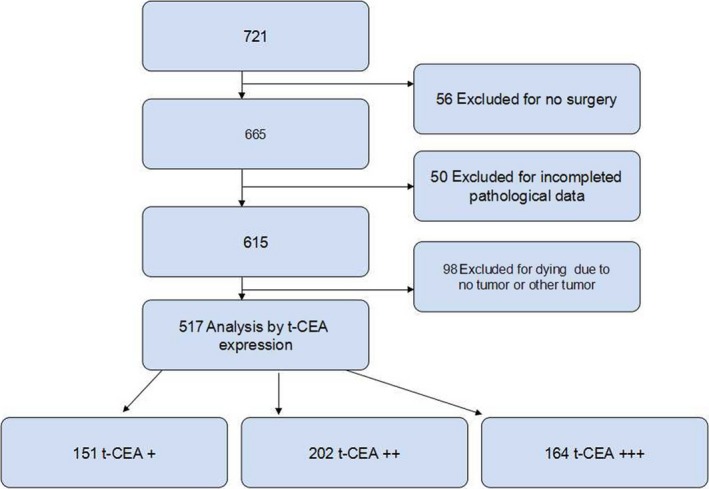
Methods: A total of 517 patients from January 2006 to December 2010 with stages I-III CRC were retrospectively examined, with 5-year postoperative follow-up and death as end-points. T-CEA expression, s-CEA expression, and clinical pathological parameters were inputted into the SPSS 21.0 software. The Kaplan-Meier method was used to analyze the 5-year disease-free survival (DFS) rate of patients in different tumor node metastasis (TNM) stages based on t-CEA and s-CEA expression.
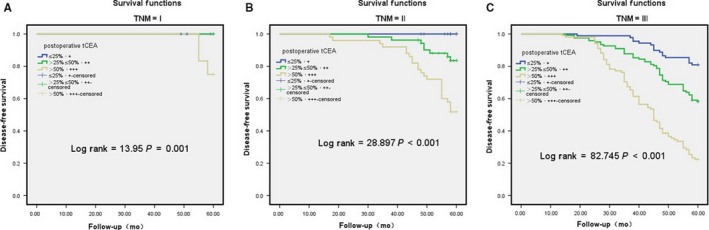
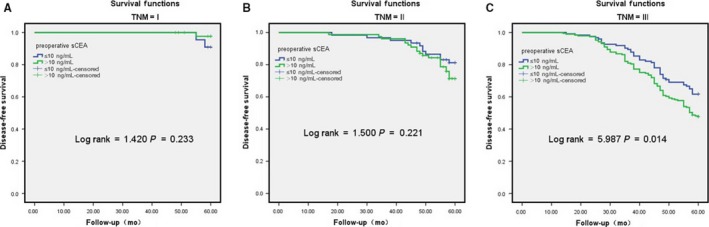
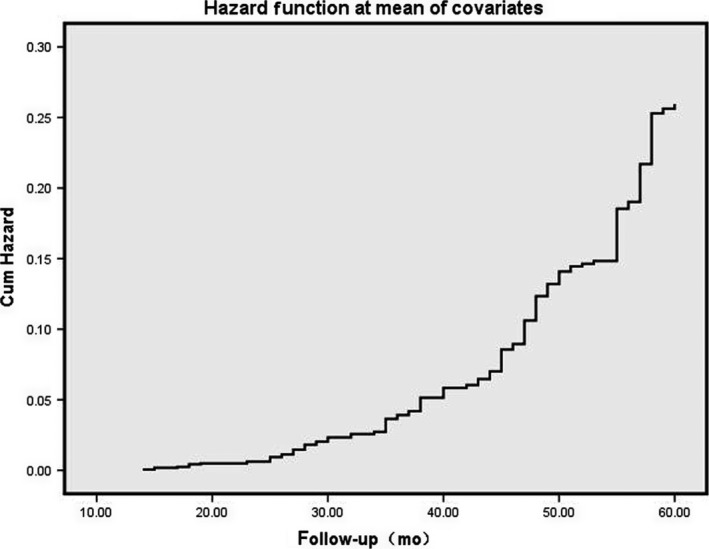
Results: Tumor differentiation and the number of positive lymph node harvests were significantly different among the t-CEA groups (P < 0.001, P = 0.002); however, clinicopathological features showed no significant difference. The groups with high s-CEA and t-CEA expression had a significantly poorer prognosis than those with low s-CEA (P = 0.021) and t-CEA (P < 0.01) expression, respectively. The multivariate analysis demonstrated that t-CEA was an independent prognostic factor in CRC (P < 0.001), but s-CEA was not (P = 0.339). The 5-year disease-free survival rates among the t-CEA groups were significantly different in stages I, II, and III of CRC (P = 0.001, P < 0.001, P < 0.001), whereas in the s-CEA groups, this difference was observed only in stage III (P = 0.014).
Conclusion: This study shows that postoperative t-CEA expression is an independent factor associated with poorer CRC prognosis and has a higher prognostic value than that of preoperative s-CEA expression.
Keywords: carcinoembryonic antigen; colorectal carcinoma; prognosis.
© 2018 The Authors. Cancer Medicine published by John Wiley & Sons Ltd.
Figures
References
-
- American Cancer Society . Cancer Facts & Figures 2011–13. Atlanta: American Cancer Society; 2011:4.
-
- Ferlay J, Parkin DM, Steliarova‐Foucher E. Estimates of cancer incidence and mortality in Europe in 2008. Eur J Cancer. 2010;46:765‐781. - PubMed
-
- Siegel R, Ms D, Dvm AJ. Cancer statistics, 2013. CA Cancer J Clin. 2013;64(1):9‐29. - PubMed
-
- Søreide K, Nedrebø BS, Knapp J‐C, Glomsaker TB, Søreide JA, Kørner H. Evolving molecular classification by genomic and proteomic biomarkers in colorectal cancer: potential implications for the surgical oncologist. Surg Oncol. 2009;18(1):31‐50. - PubMed
-
- Duffy MJ. Carcinoembryonic antigen as a marker for colorectal cancer: is it clinically useful? Clin Chem. 2001;47(4):624‐630. - PubMed
Publication types
MeSH terms
Substances
LinkOut - more resources
Full Text Sources
Medical
