Review
. 2019 Jul 1;527(10):1720-1730.
doi: 10.1002/cne.24554. Epub 2018 Nov 15.

The modular organization of the cerebral cortex: Evolutionary significance and possible links to neurodevelopmental conditions

Affiliations
Review

The modular organization of the cerebral cortex: Evolutionary significance and possible links to neurodevelopmental conditions

Manuel F Casanova et al. J Comp Neurol. .

Abstract

The recognition of discernible anatomical regularities that appear to self-organize during development makes apparent the modular organization of the cerebral cortex. The metabolic cost engendered in sustaining interneuronal communications has emphasized the viability of short connections among neighboring neurons. This pattern of connectivity establishes a microcircuit which is repeated in parallel throughout the cerebral cortex. This canonical circuit is contained within the smallest module of information processing of the cerebral cortex; one which Vernon Mountcastle called the minicolumn. Plasticity within the brain is accounted, in part, by the presence of weak linkages that allow minicolumns to process information from a variety of sources and to quickly adapt to environmental exigencies without a need for genetic change. Recent research suggests that interlaminar correlated firing between minicolumns during the decision phase of target selection provides for the emergence of some executive functions. Bottlenecks of information processing within this modular minicolumnar organization may account for a variety of mental disorders observed in neurodevelopmental conditions.

Keywords: cerebral cortex; connectivity; minicolumns; module; system theory.


Figures

Figure 1a,b
Figure 1a,b. Multiple Subpial Transection (MST): A Disconnection Syndrome?
a. Frank Morrell, MD (1926-1977) was the A. Watson Armour III and Sarah Armour Presidential Professor of Neurological Sciences at Rush-Prebyterian-St. Luke’s Medical Center in Chicago. Taken from Tovar-Spinoza and Rutka (2009) Textbook of Stereotactic and Functional Neurosurgery, Springer. b. Multiple Subpial Transections consists of linear and parallel cuts 5 mm apart across the region defined as the epileptogenic zone. Taken from Tovar-Spinoza and Rutka (2009) Textbook of Stereotactic and Functional Neurosurgery, Springer. Biological systems often impose boundary conditions on its modules. These boundaries can be thought as constraints to guide a particular system down a path of operation. In the cerebral cortex, modules of information processing are arranged in a vertical disposition so as to transverse the cortex from white matter to pial surface. Early experiments by Sperry and associates (1955) showed that subpial slicing of the cat’s visual cortex did not impair the function (i.e., vision) of modules in the intervened area. Other experiments indicated that the less extensive horizontal, or between modules connectivity, was critical for the development of seizures (Smith, 1998). Morell hypothesized that subpial transection would therefore disrupt the spread of an ictal discharge without affecting the critical function performed by modules in that given area (Morrell and Hanbery, 1969; Morrell et al., 1999). Multiple subpial transections is now a routine surgical intervention for cases where resective techniques would lead to undesirable loss of function, e.g., preservation of language in Landau-Kleffner syndrome.
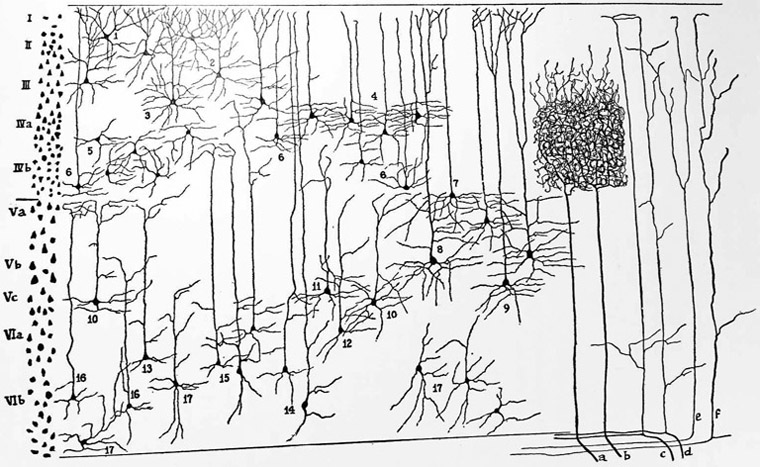
Figure 2
Figure 2. Lorente de Nó
According to Lorente de Nó, “It is possible now to reach a comprehensive view of the organization of the cortex. The small strip reproduced on the left is the vertical section of a cylinder having a specific afferent fiber like a as axis. All of the elements of the cortex are represented in it, and therefore it may be called an elementary unit, in which, theoretically, the whole process of the transmission of impulses from the afferent fiber to the efferent axon may be accomplished” (Lorente de Nó, 1938; p. 290). Within the chains of neurons, de Nó differentiated between short and long links depending on whether they connected cells of the same or different layers. The long links varied little in different mammals, but the short links increased progressively in number from mouse to man. Cajal, who was de Nó’s mentor, thought that short links were the “anatomical expression of the delicacy of function of the brain of man” (Lorente de Nó, 1938; p. 294). Figure reproduced from Lorente de Nó (1938), Physiology of the Nervous System, Oxford University Press.
Figure 3
Figure 3
A canonical circuit for the neocortex: Thalamic relay cells mainly from synapse in the middle layers of the cortex, but they also form synapses with neurons in all six cortical layers, including the tufts of pyramidal cells in layer 1. In all layers the excitatory (red) and inhibitory (blue) neurons form recurrent connections with like cells within the same layer (dashed lines) and with other cell types (continuous lines). Layer 4 in some primary sensory cortical areas contain a specialist excitatory cell type, the spiny stellate cell (A), which projects to pyramidal cells and inhibitory cells in layer 4 and other layers. The superficial layer pyramidal cells (B) connect locally and project to other areas of cortex. Inhibitory neurons (C) are found in all layers (only one representative is shown here), and they constitute about 15% of the neurons in the neocortex. The deep layer pyramidal cells (D) also connect recurrently locally and project to subcortical nuclei in the thalamus, midbrain, and spinal cord. Figure taken from Douglas and Martin, 2010. Handbook of Brain Microcircuits, Oxford University Press, ch. 2, p.16.

References

    1. Abeles M, Goldstein MH Jr. Functional architecture in cat primary auditory cortex: columnar organization and organization according to depth. J Neurophysiology 33:172–187, 1970. - PubMed
    1. Arbib MA, Erdi P. Precis of neural organization: structure, function, and dynamics. Behav Brain Sci 23:513–571, 2000. - PubMed
    1. Babich V, Aksenov N, Alexeenko V, Oei SL, Buchlow G, Tomilin N. Association of some potential hormone response elements in human genes with the Alu family repeats. Gene 239:341–349, 1999. - PubMed
    1. Bassett DS, Bullmore E. Small-world brain networks. Neuroscientist 12:512–523, 2006. - PubMed
    1. Batuev AS, Babmindra VP. Modular organization of the cerebral cortex. Biofizika - PubMed

Publication types