


Predicting the Risk of Readmission From Dehydration After Ileostomy Formation: The Dehydration Readmission After Ileostomy Prediction Score
- PMID: 30303886
- PMCID: PMC6219896
- DOI: 10.1097/DCR.0000000000001217
Predicting the Risk of Readmission From Dehydration After Ileostomy Formation: The Dehydration Readmission After Ileostomy Prediction Score
Abstract
Background: All-cause readmission rates in patients undergoing ileostomy formation are as high as 20% to 30%. Dehydration is a leading cause. No predictive model for dehydration readmission has been described.
Objective: The purpose of this study was to develop and validate the Dehydration Readmission After Ileostomy Prediction scoring system to predict the risk of readmission for dehydration after ileostomy formation.
Design: Patients who underwent ileostomy formation were identified using the American College of Surgeons National Surgical Quality Improvement Program data set (2012-2015). Predictors for dehydration were identified using multivariable logistic regression analysis and translated into a point scoring system based on corresponding β-coefficients using 2012-2014 data (derivation). Model discrimination was assessed with receiver operating characteristic curves using 2015 data (validation).
Settings: This study used the American College of Surgeons National Surgical Quality Improvement Program.
Patients: A total of 8064 (derivation) and 3467 patients (validation) were included from the American College of Surgeons National Surgical Quality Improvement Program.
Main outcome measures: Dehydration readmission within 30 days of operation was measured.
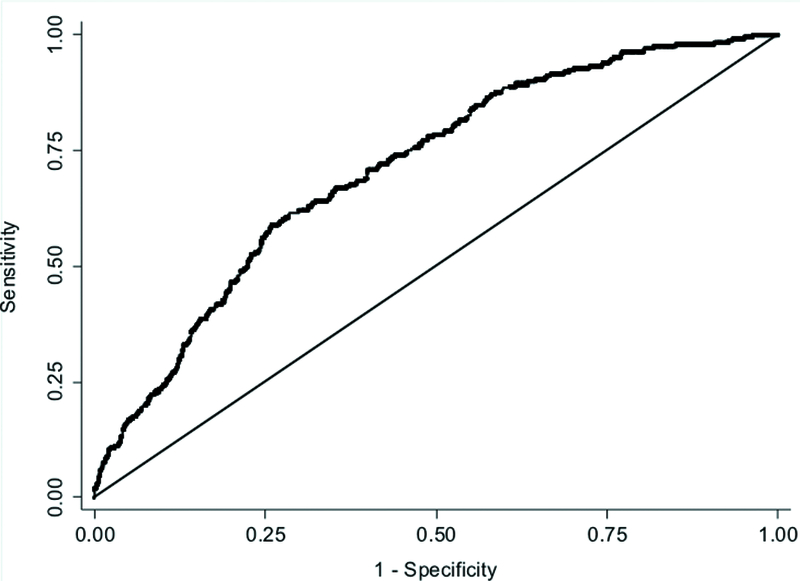
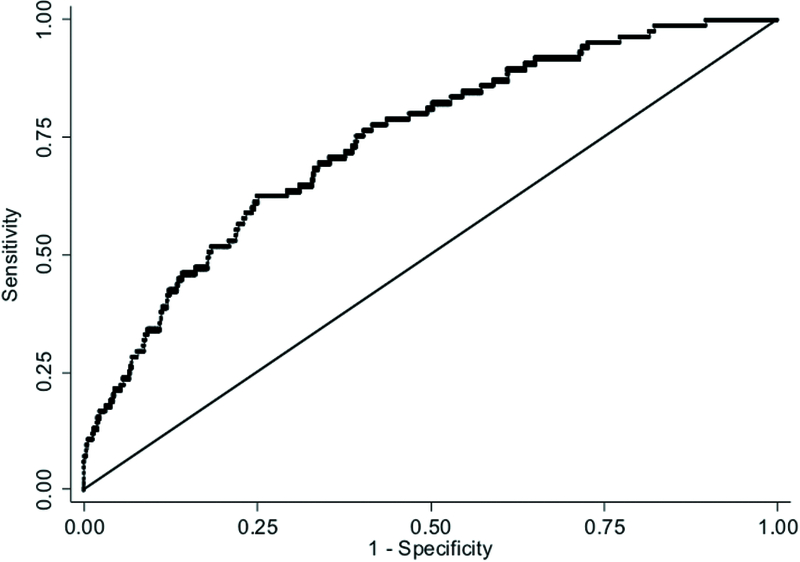
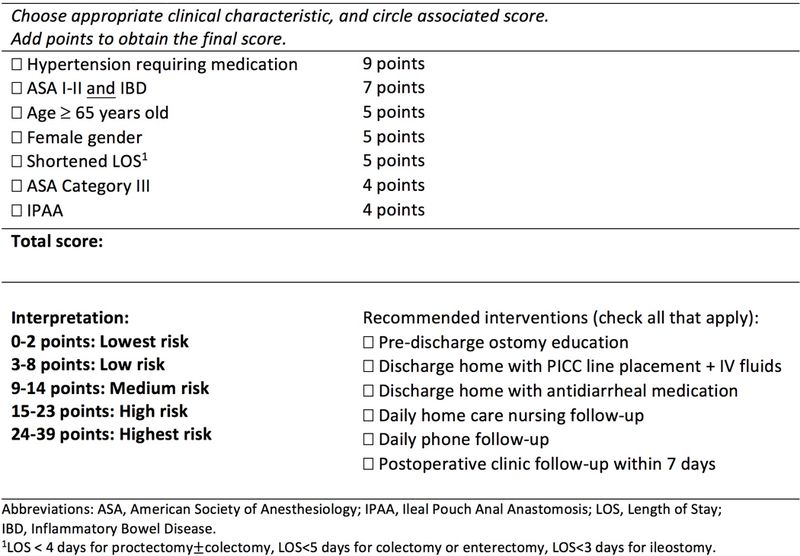
Results: A total of 8064 patients were in the derivation sample, with 2.9% (20.1% overall) readmitted for dehydration. Twenty-five variables were queried, and 7 predictors were identified with points assigned: ASA class III (4 points), female sex (5 points), IPAA (4 points), age ≥65 years (5 points), shortened length of stay (5 points), ASA class I to II with IBD (7 points), and hypertension (9 points). A 39-point, 5-tier risk category scoring system was developed. The model performed well in derivation (area under curve = 0.71) and validation samples (area under curve = 0.74) and passed the Hosmer-Lemeshow goodness-of-fit test.
Limitations: Limitations of this study pertained to those of the American College of Surgeons National Surgical Quality Improvement Program, including a lack of generalizability, lack of ileostomy-specific variables, and inability to capture multiple readmission International Classification of Diseases, 9/10 edition, codes.
Conclusions: The Dehydration Readmission After Ileostomy Prediction score is a validated scoring system that identifies patients at risk for dehydration readmission after ileostomy formation. It is a specific approach to optimize patient factors, implement interventions, and prevent readmissions. See Video Abstract at http://links.lww.com/DCR/A746.
Figures
References
-
- Centers for Medicare & Medicaid Services. Readmissions Reduction Program (HRRP). https://www.cms.gov/medicare/medicare-fee-for-service-payment/acuteinpat.... Published 2016. Accessed November 10, 2016.
-
- Damle RN, Alavi K. Risk factors for 30-d readmission after colorectal surgery: a systematic review. J Surg Res. 2016;200:200–207. - PubMed
-
- Damle RN, Cherng NB, Flahive JM, et al. Clinical and financial impact of hospital readmissions after colorectal resection: predictors, outcomes, and costs. Dis Colon Rectum. 2014;57:1421–1429. - PubMed
-
- Kulaylat AN, Dillon PW, Hollenbeak CS, Stewart DB. Determinants of 30-d readmission after colectomy. J Surg Res. 2015;193:528–535. - PubMed
-
- Orcutt ST, Li LT, Balentine CJ, et al. Ninety-day readmission after colorectal cancer surgery in a Veterans Affairs cohort. J Surg Res. 2016;201:370–377. - PubMed
Publication types
MeSH terms
Grants and funding
LinkOut - more resources
Full Text Sources
Medical
