. 2018 Nov 30;46(21):11466-11476.
doi: 10.1093/nar/gky913.

Streptococcus suis contains multiple phase-variable methyltransferases that show a discrete lineage distribution

Affiliations

Streptococcus suis contains multiple phase-variable methyltransferases that show a discrete lineage distribution

John M Atack et al. Nucleic Acids Res. .

Abstract

Streptococcus suis is a major pathogen of swine, responsible for a number of chronic and acute infections, and is also emerging as a major zoonotic pathogen, particularly in South-East Asia. Our study of a diverse population of S. suis shows that this organism contains both Type I and Type III phase-variable methyltransferases. In all previous examples, phase-variation of methyltransferases results in genome wide methylation differences, and results in differential regulation of multiple genes, a system known as the phasevarion (phase-variable regulon). We hypothesized that each variant in the Type I and Type III systems encoded a methyltransferase with a unique specificity, and could therefore control a distinct phasevarion, either by recombination-driven shuffling between different specificities (Type I) or by biphasic on-off switching via simple sequence repeats (Type III). Here, we present the identification of the target specificities for each Type III allelic variant from S. suis using single-molecule, real-time methylome analysis. We demonstrate phase-variation is occurring in both Type I and Type III methyltransferases, and show a distinct association between methyltransferase type and presence, and population clades. In addition, we show that the phase-variable Type I methyltransferase was likely acquired at the origin of a highly virulent zoonotic sub-population.


Figures
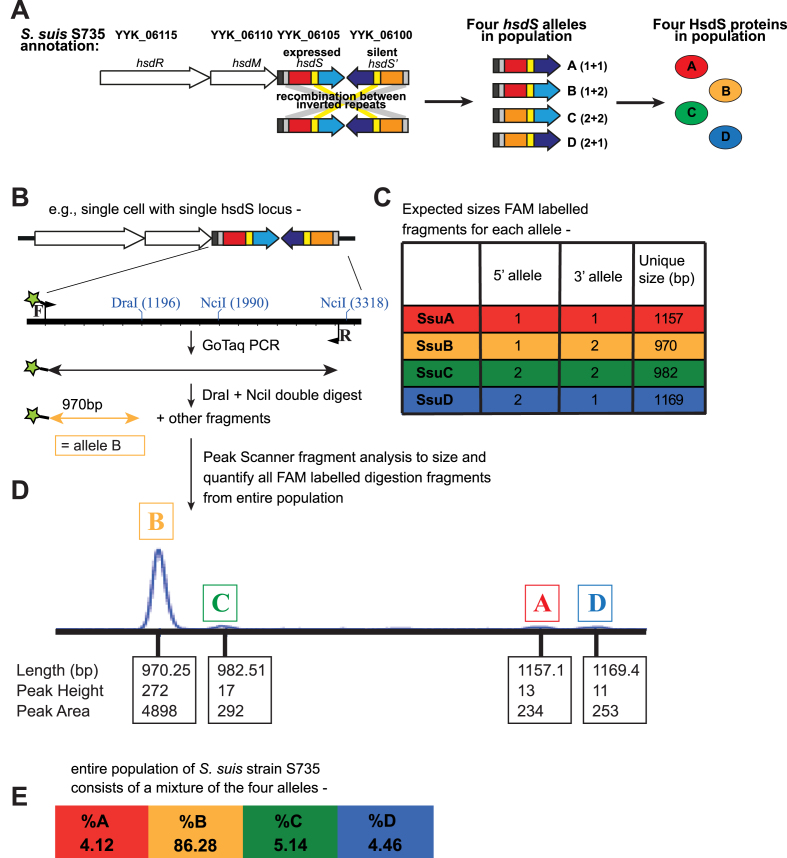
Figure 1.
Figure 1.
Demonstration that Streptococcus suis contains a Type I hsd locus that is able to phase-vary. (A) Illustration of the Type I hsd R-M locus from S. suis strain S735 containing duplicate, variable hsdS specificity loci that contain IRs (yellow and grey boxes). By shuffling between variable 5′ (red and orange regions) and 3′ (blue and purple) TRDs, four unique hsdS genes can be encoded at the hsdS expressed locus immediately downstream of the hsdM gene. This results in the expression of four unique allelic variants of the HsdS protein, all of which are predicted to lead to different methyltransferase specificities; (B) Illustration of FAM-labelled PCR assay used to type and quantify hsdS alleles present in the expressed locus in the S. suis population, with FAM label illustrated as green star on forward primer, and (C) predicted sizes of each allelic variant based on in silico analysis. (D) Following PCR and restriction digest, FAM-labelled fragments are separated and quantified using a Gene Analyser (Life Technologies) and quantified used Peak Scanner software in order to determine the percentage of each allele present in a S. suis population; (E) quantification of hsdS alleles A–D present in a population of S. suis strain S735 following Peak Scanner analysis.
Figure 2.
Figure 2.
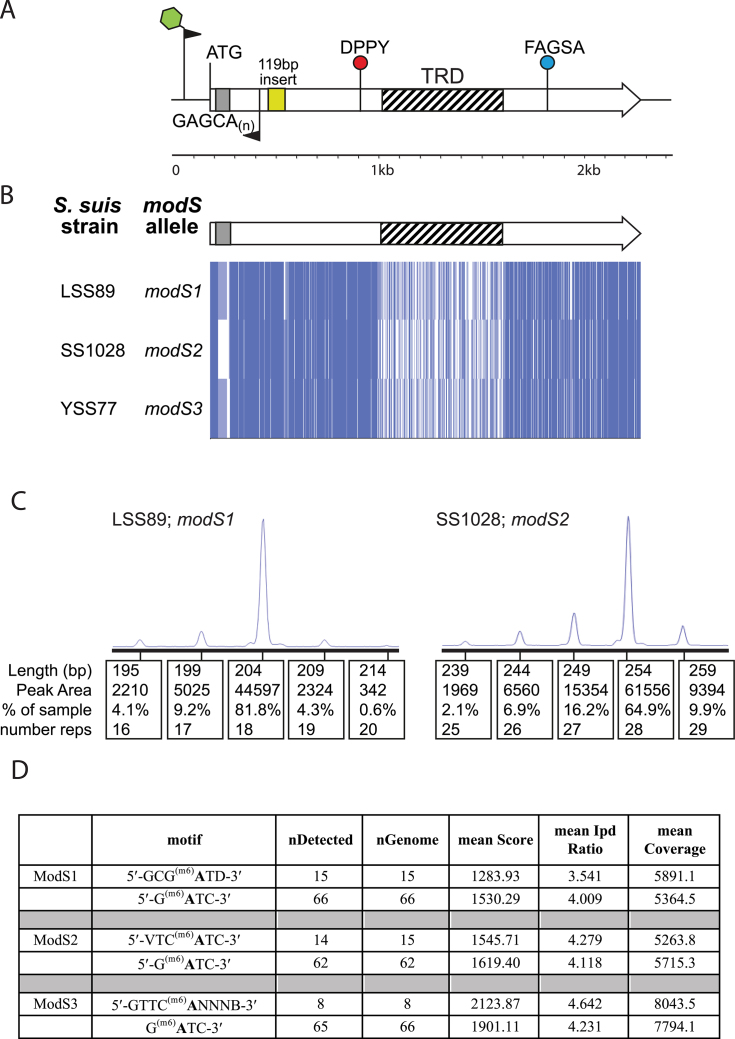
Streptococcus suis contains three allelic variants of the new phase-variable Type III modS gene. (A) Illustration of the Type III mod gene, modS, present in multiple strains of S. suis, showing the location of key features; DPPY—catalytic motif; FXGXG—AdoMet substrate binding motif; repeat tract at 5′ end of gene shown by a grey box and GAGCA(n); 119 bp ‘insert’ sequence shown by yellow box; location of FAM-labelled primer pair used to carry out fragment length analysis (results in panel C) shown, with FAM label illustrated as green star on forward primer; (B) alignment of the three modS alleles identified in this study, alleles modS1, modS2 and modS3, from S. suis strains LSS89, SS1028 and YS77, respectively. Alignments were carried out using ClustalW, and visualized in JalView overview feature; (C) Fragment length analysis PCR and quantification of fragment sizes using a Gene Analyser (Life Technologies) and quantified used Peak Scanner software. Percentage of each peak area indicates the percentage of the total bacterial population containing the number of repeats indicated by that particular peak size (bp); and (D) SMRT sequencing and methylome analysis results of plasmid vectors from Escherichia coli BL21 strains over-expressing one of the three ModS allelic variants, demonstrating the methyltransferase specificity for ModS1 (5′-GCG(m6)ATD-3′), ModS2 (5′-VTC(m6)ATC-3′) and ModS3 (5′-GTTC(m6)ANNNB-3′). Dam methylation (5′-G(m6)ATC-3′) from the same vector is shown underneath the respective ModS data in the table. nDetected = number of sites called as methylated in each plasmid vector; nGenome = number of sites present in each plasmid vector; IPD = interpulse duration. Only motifs that had an IPD > 3.5 are determined to be significant as methylated. Nucleotide codes: N = any nucleotide; B = G, C or T; D = A, G or T; V = A, G or C.
Figure 3.
Figure 3.
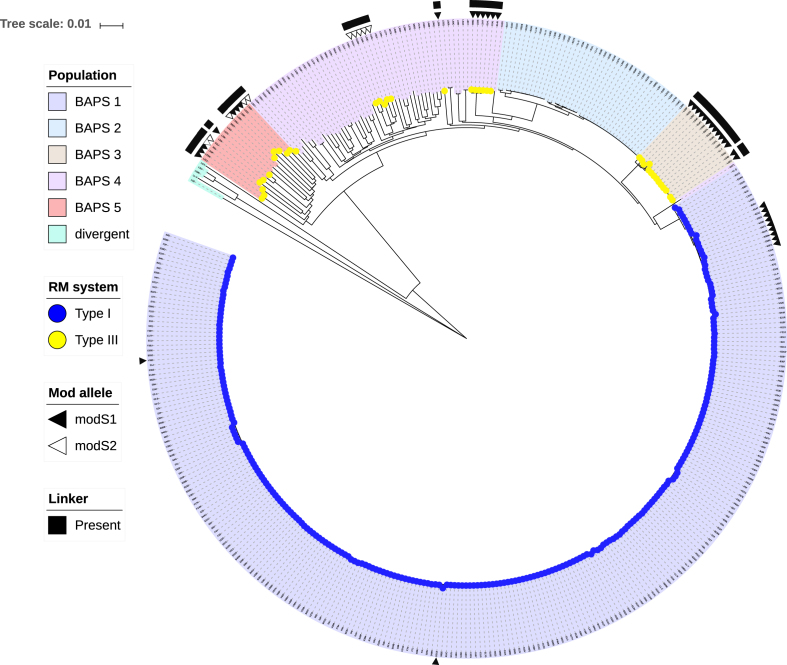
The distribution of the phase-variable Type I and Type III methyltransferases in Streptococcus suis. A neighbour joining tree showing the genetic distance between isolates based on all sites in a core genome of S. suis taken from Weinert et al. (9). BAPS are represented by coloured clades and the presence of the phase-variable Type I methyltransferase (blue) and the presence of the phase-variable Type III methyltransferase (yellow) are indicated by coloured tips. The Type I methyltransferase is restricted to BAPS population 1, which has been shown to be a virulent zoonotic population (9). The Type III methyltransferase (modS) is more interspersed, being found in three different populations, with two populations containing a mixture of the modS1 (filled triangle) and modS2 (empty triangle) alleles (shown as the second column). The Type III methyltransferase with modS1 allele is also found within population 1 but all isolates lack the 119 bp ‘linker’ sequence (presence shown as filled square in the first column). The scale bar indicates the genetic distance (number of substitutions per site).

References

    1. Gottschalk M. Zimmerman J, Karriker L, Rameriz A, Schwartz K, Stevenson G. Diseases of Swine. 2010; 10:Ames, IA: Wiley-Blackwell; 841–855.
    1. Wertheim H.F., Nghia H.D., Taylor W., Schultsz C.. Streptococcus suis: an emerging human pathogen. Clin. Infect. Dis. 2009; 48:617–625. - PubMed
    1. Tang J., Wang C., Feng Y., Yang W., Song H., Chen Z., Yu H., Pan X., Zhou X., Wang H. et al. . Streptococcal toxic shock syndrome caused by Streptococcus suis serotype 2. PLoS Med. 2006; 3:e151. - PMC - PubMed
    1. Goyette-Desjardins G., Auger J.P., Xu J., Segura M., Gottschalk M.. Streptococcus suis, an important pig pathogen and emerging zoonotic agent-an update on the worldwide distribution based on serotyping and sequence typing. Emerg. Microbes Infect. 2014; 3:e45. - PMC - PubMed
    1. Nghia H.D., Tu le T.P., Wolbers M., Thai C.Q., Hoang N.V., Nga T.V., Thao le T.P., Phu N.H., Chau T.T., Sinh D.X. et al. . Risk factors of Streptococcus suis infection in Vietnam. A case-control study. PLoS One. 2011; 6:e17604. - PMC - PubMed

Publication types

MeSH terms