


Ebola Virus Maintenance: If Not (Only) Bats, What Else?
- PMID: 30304789
- PMCID: PMC6213544
- DOI: 10.3390/v10100549
Ebola Virus Maintenance: If Not (Only) Bats, What Else?
Abstract
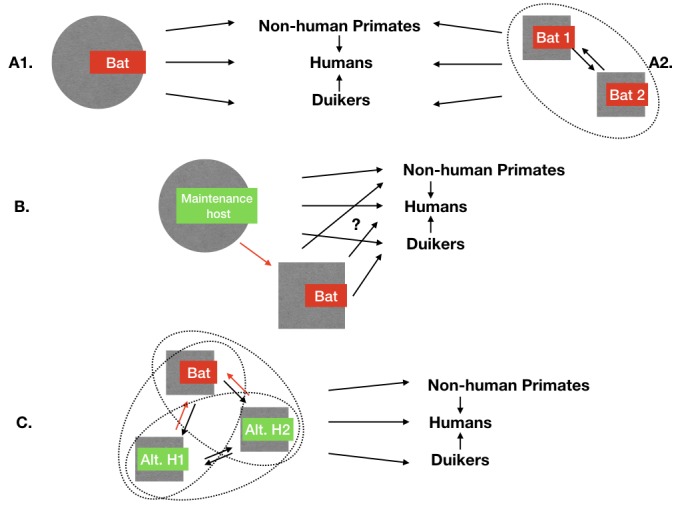
The maintenance mechanisms of ebolaviruses in African forest ecosystems are still unknown, but indirect evidences point at the involvement of some bat species. Despite intense research, the main bat-maintenance hypothesis has not been confirmed yet. The alternative hypotheses of a non-bat maintenance host or a maintenance community including, or not, several bat and other species, deserves more investigation. However, African forest ecosystems host a large biodiversity and abound in potential maintenance hosts. How does one puzzle out? Since recent studies have revealed that several bat species have been exposed to ebolaviruses, the common denominator to these hypotheses is that within the epidemiological cycle, some bats species must be exposed to the viruses and infected by these potential alternative hosts. Under this constraint, and given the peculiar ecology of bats (roosting behaviour, habitat utilisation, and flight mode), we review the hosts and transmission pathways that can lead to bat exposure and infection to ebolaviruses. In contrast to the capacity of bats to transmit ebolaviruses and other pathogens to many hosts, our results indicate that only a limited number of hosts and pathways can lead to the transmission of ebolaviruses to bats, and that the alternative maintenance host, if it exists, must be amongst them. A list of these pathways is provided, along with protocols to prioritise and investigate these alternative hypotheses. In conclusion, taking into account the ecology of bats and their known involvement in ebolaviruses ecology drastically reduces the list of potential alternative maintenance hosts for ebolaviruses. Understanding the natural history of ebolaviruses is a health priority, and investigating these alternative hypotheses could complete the current effort focused on the role of bats.
Keywords: Africa; bat; community ecology; ebola virus; filovirus; maintenance host; transmission pathways.
Conflict of interest statement
No conflict of interest.
Figures
References
-
- Kuhn J.H., Becker S., Ebihara H., Geisbert T.W., Johnson K.M., Kawaoka Y., Lipkin W.I., Negredo A.I., Netesov S.V., Nichol S.T., et al. Proposal for a revised taxonomy of the family filoviridae: Classification, names of taxa and viruses, and virus abbreviations. Arch. Virol. 2010;155:2083–2103. doi: 10.1007/s00705-010-0814-x. - DOI - PMC - PubMed
-
- Gonzalez J.P., Pourrut X., Leroy E. Ebolavirus and other filoviruses. In: Childs J.E., Mackenzie J.S., Richt J.A., editors. Wildlife and Emerging Zoonotic Diseases: The Biology, Circumstances and Consequences of Cross-Species Transmission. Springer; Heidelberg, Germany: New York, NY, USA: 2007. pp. 363–388.
Publication types
MeSH terms
LinkOut - more resources
Full Text Sources
Medical
