


The Next Generation Scientist program: capacity-building for future scientific leaders in low- and middle-income countries
- PMID: 30305069
- PMCID: PMC6180641
- DOI: 10.1186/s12909-018-1331-y
The Next Generation Scientist program: capacity-building for future scientific leaders in low- and middle-income countries
Abstract
Background: Scientific and professional development opportunities for early career scientists in low- and middle- income countries (LMICs) are limited and not consistent. There is a disproportionately low number of biomedical and clinical researchers in LMIC's relative to their high burden of disease, a disparity that is aggravated by emigration of up to 70% of scientists from their countries of birth for education and employment elsewhere. To help address this need, a novel University-accredited, immersive fellowship program was established by a large public-academic-private network. We sought to describe the program and summarize progress and lessons learned over its first 7-years.
Methods: Hallmarks of the program are a structured learning curriculum and bespoke research activities tailored to the needs of each fellow. Research projects expose the scientists to state-of-the-art methodologies and leading experts in their fields while also ensuring that learnings are implementable within their home infrastructure. Fellows run seminars on drug discovery and development that reinforce themes of scientific leadership and teamwork together with practical modules on addressing healthcare challenges within their local systems. Industry mentors achieve mutual learning to better understand healthcare needs in traditionally underserved settings. We evaluated the impact of the program through an online survey of participants and by assessing research output.
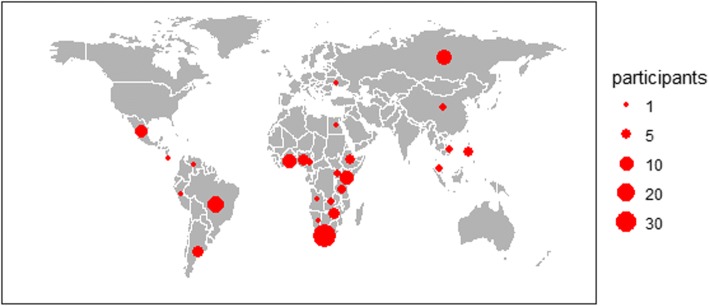
Results: More than 140 scientists and clinicians from 25 countries participated over the 7-year period. Evaluation revealed strong evidence of knowledge and skills transfer, and beneficial self-reported impact on fellow's research output and career trajectories. Examples of program impact included completion of post-graduate qualifications; establishment and implementation of good laboratory- and clinical- practice mechanisms; and becoming lead investigators in local programs. There was a high retention of fellows in their home countries (> 75%) and an enduring professional network among the fellows and their mentors.
Conclusions: Our experience demonstrates an example for how multi-sectoral partners can contribute to scientific and professional development of researchers in LMICs and supports the idea that capacity-building efforts should be tailored to the specific needs of beneficiaries to be maximally effective. Lessons learned may be applied to the design and conduct of other programs to strengthen science ecosystems in LMICs.
Keywords: Capability development; Capacity development; Early career researcher development; Education; Fellowship; Postgraduate research; Public health; Research and Development.
Conflict of interest statement
Ethics approval and consent to participate
This report was categorized as a “quality assurance and practice experience report”, and a specific ethics committee approval was deemed unnecessary according to Swiss national guidelines (
Consent for publication
All respondents confirmed their written consent to participate in the evaluation of the program. Respondents who are cited in Table 4 and who are identifiable via their published literature reviewed and edited the text describing their work, and provided their written approval and specific written permission for how their experience in the program has been described in this manuscript.
Competing interests
GP, AK, MG, FM, JS, BT were employees of Novartis at the time of this study. GP is an employee of CP+ Associates GmbH, a consulting firm focused on scientific capability development in low- and middle-income countries.
Publisher’s Note
Springer Nature remains neutral with regard to jurisdictional claims in published maps and institutional affiliations.
Figures
References
MeSH terms
LinkOut - more resources
Full Text Sources
