. 2018 Nov 15;201(10):3058-3072.
doi: 10.4049/jimmunol.1800597. Epub 2018 Oct 10.

Dicer-2 Regulates Resistance and Maintains Homeostasis against Zika Virus Infection in Drosophila

Affiliations

Dicer-2 Regulates Resistance and Maintains Homeostasis against Zika Virus Infection in Drosophila

Sneh Harsh et al. J Immunol. .

Abstract

Zika virus (ZIKV) outbreaks pose a massive public health threat in several countries. We have developed an in vivo model to investigate the host-ZIKV interaction in Drosophila We have found that a strain of ZIKV replicates in wild-type flies without reducing their survival ability. We have shown that ZIKV infection triggers RNA interference and that mutating Dicer-2 results in enhanced ZIKV load and increased susceptibility to ZIKV infection. Using a flavivirus-specific Ab, we have found that ZIKV is localized in the gut and fat body cells of the infected wild-type flies and results in their perturbed homeostasis. In addition, Dicer-2 mutants display severely reduced insulin activity, which could contribute toward the increased mortality of these flies. Our work establishes the suitability of Drosophila as the model system to study host-ZIKV dynamics, which is expected to greatly advance our understanding of the molecular and physiological processes that determine the outcome of this disease.


Figures

Figure 1.
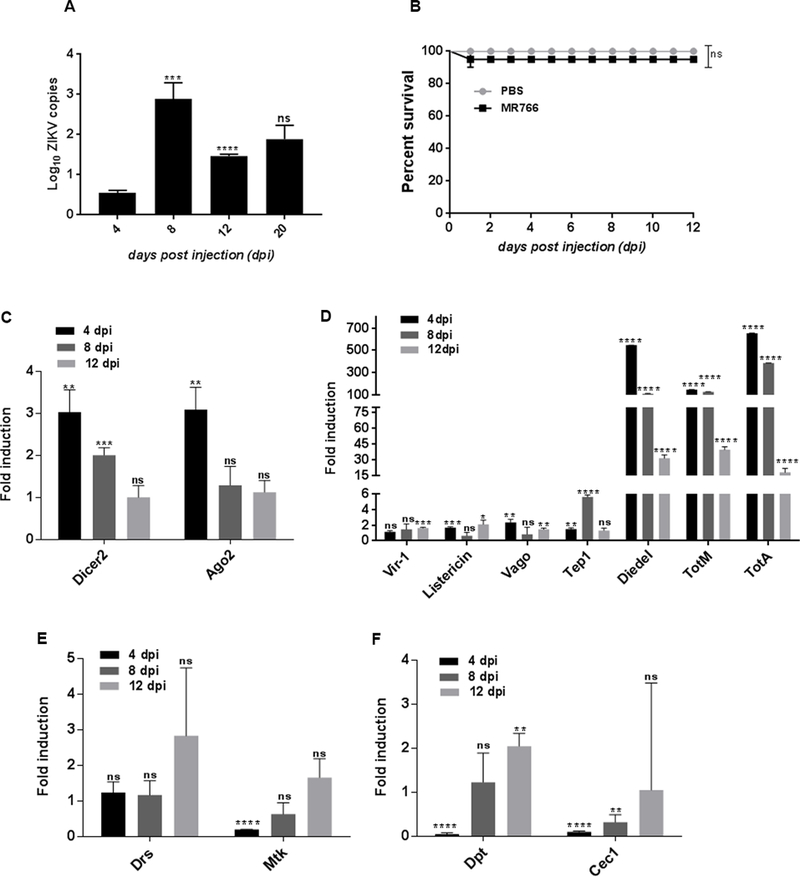
Figure 1.. ZIKV replicates in Drosophila adult flies and triggers RNAi and the expression of Turandot genes.
(A) Drosophila female w1118 adult flies were injected with ZIKV (African strain MR766; 110 million PFUs/ml) and ZIKV load was estimated at several days post injection (dpi). Absolute ZIKV copy numbers were quantified via qRT-PCR. (B) Survival of w1118 adult flies after intrathoracic injection with ZIKV was monitored at 24-hour intervals for 12 days. Injections with PBS served as negative controls. Grey and black lines depicting the survival of PBS and ZIKV-injected flies are superimposed, but for clarity, they are shown in parallel. Data represent the mean ± SD of three biological replicates of at least 20 female flies. Log-rank (Mantel-Cox) was used for statistical analysis; ns denotes no significant differences between experimental treatments. (C-F) ZIKV-infected flies were processed for RNA analysis and gene expression levels were determined by quantitative RT-PCR at 4, 8 and 12dpi. (C) Transcript levels of RNAi machinery, Ago-2 and Dicer-2. (D) Transcript levels of JAK/STAT gene targets including the Turandot (Tot) genes TotA and TotM, the antiviral cytokine Diedel, the thioester-containing protein Tep1, and the antiviral STAT regulated target genes Vago, Vir-1 and Listericin. (E) Transcript levels of Toll signaling gene readouts Drosomycin (Drs) and Metchnikowin (Mtk) throughout the stages of infection. (F) Transcript levels of Imd signaling gene readouts Diptericin (Dpt) and Cecropin (Cec) in flies responding to ZIKV infection. All data were normalized to the housekeeping gene RpL32 shown relative to wild-type flies injected with PBS (sterile control). Three independent experiments were carried out with 10 flies per sample in triplicates (*p=0.0215, **p=0.002, ***p=0.0006, ****p<0.0001, 0.0002). Bars represent the mean ± SD and ns denotes no significant differences between experimental treatments. Statistical analysis was performed using Student’s t-test.
Figure 2.
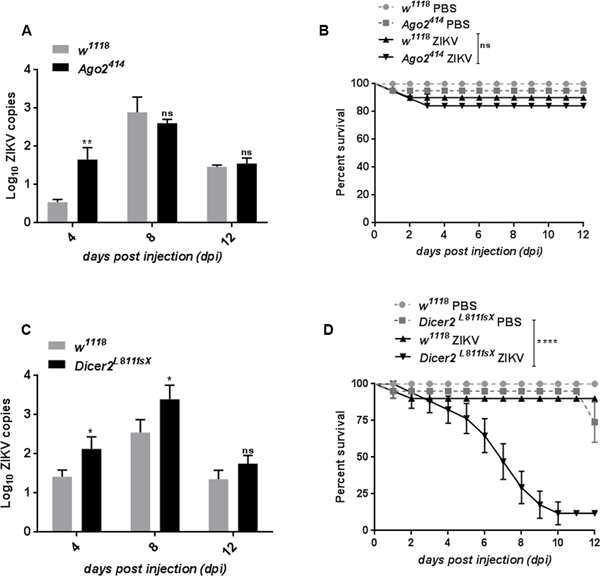
Figure 2.. Inactivating Dicer-2 results in enhanced ZIKV load and compromised fly survival.
ZIKV load and survival in Ago2414 and Dicer2L811fsX loss-of-function mutant flies and w1118 background controls. (A) Quantitative RT-PCR analysis depicting ZIKV load in Ago-2 mutant flies compared to the w1118 controls. (B) Survival analysis of w1118 and Ago-2 mutant flies injected with PBS and ZIKV. (C) ZIKV load in Dicer-2 mutant compared to the wild-type control flies. (D) Survival analysis of w1118 and Dicer-2 mutant flies injected with PBS and ZIKV. All ZIKV load data represent the mean and standard deviation of three independent experiments in triplicates (*p=0.05, **p=0.04). For survival experiments, three groups of 20 female flies from each fly strain were injected with ZIKV and fly survival was monitored at 24-hour intervals and up to 12 dpi. Log-rank (Mantel-Cox) was used for survival data analysis (****p<0.0001; ns denotes no significant differences between experimental treatments).
Figure 3.
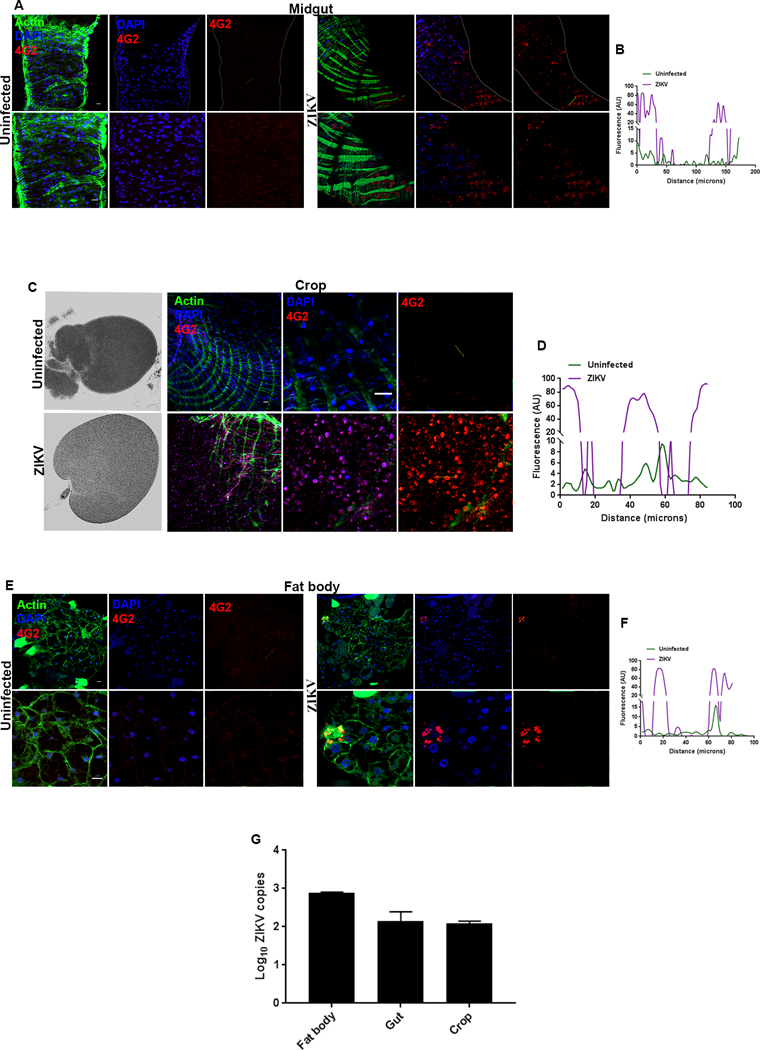
Figure 3.. Midgut, crop and fat body of ZIKV infected flies shows flavivirus-specific 4G2 expression.
Representative midgut, crop and fat body images from uninfected w1118 adult flies and flies infected with ZIKV at 8 days post injection (8 dpi). The expression of ZIKV was detected through anti-flavivirus antibody, 4G2. (A) The first panel shows dissected midgut from uninfected w1118 flies along with the enlarged images in the lower panel, while the second panel shows dissected midgut from ZIKV infected adult flies. (B) Quantification of the 4G2 fluorescence intensity in midgut in uninfected and ZIKV-infected flies. The intensity plot corresponds to a line connecting two points (marked by yellow line in the images). Fluorescence intensity is represented in pseudocolors where magenta marks the intensity for ZIKV infection and green for uninfected control (AU, arbitrary unit). (C) Expression of 4G2 in the crop (organ in the digestive tract) in uninfected controls and ZIKV-infected adult flies. (D) Quantification of the 4G2 fluorescence intensity in crop from uninfected and ZIKV-infected flies. The intensity plot corresponds to a line connecting two points (marked by yellow line in the images; AU, arbitrary unit). (E) Expression of 4G2 in the fat body tissue from uninfected controls and ZIKV-injected adult flies. (F) Measurement of fluorescence intensity of 4G2 expression in the fat body from uninfected controls and ZIKV-injected flies (AU, arbitrary unit). (G) ZIKV load in the fat body, gut and crop tissue from ZIKV-injected flies (8 dpi). In all images, 4G2 was marked in red, Actin in green and nuclei were marked in blue. Scale bars: 100 microns.
Figure 4.
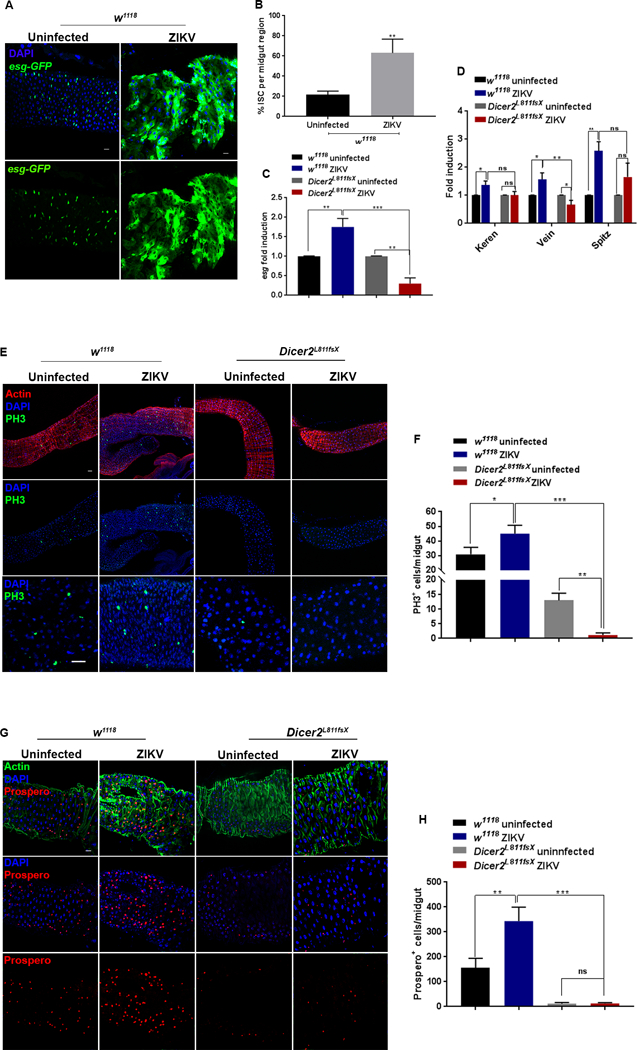
Figure 4.. ZIKV-infected Dicer-2 mutant flies fail to trigger infection-induced intestinal stem cell proliferation.
(A) Representative images of gut in ZIKV infected wild-type (w1118) flies at 8 days post injection (8 dpi) and in uninfected controls. Intestinal stem cells (ISC) were marked by the expression of an esgGal4UAS-GFP reporter. (B) Percentage of esg positive cells or ISC per midgut region. (C) Quantitative RT-PCR analysis showing the mRNA level of escargot in the midgut of uninfected and ZIKV-infected wild-type and Dicer-2 mutant flies. (D) Quantitative RT-PCR analysis of genes encoding EGFR signaling ligands, Keren, Vein and Spitz in midgut of the uninfected controls and ZIKV-infected wild-type and Dicer-2 mutant flies. (E) Representative images of midgut in uninfected and ZIKV-infected wild-type (w1118) and Dicer-2 mutant flies. Midgut tissues were stained with anti-PH3 (green) to mark the mitotically active cells. Cytoarchitecture was marked with Actin (red) and nuclei were stained with DAPI (blue). (F) Quantification of PH3-positive cells per midgut tissue in uninfected and ZIKV-infected wild-type and Dicer-2 mutant flies. (G) Proportion of enteroendocrine (EE) cells in the midgut of uninfected and ZIKV-infected wild-type and Dicer-2 mutant flies. EE cells were stained with anti-Prospero antibody (red). Actin was marked in green while nuclei were stained with DAPI (blue). (H) Quantification of Prospero positive cells per midgut tissue. Levels of mRNA were normalized against RpL32 and three independent experiments were performed. In all graphs, bars represent mean ± SD. Statistical analysis was performed using Student’s t-test (*p<0.05, **p < 0.05, ***p<0.05); ns denotes no significant differences between experimental treatments. Scale bars: 100 microns.
Figure 5.
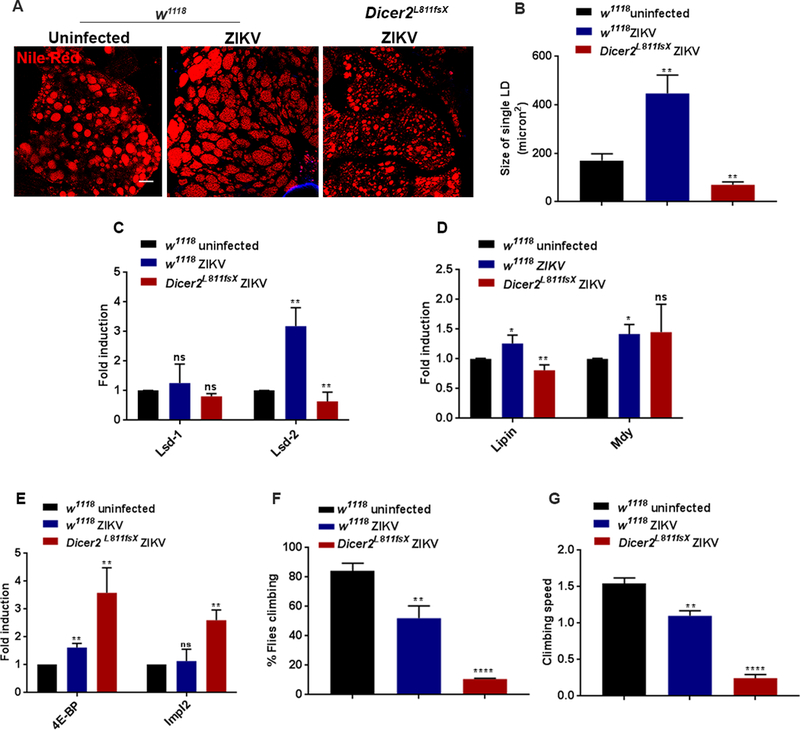
Figure 5.. The increased susceptibility of Dicer-2 mutant flies to ZIKV infection is linked tolipodystrophy and Impl2-induced wasting.
(A) Representative images of fat body lipid droplets in ZIKV-infected wild-type (w1118) flies, Dicer-2 mutants and uninfected background controls at 8 days post injection (8 dpi). The neutral lipids were marked with Nile Red. (B) Quantification of lipid droplet size in ZIKV infected wild-type and Dicer-2 mutant flies as well as in uninfected controls. (C-D) Expression analysis of lipid-metabolism related genes in ZIKV-infected w1118 flies and Dicer-2 mutants, and in uninfected w1118 individuals. (C) Lsd-1 and Lsd-2 were used as read-outs for lipolysis, while (D) Lipin and mdy were used as read-outs for lipogenesis. (E) Quantitative RT-PCR analysis of the Foxo target gene 4E-BP and insulin antagonist Impl2 in ZIKV-infected wild-type (w1118) flies, Dicer-2 mutants and uninfected background controls. (F, G) Climbing ability and speed of climbing in uninfected wild-type controls and ZIKV-infected wild-type and Dicer-2 mutant flies. Levels of mRNA were normalized against RpL32 and three independent experiments were performed. In all graphs, bars represent mean ± SD. Statistical analysis was performed using Student’s t-test (*p<0.05, **p < 0.05, **** p<0.0001); ns denotes no significant differences between experimental treatments. Scale bars: 100 microns.

References

    1. Musso D, and Gubler DJ. 2016. Zika Virus. Clin. Microbiol. Rev. 29: 487–524. - PMC - PubMed
    1. Wikan N, and Smith DR. 2016. Zika virus: history of a newly emerging arbovirus. Lancet. Infect. Dis. 16: e119–e126. - PubMed
    1. Medzhitov R 2007. Recognition of microorganisms and activation of the immune response. Nature 449: 819–826. - PubMed
    1. Buchon N, Silverman N, and Cherry S. 2014. Immunity in Drosophila melanogaster--from microbial recognition to whole-organism physiology. Nat. Rev. Immunol. 14: 796–810. - PMC - PubMed
    1. Wang XH, Aliyari R, Li WX, Li HW, Kim K, Carthew R, Atkinson P, and Ding SW. 2006. RNA interference directs innate immunity against viruses in adult Drosophila. Science 312: 452–454. - PMC - PubMed

Publication types

MeSH terms