


Energy Stress-Mediated Cytotoxicity in Tuberous Sclerosis Complex 2-Deficient Cells with Nelfinavir and Mefloquine Treatment
- PMID: 30308940
- PMCID: PMC6210998
- DOI: 10.3390/cancers10100375
Energy Stress-Mediated Cytotoxicity in Tuberous Sclerosis Complex 2-Deficient Cells with Nelfinavir and Mefloquine Treatment
Abstract
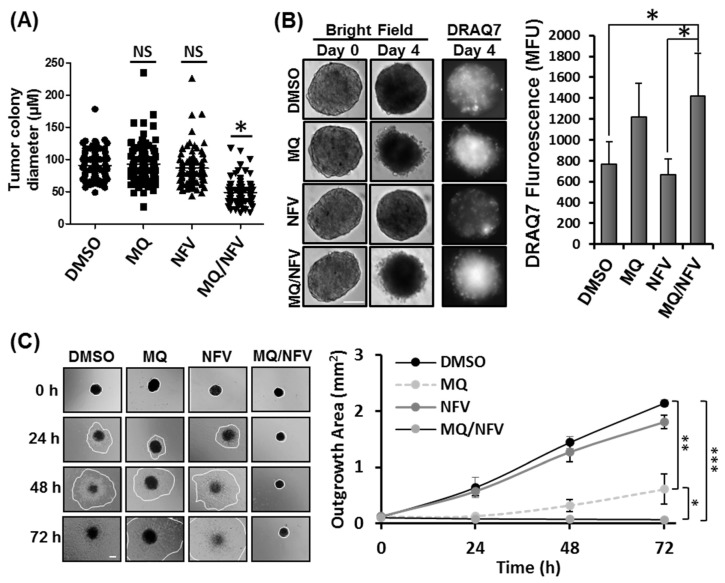
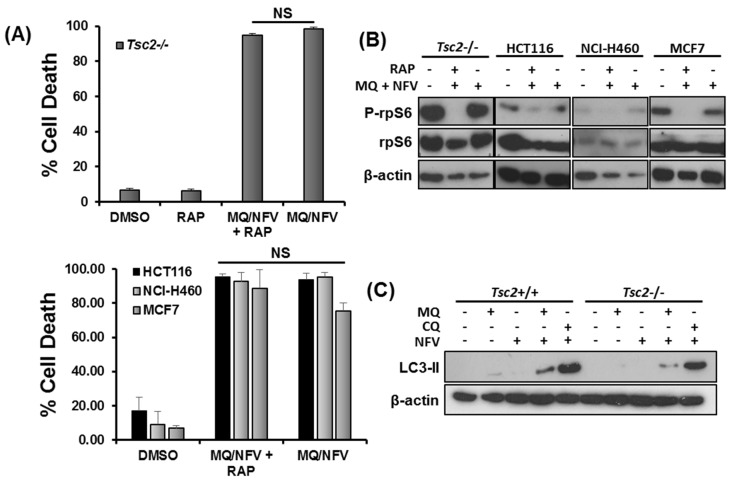
To find new anti-cancer drug therapies, we wanted to exploit homeostatic vulnerabilities within Tuberous Sclerosis Complex 2 (TSC2)-deficient cells with mechanistic target of rapamycin complex 1 (mTORC1) hyperactivity. We show that nelfinavir and mefloquine synergize to selectively evoke a cytotoxic response in TSC2-deficient cell lines with mTORC1 hyperactivity. We optimize the concentrations of nelfinavir and mefloquine to a clinically viable range that kill cells that lack TSC2, while wild-type cells tolerate treatment. This new clinically viable drug combination causes a significant level of cell death in TSC2-deficient tumor spheroids. Furthermore, no cell recovery was apparent after drug withdrawal, revealing potent cytotoxicity. Transcriptional profiling by RNA sequencing of drug treated TSC2-deficient cells compared to wild-type cells suggested the cytotoxic mechanism of action, involving initial ER stress and an imbalance in energy homeostatic pathways. Further characterization revealed that supplementation with methyl pyruvate alleviated energy stress and reduced the cytotoxic effect, implicating energy deprivation as the trigger of cell death. This work underpins a critical vulnerability with cancer cells with aberrant signaling through the TSC2-mTORC1 pathway that lack flexibility in homeostatic pathways, which could be exploited with combined nelfinavir and mefloquine treatment.
Keywords: ER stress; TSC; cancer therapy; energy homeostasis; mTOR; mefloquine; nelfinavir.
Conflict of interest statement
The authors declare no conflict of interest. RE is non-executive director of Biostatus Ltd., the vendor of DRAQ7.The funders had no role in the design of the study; in the collection, analyses, or interpretation of data; in the writing of the manuscript, and in the decision to publish the results.
Figures



References
-
- Tee A.R., Fingar D.C., Manning B.D., Kwiatkowski D.J., Cantley L.C., Blenis J. Tuberous sclerosis complex-1 and -2 gene products function together to inhibit mammalian target of rapamycin (mTOR)-mediated downstream signaling. Proc. Natl. Acad. Sci. USA. 2002;99:13571–13576. doi: 10.1073/pnas.202476899. - DOI - PMC - PubMed
Grants and funding
LinkOut - more resources
Full Text Sources
Miscellaneous
