


Multidrug resistant Pseudomonas aeruginosa in Estonian hospitals
- PMID: 30309321
- PMCID: PMC6182868
- DOI: 10.1186/s12879-018-3421-1
Multidrug resistant Pseudomonas aeruginosa in Estonian hospitals
Abstract
Background: We aimed to identify the main spreading clones, describe the resistance mechanisms associated with carbapenem- and/or multidrug-resistant P. aeruginosa and characterize patients at risk of acquiring these strains in Estonian hospitals.
Methods: Ninety-two non-duplicated carbapenem- and/or multidrug-resistant P. aeruginosa strains were collected between 27th March 2012 and 30th April 2013. Clinical data of the patients was obtained retrospectively from the medical charts. Clonal relationships of the strains were determined by whole genome sequencing and analyzed by multi-locus sequence typing. The presence of resistance genes and beta-lactamases and their origin was determined. Combined-disk method and PCR was used to evaluate carbapenemase and metallo-beta-lactamase production.
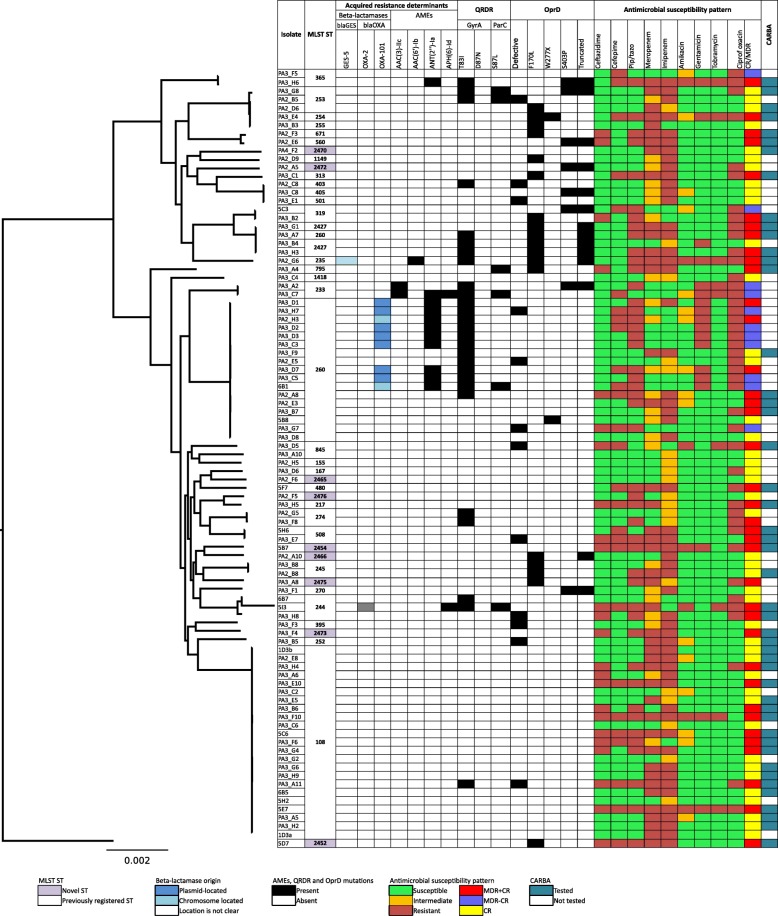
Results: Forty-three strains were carbapenem-resistant, 11 were multidrug-resistant and 38 were both carbapenem- and multidrug-resistant. Most strains (54%) were isolated from respiratory secretions and caused an infection (74%). Over half of the patients (57%) were ≥ 65 years old and 85% had ≥1 co-morbidity; 96% had contacts with healthcare and/or had received antimicrobial treatment in the previous 90 days. Clinically relevant beta-lactamases (OXA-101, OXA-2 and GES-5) were found in 12% of strains, 27% of which were located in plasmids. No Ambler class B beta-lactamases were detected. Aminoglycoside modifying enzymes were found in 15% of the strains. OprD was defective in 13% of the strains (all with CR phenotype); carbapenem resistance triggering mutations (F170 L, W277X, S403P) were present in 29% of the strains. Ciprofloxacin resistance correlated well with mutations in topoisomerase genes gyrA (T83I, D87N) and parC (S87 L). Almost all strains (97%) with these mutations showed ciprofloxacin-resistant phenotype. Multi-locus sequence type analysis indicated high diversity at the strain level - 36 different sequence types being detected. Two sequence types (ST108 (n = 23) and ST260 (n = 18)) predominated. Whereas ST108 was associated with localized spread in one hospital and mostly carbapenem-resistant phenotype, ST260 strains occurred in all hospitals, mostly with multi-resistant phenotype and carried different resistance genotype/machinery.
Conclusions: Diverse spread of local rather than international P. aeruginosa strains harboring multiple chromosomal mutations, but not plasmid-mediated Ambler class B beta-lactamases, were found in Estonian hospitals.
Trial registration: This trial was registered retrospectively in ClinicalTrials.gov ( NCT03343119 ).
Keywords: Beta-lactamases; Carbapenem resistance; Outbreak; WGS (whole-genome sequencing).
Conflict of interest statement
Ethics approval and consent to participate
The study protocol was approved with a waiver of informed consent by the Ethics Committee of the University of Tartu.
Consent for publication
Not applicable.
Competing interests
The authors declare that they have no competing interests.
Publisher’s Note
Springer Nature remains neutral with regard to jurisdictional claims in published maps and institutional affiliations.
Figures
References
-
- Gomez-Zorrilla S, Camoez M, Tubau F, Periche E, Canizares R, Dominguez MA, Ariza J, Pena C. Antibiotic pressure is a major risk factor for rectal colonization by multidrug-resistant Pseudomonas aeruginosa in critically ill patients. Antimicrob Agents Chemother. 2014;58(10):5863–5870. doi: 10.1128/AAC.03419-14. - DOI - PMC - PubMed
Publication types
MeSH terms
Substances
Associated data
Grants and funding
LinkOut - more resources
Full Text Sources
Medical
Miscellaneous
