


Silyl-mediated photoredox-catalyzed Giese reaction: addition of non-activated alkyl bromides
- PMID: 30310596
- PMCID: PMC6115631
- DOI: 10.1039/c8sc02253d
Silyl-mediated photoredox-catalyzed Giese reaction: addition of non-activated alkyl bromides
Abstract
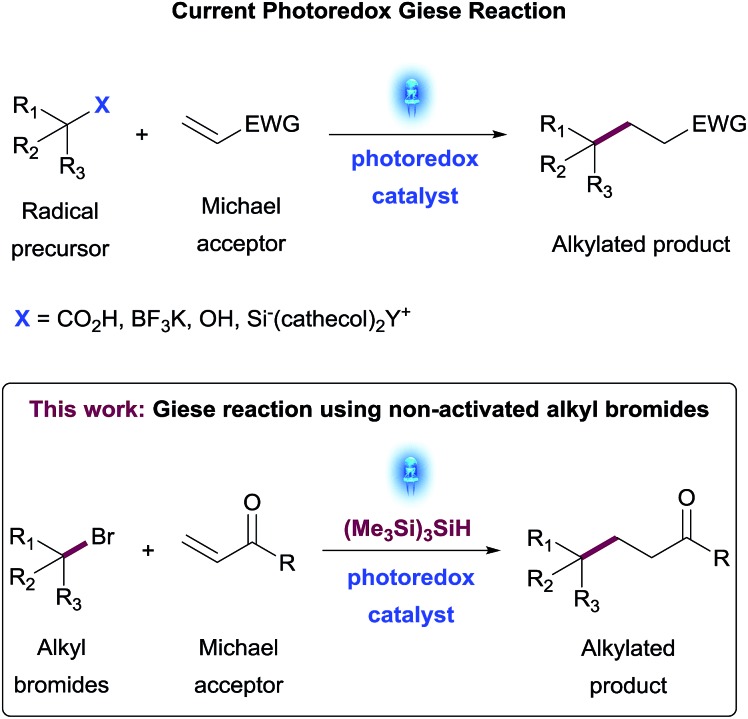
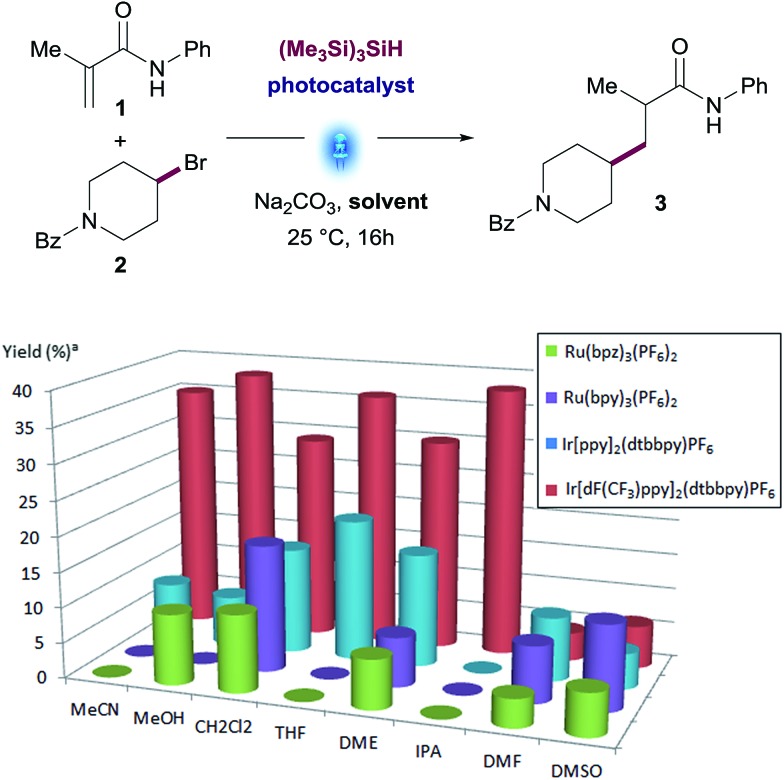
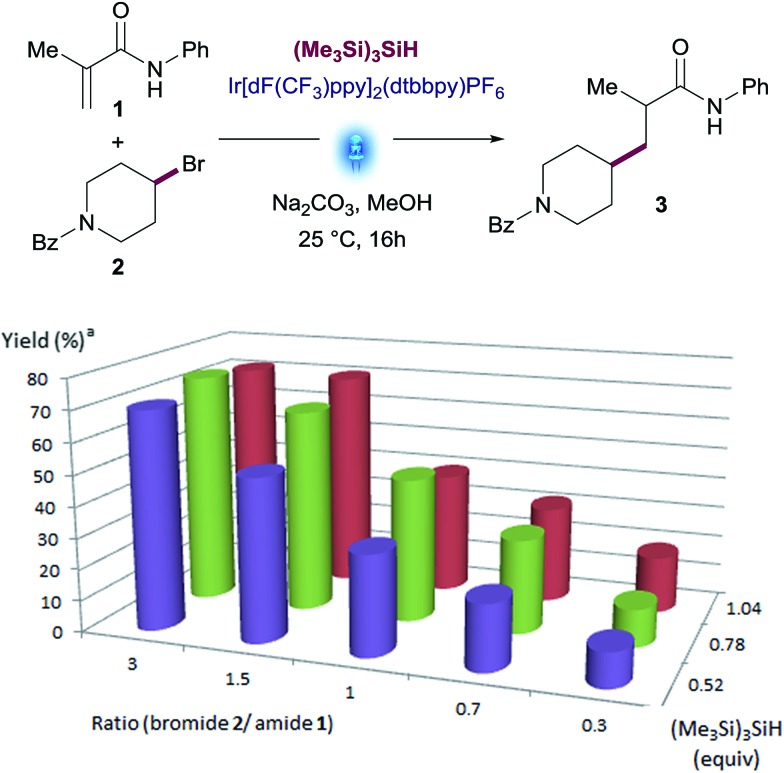
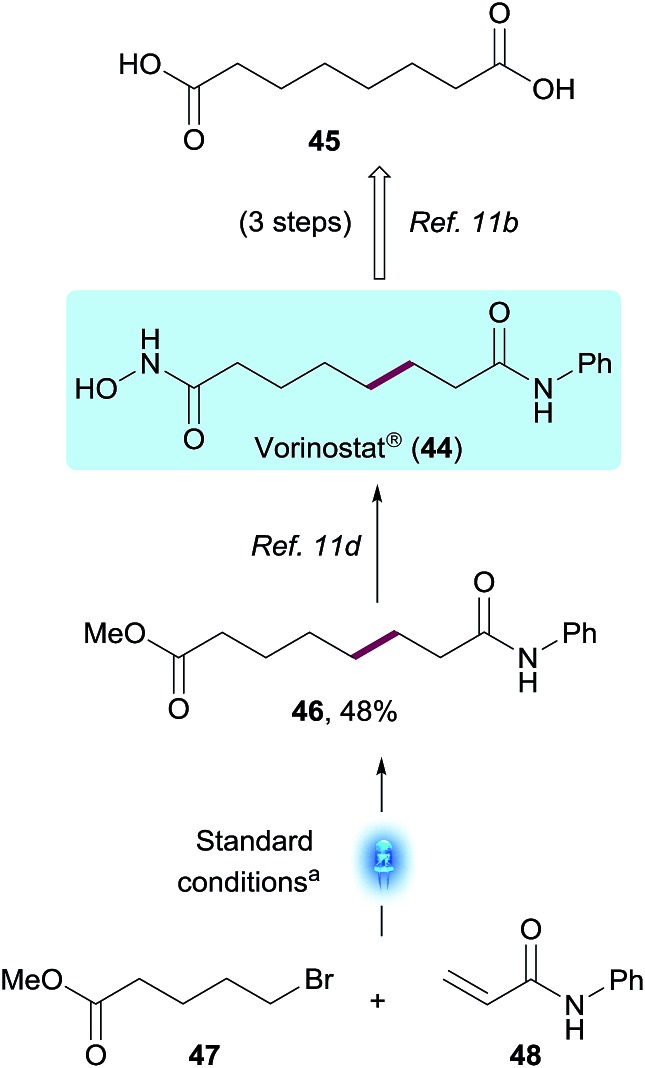
The emergence of photoredox catalysis has enabled the discovery of mild and efficient conditions for the generation of a variety of radical reaction platforms. Herein is disclosed the development of a conjugate addition reaction of non-activated alkyl bromides to Michael acceptors under visible-light photoredox catalysis. Optimization of the reaction was achieved using high-throughput experimentation (HTE) tools to enable the identification of mild, general and practical reaction conditions. A diverse set of alkyl bromides was successfully added to cyclic or acyclic α,β-unsaturated esters and amides. The features of this transformation allowed also access to a key intermediate of Vorinostat®, an HDAC inhibitor used to fight cancer and HIV.
Figures
References
-
- Cernak T., Dykstra K. D., Tyagarajan S., Vachal P., Krska S. W. Chem. Soc. Rev. 2016;45:546. - PubMed
- Roughley S. D., Jordan A. M. J. Med. Chem. 2011;54:3451. - PubMed
- Jordan A. M., Roughley S. D. Drug Discovery Today. 2009;14:731. - PubMed
- Carey J. S., Laffan D., Thomson C., Williams M. T. Org. Biomol. Chem. 2006:2337. - PubMed
-
-
For selected reviews on 1,4-conjugate additions, see:
- Perlmutter P., Conjugate Addition Reactions in Organic Synthesis, Pergamon, Oxford, 1992.
- Schmalz H.-G., in Comprehensive Organic Synthesis, ed. B. M. Trost and I. Fleming, Pergamon Press, Oxford, 1991, vol. 4, ch. 1.5.
-
-
-
For selected reviews:
- Schultz D. M., Yoon T. P. Science. 2014;343:941. - PMC - PubMed
- Prier C. K., Rankic D. A., MacMillan D. W. C. Chem. Rev. 2013;113:5322. - PMC - PubMed
- Yoon T. P. ACS Catal. 2013;3:895. - PMC - PubMed
- Xi Y., Yi H., Lei A. Org. Biomol. Chem. 2013;11:2387. - PubMed
- Reckenthler M., Griesbeck A. G. Adv. Synth. Catal. 2013;355:2727.
- Garlets Z. J., Nguyen J. D., Stephenson C. R. J. Isr. J. Chem. 2014;54:351. - PMC - PubMed
- Douglas J. J., Nguyen J. D., Cole K. P., Stephenson C. R. J. Aldrichimica Acta. 2014;47:15.
- Nicewicz D. A., Nguyen T. M. ACS Catal. 2014;4:355.
-
-
- Giese B., Dupuis J. Angew. Chem., Int. Ed. Engl. 1983;22:622.
- Giese B. Angew. Chem., Int. Ed. Engl. 1983;22:753.
- Giese B., Gonzalez-Gomez J. A., Witzel T. Angew. Chem., Int. Ed. Engl. 1984;23:69.
- Jasperse C. P., Curran D. P., Fevig T. L., Chem. Rev., 1991, 91 , 1237 , For seminal work on the addition of alkyl radicals to Michael acceptors involving a photoactive metal complex see: .
- Okada K., Okamoto K., Morita N., Okubo K., Oda M., J. Am. Chem. Soc., 1991, 113 , 9401 , For a specific example involving an alkyl bromide under photoredox conditions, see: .
- Zhou S., Zhang D., Sun Y., Li R., Zhang W., Li A. Adv. Synth. Catal. 2014;356:2867.
LinkOut - more resources
Full Text Sources
