


Opioid Agonist Treatment and Improved Outcomes at Each Stage of the HIV Treatment Cascade in People Who Inject Drugs in Ukraine
- PMID: 30312275
- PMCID: PMC8215524
- DOI: 10.1097/QAI.0000000000001827
Opioid Agonist Treatment and Improved Outcomes at Each Stage of the HIV Treatment Cascade in People Who Inject Drugs in Ukraine
Abstract
Background: The HIV treatment cascade is a crucial tool to guide HIV prevention and treatment strategies. The extent to which opioid agonist treatments (OATs) such as methadone and buprenorphine influence this cascade was examined in a nationwide study of people who inject drugs (PWID) in Ukraine.
Setting: Cross-sectional stratified survey of PWID followed by HIV and hepatitis C virus testing in 5 Ukrainian cities.
Methods: Opioid-dependent PWID (N = 1613) were sampled from January 2014 to March 2015. Analysis was confined to 520 participants with HIV, with 184 (35.4%) prescribed OAT. Weighted logistic regression models were used to assess independent factors associated with the 5 steps in the HIV treatment cascade.
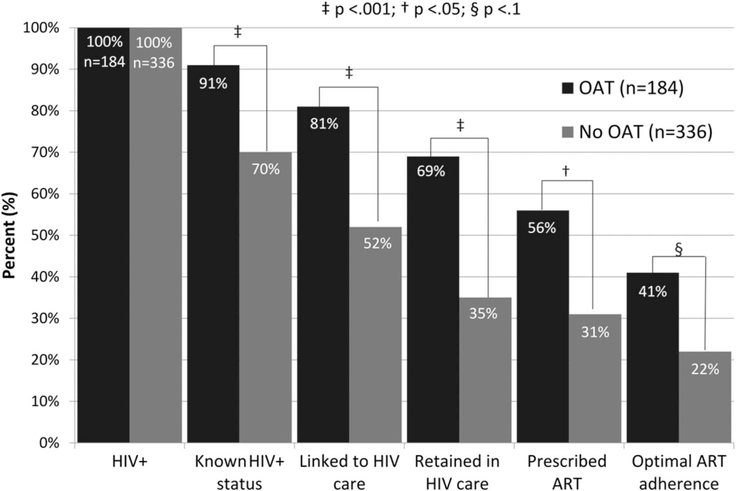
Results: Compared with PWID not on OAT (N = 336), participants who prescribed OAT (N = 184) were significantly more likely to be diagnosed (91% vs. 71%), linked (81% vs. 52%), and retained (69% vs. 35%) in HIV care, and prescribed (56% vs. 31%) and optimally (>95% of doses) adherent to antiretroviral therapy (41% vs. 22%). Receiving OAT contributed most as an independent factor with every step of the cascade. Other steps in the HIV treatment cascade were influenced by age, depression, and geographical variability.
Conclusions: OAT remains an essential and effective strategy to not only treat patients with opioid use disorder, but also a crucial strategy to engage PWID in care to meet UNAIDS 90-90-90 targets. Geographical differences suggest local structural impediments. With low OAT coverage prescribed for 2.9% of the estimated 347,000 PWID in Ukraine, OAT expansion requires strategic interventions that target the individual, clinical care settings, policies, and funding.
Conflict of interest statement
The authors have no funding or conflicts of interest to disclose.
Figures
References
-
- Joint United Nations Programme on HIV/AIDS (UNAIDS). Global AIDS Update 2016. Geneva, Switzerland; 2016: Available at: http://www.unaids.org/sites/default/files/media_asset/global-AIDS-update.... Accessed May 28, 2016.
-
- Mathers BM, Degenhardt L, Ali H, et al. HIV prevention, treatment, and care services for people who inject drugs: a systematic review of global, regional, and national coverage. Lancet. 2010;375:1014–1028. - PubMed
-
- Alliance for Public Health. Monitoring of Behavior and HIV Prevalence in People Who Inject Drugs and Their Sexual Partners in Ukraine: Alliance for Public Health; 2015. Available at: http://aph.org.ua/wp-content/uploads/2015/09/Monitoryng-povedinky-SIN_PR.... Accessed January 15, 2018.
-
- Bank TW. Prevalence of HIV, Total (% of Population Ages 15–49). UNAIDS Estimates. Overview Per Country 2014; 2016. Available at: http://data.worldbank.org/indicator/SH.DYN.AIDS.ZS?end=2014&start=2003. Accessed July 14, 2016.
Publication types
MeSH terms
Substances
Grants and funding
LinkOut - more resources
Full Text Sources
Medical
