. 2018 Oct 13;19(1):748.
doi: 10.1186/s12864-018-5138-3.

RNA viromes of the oriental hybrid lily cultivar "Sorbonne"

Affiliations

RNA viromes of the oriental hybrid lily cultivar "Sorbonne"

Yeonhwa Jo et al. BMC Genomics. .

Abstract

Background: The lily is a perennial flowering plant belonging to the genus Lilium in the family Liliaceae. Most cultivated lily plants are propagated by bulbs. Therefore, numerous lily bulbs are frequently infected by diverse viruses causing viral diseases. To date, no study has examined the viromes of plants of one type with identical genetic backgrounds collected from different geographical regions.

Results: Here, we examined different viromes of the lily cultivar "Sorbonne" using 172 gigabytes of transcriptome data composed of 23 libraries from four different projects for the cultivar "Sorbonne." We identified 396 virus-associated contigs from all but one library. We identified six different viruses, including Plantago asiatica mosaic virus (PlAMV), Cucumber mosaic virus (CMV), Lily symptomless virus (LSV), Tulip virus X (TVX), Lily mottle virus (LMoV), and Tobacco rattle virus (TRV). Of them, PlAMV was the most common virus infecting the lily. Scale and flower samples possessed a high number of virus-associated reads. We assembled 32 nearly complete genomes for the six identified viruses possessing the polyadenylate tails. Genomes of all six viruses were highly conserved in the lily cultivar "Sorbonne" based on mutation analysis. We identified defective RNAs from LSV, TVX, and PlAMV localized in the triple gene block region. Phylogenetic analyses showed that virus genomes are highly correlated with geographical regions and host plants.

Conclusions: We conducted comprehensive virome analyses of a single lily cultivar, "Sorbonne," using transcriptome data. Our results shed light on an array of lily virome-associated topics, including virus identification, the dominant virus, virus accumulation in different plant tissues, virus genome assembly, virus mutation, identification of defective RNAs, and phylogenetic relationships of identified viruses. Taken together, we provide very useful methods and valuable results that can be applied in other virome-associated studies.

Keywords: Genome; Lily; Transcriptome; Virome; Virus; “Sorbonne”.


Conflict of interest statement

Ethics approval and consent to participate

This study did not include the use of any animals, human or otherwise, so did not require ethical approval.

Consent for publication

Not applicable.

Competing interests

The authors declare that they have no competing interests.

Publisher’s Note

Springer Nature remains neutral with regard to jurisdictional claims in published maps and institutional affiliations.

Figures
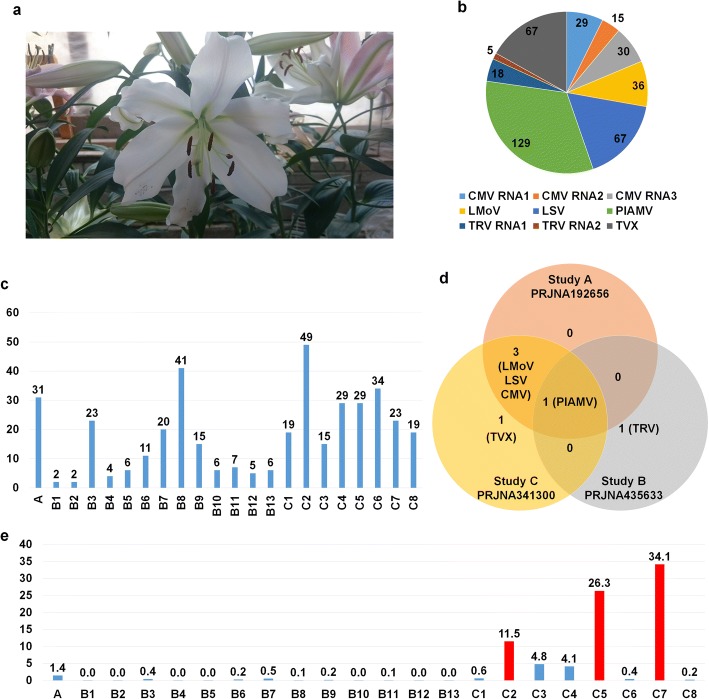
Fig. 1
Fig. 1
Study of viromes for lily cultivar “Sorbonne”. a Flower of lily cultivar “Sorbonne” grown in greenhouse. Image was taken by WKC. b Pie chart showing number of virus-associated contigs from all examined transcriptome data. c Number of virus-associated contigs in each lily transcriptome. d Comparison of identified viruses in three different studies: A, B, and C. e Proportion (percentage) of virus-associated reads in each lily transcriptome. Virus-associated reads were obtained by BLASTN search against identified virus reference genome. Red bars indicate lily transcriptomes containing high proportion of virus-associated reads
Fig. 2
Fig. 2
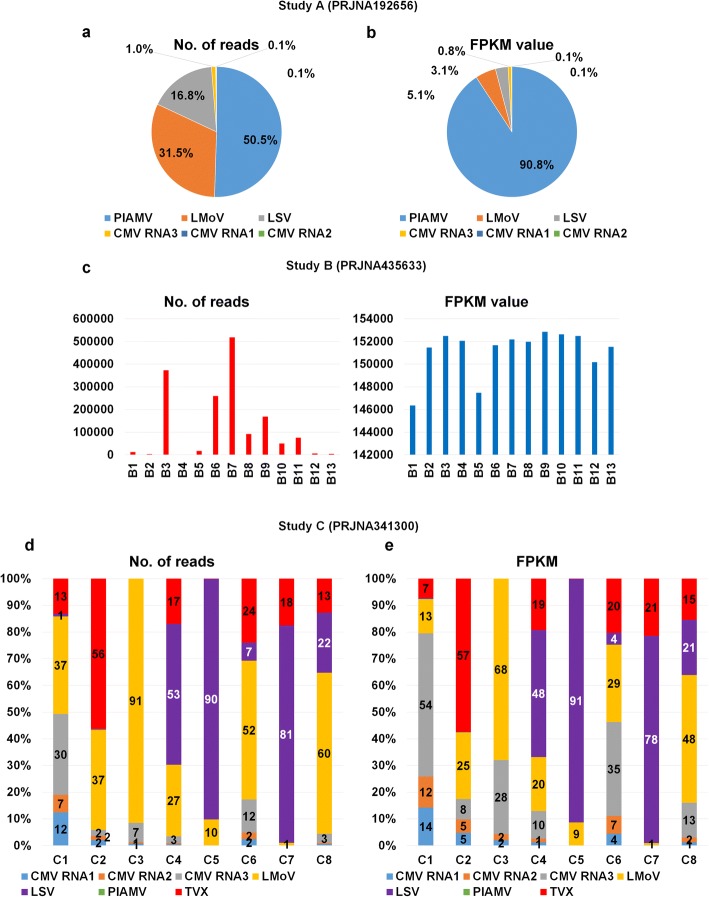
Proportion of identified viruses based on number of virus-associated reads and FPKM values. Pie charts showing proportion of identified viruses based on virus-associated reads (a) and FPKM values (b) in Study A. All virus-associated reads were identified by BLASTN search against identified virus reference genome. c Bar graphs showing change in PlAMV-associated reads (red bar) and FPKM values (blue bar) in different lily transcriptomes for Study B. Bar charts showing proportion of identified viruses based on virus-associated reads (d) and FPKM values (e) in Study C
Fig. 3
Fig. 3
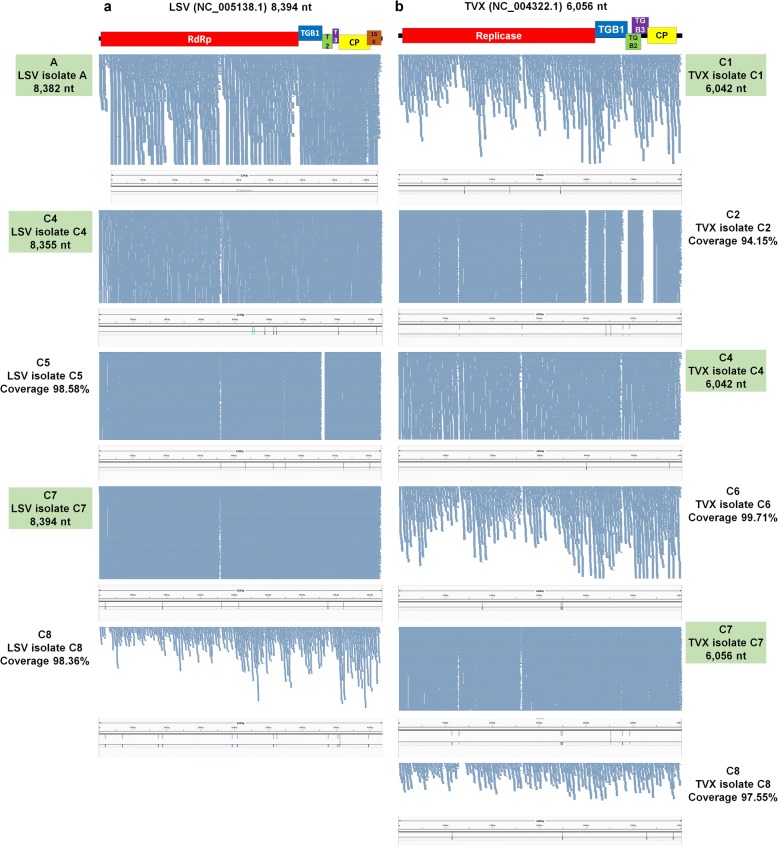
Genome assembly, mapping of reads on virus genome, and mutation analyses for LSV and TVX. Genome organization of LSV (a) and TVX (b) based on corresponding reference genome. Green boxes indicate information of assembled virus genome, such as SRA number, name of isolate, and genome size. The positions of identified SNPs in each virus genome were visualized by the Tablet program
Fig. 4
Fig. 4
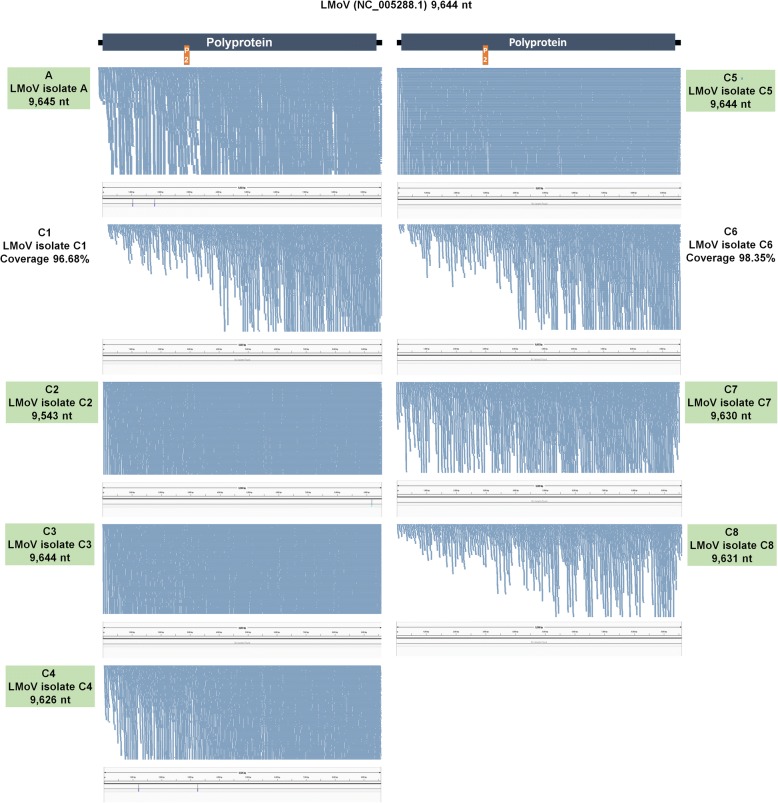
Genome assembly, mapping of reads on virus genome, and mutation analyses for LMoV. Genome organization of LMoV based on corresponding reference genome. Green boxes indicate information of assembled virus genome, such as SRA number, name of isolate, and genome size. The positions of identified SNPs in each virus genome were visualized by the Tablet program
Fig. 5
Fig. 5
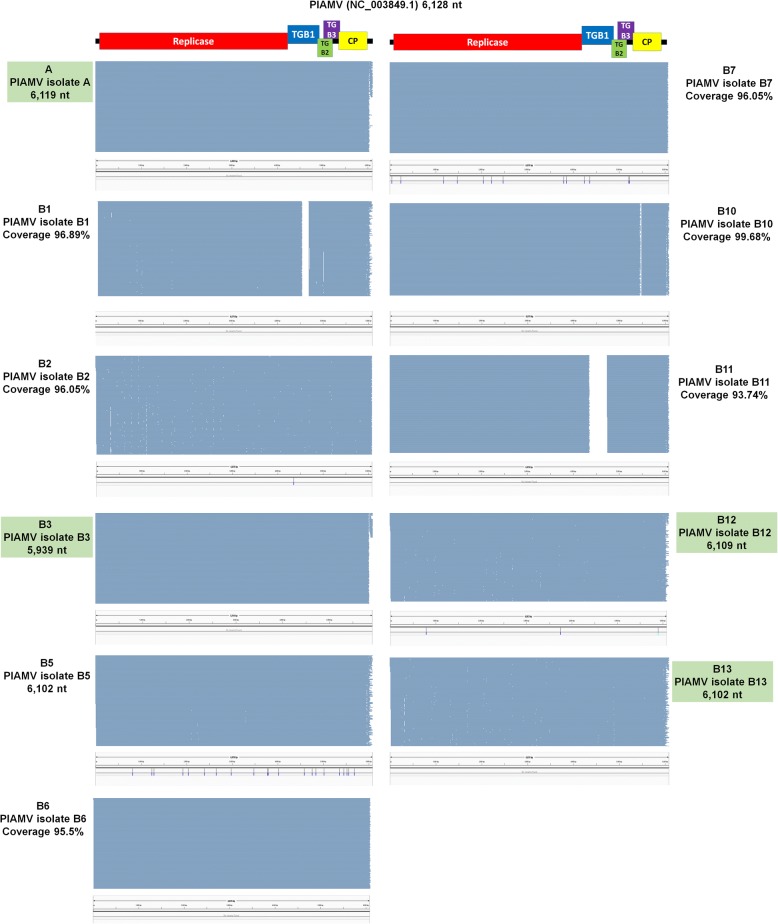
Genome assembly, mapping of reads on virus genome, and mutation analyses for PlAMV. Genome organization of PlAMV based on corresponding reference genome. Green boxes indicate information of assembled virus genome, such as SRA number, name of isolate, and genome size. The positions of identified SNPs in each virus genome were visualized by the Tablet program
Fig. 6
Fig. 6
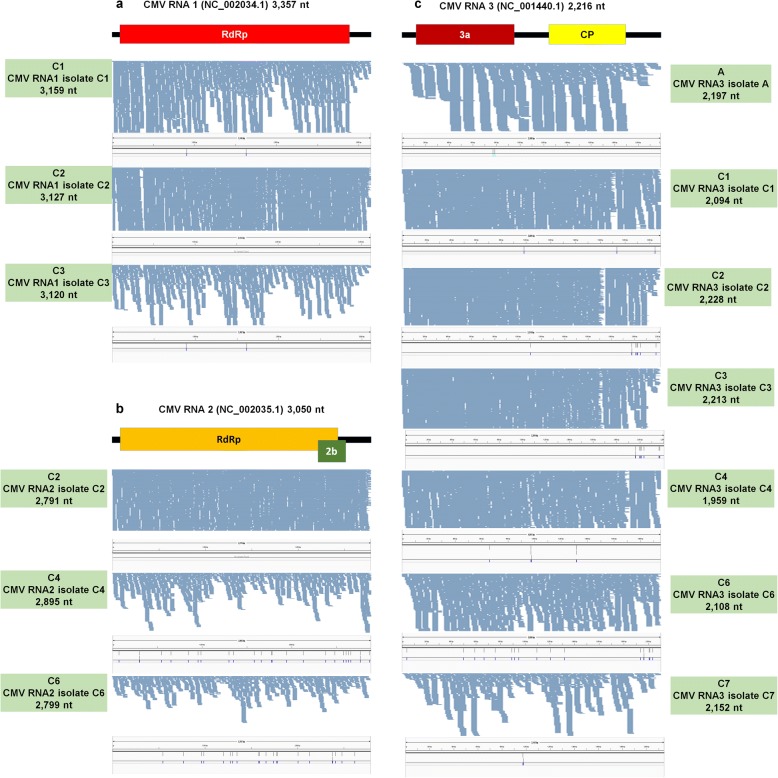
Genome assembly, mapping of reads on virus genome, and mutation analyses for CMV. Genome organization of three RNA fragments, RNA 1 (a), RNA 2 (b), and RNA 3 (c), of CMV genome. Green boxes indicate information of assembled virus genome, such as SRA number, name of isolate, and genome size. The positions of identified SNPs in each virus genome were visualized by the Tablet program
Fig. 7
Fig. 7
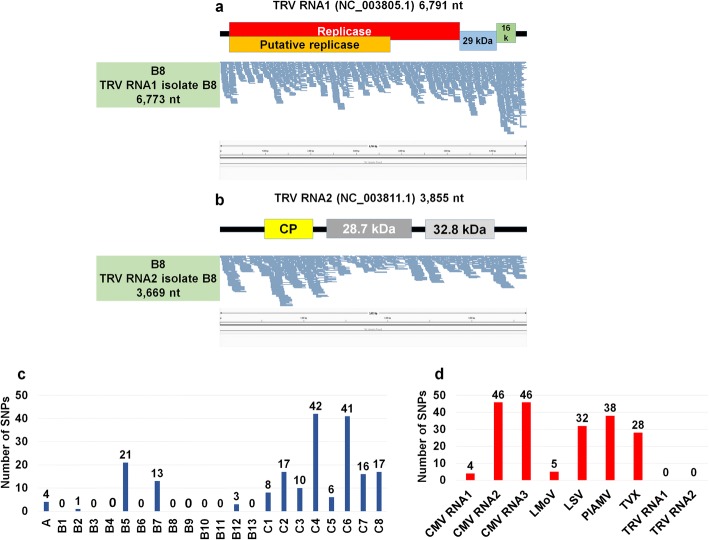
Genome assembly, mapping of reads on virus genome, and mutation analyses for TRV and number of identified SNPs. Genome organization of two RNA fragments, RNA1 (a) and RNA2 (b), of TRV genome. Green boxes indicate information of assembled virus genome, such as SRA number, name of isolate, and genome size. The positions of identified SNPs in each virus genome were visualized by the Tablet program. Number of identified SNPs associated with identified viruses in each transcriptome (c) and total number of identified SNPs for each virus (d)
Fig. 8
Fig. 8
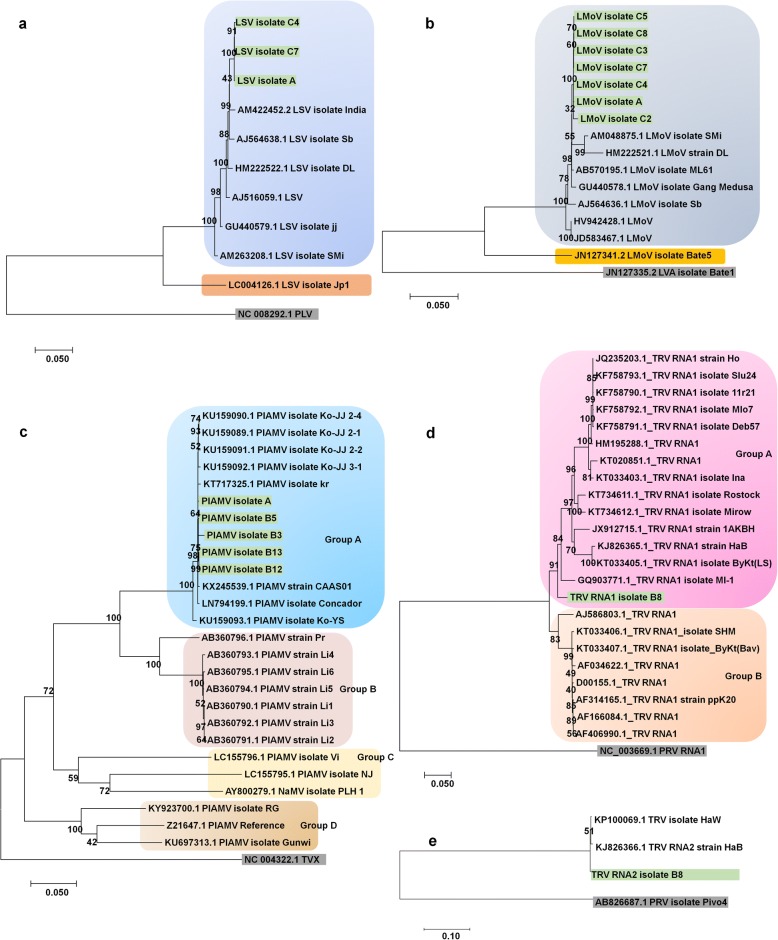
Phylogenetic relationships of LSV, LMoV, PlAMV, and TRV isolates with known isolates. a Phylogenetic tree of complete genomes for three LSV isolates, A, C4, and C7. Potato latent virus (PLV) was used as an outgroup. b Phylogenetic tree of complete genomes for seven LMoV isolates, A, C2, C3, C4, C5, C7, and C8. Lily virus A (LVA) was used as an outgroup. c Phylogenetic tree of complete genomes for five PlAMV isolates, A, B3, B5, B12, and B13. TVX was used as an outgroup. Phylogenetic tree of complete RNA1 (d) and RNA2 (e) for TRV isolate B8. Pepper ringspot virus (PRV) was used as an outgroup. Available genome sequences for LSV, LMoV, PlAMV, and TRV were also used for phylogenetic construction. Accession numbers and names of virus isolates or strains were provided. The isolates from this study were indicated by the color green
Fig. 9
Fig. 9
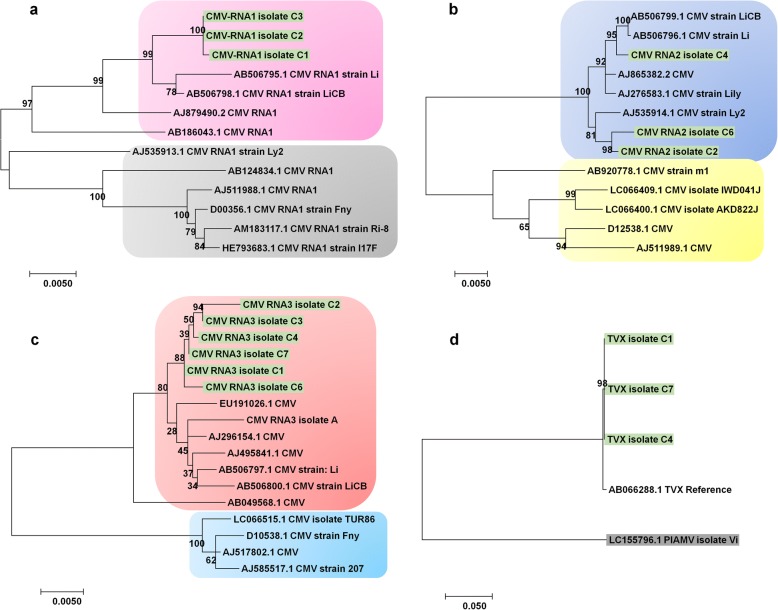
Phylogenetic relationships of CMV and TVX with known isolates. Phylogenetic trees of RNA1 (a), RNA2 (b), and RNA2 (c) for identified CMV isolates. Due to the presence of a large number of CMV genome sequences, only highly matched CMV isolates were used for BLASTN search. d Phylogenetic tree of TVX isolates, C1, C4, and C7. PlAMV was used as an outgroup. Available genome sequences for CMV and TVX were also used for phylogenetic construction. Accession numbers and names of virus isolates or strains were provided. The isolates from this study were indicated by the color green

References

    1. Du Y-p, Bi Y, Zhang M-f, Yang F-p, Jia G-x, Zhang X-h. Genome size diversity in Lilium (Liliaceae) is correlated with karyotype and environmental traits. Front Plant Sci. 2017;8:1303. doi: 10.3389/fpls.2017.01303. - DOI - PMC - PubMed
    1. Lim K-B, Barba-Gonzalez R, Zhou S, Ramanna M, Van Tuyl JM. Interspecific hybridization in lily (Lilium): taxonomic and commercial aspects of using species hybrids in breeding. Floriculture Ornamental Plant biotechnol. 2008;5:138–145.
    1. Marasek-Ciolakowska A, Nishikawa T, Shea DJ, Okazaki K. Breeding of lilies and tulips—interspecific hybridization and genetic background—. Breed Sci. 2018;68(1):35–52. doi: 10.1270/jsbbs.17097. - DOI - PMC - PubMed
    1. Simmonds J, Cumming B. Propagation of Lilium hybrids. II. Production of plantlets from bulb-scale callus cultures for increased propagation rates. Sci Hortic. 1976;5(2):161–170. doi: 10.1016/0304-4238(76)90078-9. - DOI
    1. Chastagner Gary A., van Tuyl Jaap M., Verbeek Martin, Miller William B., Westerdahl Becky B. Handbook of Plant Disease Management. Cham: Springer International Publishing; 2017. Diseases of Lily; pp. 1–61.

LinkOut - more resources