


Association between Deepwater Horizon oil spill response and cleanup work experiences and lung function
- PMID: 30317099
- PMCID: PMC6400458
- DOI: 10.1016/j.envint.2018.09.058
Association between Deepwater Horizon oil spill response and cleanup work experiences and lung function
Abstract
Introduction: Oil spill response and cleanup (OSRC) workers had potentially stressful experiences during mitigation efforts following the 2010 Deepwater Horizon disaster. Smelling chemicals; skin or clothing contact with oil; heat stress; handling oily plants/wildlife or dead animal recovery; and/or being out of regular work may have posed a risk to worker respiratory health through psychological stress mechanisms.
Objective: To evaluate the association between six potentially stressful oil spill experiences and lung function among OSRC workers 1-3 years following the Deepwater Horizon disaster, while controlling for primary oil spill inhalation hazards and other potential confounders.
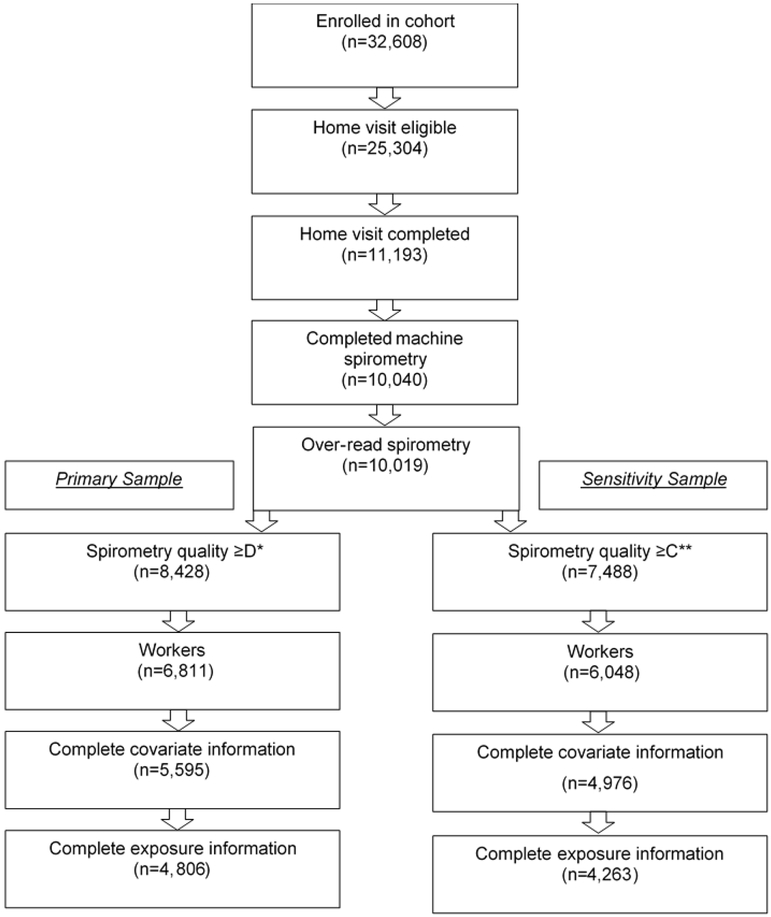
Methods: Of 6811 GuLF STUDY participants who performed OSRC work and completed a quality spirometry test, 4806 provided information on all exposures and confounders. We carried out complete case analysis and used multiple imputation to assess risk among the larger sample. Potentially stressful work experiences were identified from an earlier study of these workers. The lung function parameters of interest include the forced expiratory volume in 1 s (FEV1, mL), the forced vital capacity (FVC, mL) and the ratio (FEV1/FVC, %).
Results: On average, participants in the analytic sample completed spirometry tests 1.7 years after the spill. Among workers with at least 2 acceptable FEV1 and FVC curves, workers with jobs that involved oily plants/wildlife or dead animal recovery had lower values for FEV1 (Mean difference: -53 mL, 95% CI: -84, -22), FVC (Mean difference: -45 mL, 95% CI: -81, -9) and FEV1/FVC (Mean difference: -0.44%, 95% CI: -0.80, -0.07) compared to unexposed workers in analyses using multiple imputation.
Conclusions: Workers involved in handling oily plants/wildlife or dead animal recovery had lower lung function than unexposed workers after accounting for other OSRC inhalation hazards.
Keywords: Deepwater Horizon; Lung function; Nonchemical stressors; Oil spill; Spirometry.
Published by Elsevier Ltd.
Conflict of interest statement
Figures
References
-
- King BS and Gibbins JD, Health hazard evaluation of Deepwater Horizon response workers. 2011: US Department of Health and Human Services, Centers for Disease Control and Prevention, National Institute for Occupational Safety and Health, Health Hazard Evaluation Program.
-
- King BS, Gibbins John D., Health Hazard Evaluation of Deepwater Horizon Response Workers. 2011, National Institute for Occupational Safety and Heatlh.
Publication types
MeSH terms
Grants and funding
LinkOut - more resources
Full Text Sources
Medical
