Review
. 2019 Feb;76(3):473-493.
doi: 10.1007/s00018-018-2943-4. Epub 2018 Oct 13.

An insight into gut microbiota and its functionalities

Affiliations
Review

An insight into gut microbiota and its functionalities

Atanu Adak et al. Cell Mol Life Sci. 2019 Feb.

Abstract

Gut microbiota has evolved along with their hosts and is an integral part of the human body. Microbiota acquired at birth develops in parallel as the host develops and maintains its temporal stability and diversity through adulthood until death. Recent developments in genome sequencing technologies, bioinformatics and culturomics have enabled researchers to explore the microbiota and in particular their functions at more detailed level than before. The accumulated evidences suggest that though a part of the microbiota is conserved, the dynamic members vary along the gastrointestinal tract, from infants to elderly, primitive tribes to modern societies and in different health conditions. Though the gut microbiota is dynamic, it performs some basic functions in the immunological, metabolic, structural and neurological landscapes of the human body. Gut microbiota also exerts significant influence on both physical and mental health of an individual. An in-depth understanding of the functioning of gut microbiota has led to some very exciting developments in therapeutics, such as prebiotics, probiotics, drugs and faecal transplantation leading to improved health.

Keywords: Functions; Gut microbiota; Health; Therapeutics.


Figures
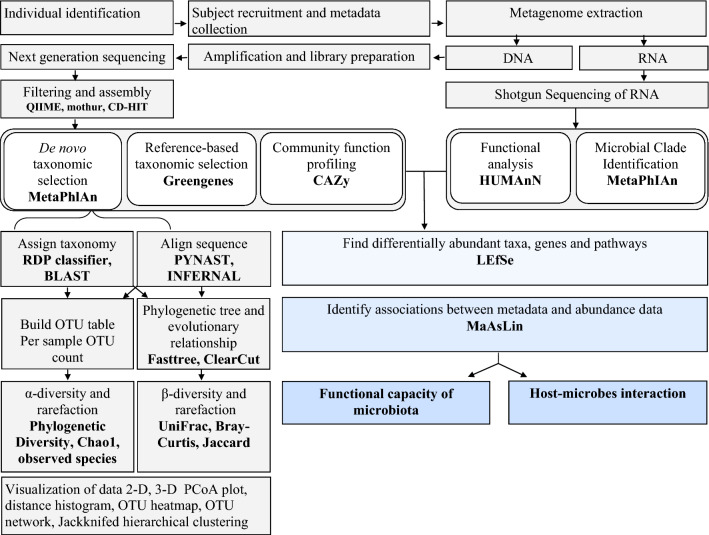
Fig. 1
Fig. 1
Bioinformatics work flow of culture independent approach. QIIME quantitative insights into microbial ecology, MG-RAST metagenomics rapid annotation using subsystem technology, CAZy carbohydrate active-enzymes, MetaPhlAn metagenomic phylogenetic analysis, KEGG Kyoto encyclopaedia for genes and genomics, COG clusters of orthologous group, PICRUst phylogenetic investigation of communities by reconstruction of unobserved states, HUMAnN The Human Microbiome Project Unified Metabolic Analysis Network, LEfSe Linear Discriminate Analysis with Effect Size, MaAsLin Multivariate Association with Linear Models, MetaPhlAn Metagenomic Phylogenetic Analysis, PICRUSt Phylogenetic Investigation of Communities by Reconstruction of Unobserved States, rRNA ribosomal RNA
Fig. 2
Fig. 2
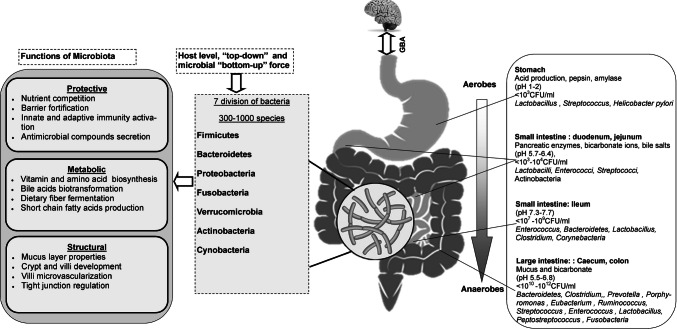
Distribution of normal gut flora in different parts of intestine and its functional activities and GBA. GBA gut brain axis
Fig. 3
Fig. 3
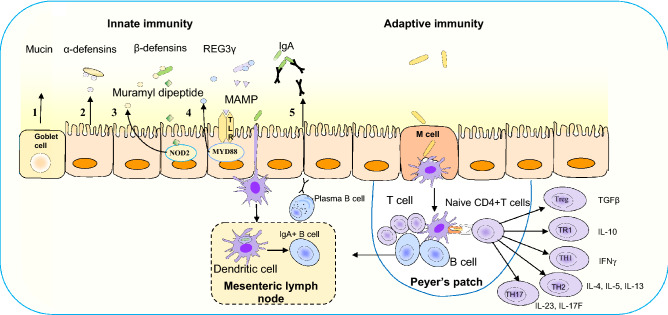
Immune mechanisms for limiting the commensals within the epithelial layer. Innate immunity: (1) mucin glycoproteins of the goblet cells form a layer over the epithelia to restrict bacterial adhesion; (2) constitutive expression of α-defensins from epithelial cells without microbial signal; (3_ β-defensin expression by muramyl dipeptide of Gram positive bacteria mediated by cytosolic nucleotide-binding oligomerization domain-containing protein 2 (NOD2); (4) C-type lectin regenerating islet-derived protein 3γ (REG3γ) via microorganism-associated molecular patterns (MAMP) activates toll-like receptors (TLRs) recruiting cytosolic adaptor myeloid differentiation primary-response protein 88 (MYD88) to restrict bacterial penetration through epithelial layer; (5) dendritic cells (DC) located beneath the epithelial dome of Peyer’s patches take up bacteria and migrate to mesenteric lymph node and induce B cells to differentiate into IgA+ plasma cells for secretion of IgA. Transcytosis of IgA across the epithelial cell layer limits bacterial association with the epithelium. Adaptive immunity: transcytosis of bacteria through M cells and luminal antigen activates DC in the Peyer′s patch and helps to differentiate the naive CD4+ T cells into Treg and TR1 characterized by expression of anti-inflammatory cytokines transforming growth factor (TGFβ) and IL10. The TH1, TH2, and TH17 cells are characterized by proinflammatory cytokines including (1) IFNγ, (2) IL-4, 5 and 13 and (3) IL-23 and IL-17F, respectively

References

    1. Woese CR, Fox GE. Phylogenetic structure of the prokaryotic domain: the primary kingdoms. Proc Natl Acad Sci USA. 1977;74(11):5088–5090. doi: 10.1073/pnas.74.11.5088. - DOI - PMC - PubMed
    1. Rosenberg E, Zilber-Rosenberg I. Microbes drive evolution of animals and plants: the hologenome concept. MBio. 2016;7(2):e01395-01315. doi: 10.1128/mBio.01395-15. - DOI - PMC - PubMed
    1. Davies J. In a map for human life, count the microbes, too. Science. 2001;291(5512):2316. doi: 10.1126/science.291.5512.2316b. - DOI - PubMed
    1. NHW Group. Peterson J, Garges S, Giovanni M, McInnes P, Wang L, et al. The NIH Human Microbiome Project. Genome Res. 2009;19(12):2317–2323. doi: 10.1101/gr.096651.109. - DOI - PMC - PubMed
    1. Relman DA, Falkow S. The meaning and impact of the human genome sequence for microbiology. Trends Microbiol. 2001;9(5):206–208. doi: 10.1016/S0966-842X(01)02041-8. - DOI - PubMed

MeSH terms

LinkOut - more resources