


Treatment at low-volume hospitals is associated with reduced short-term and long-term outcomes for patients with retroperitoneal sarcoma
- PMID: 30317543
- PMCID: PMC6289614
- DOI: 10.1002/cncr.31699
Treatment at low-volume hospitals is associated with reduced short-term and long-term outcomes for patients with retroperitoneal sarcoma
Abstract
Background: Retroperitoneal sarcomas (RPS) are rare tumors for which complete surgical resection remains the mainstay of treatment. The objective of the current study was to determine the impact of hospital case volume on outcomes in patients with RPS.
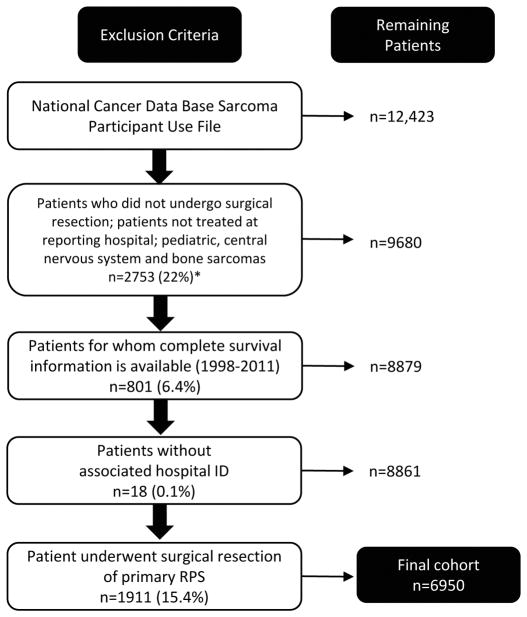
Methods: A total of 6950 patients with primary RPS who underwent surgical resection were identified from the National Cancer Data Base (1998-2011). Treating hospitals were classified by annual case volume; low-volume hospitals (LVHs) and high-volume hospitals (HVHs) were defined as those with ≤10 cases per year and >10 cases per year, respectively. Overall survival (OS) was compared using Kaplan-Meier curves. Cox proportional hazard models were created to compare risks.
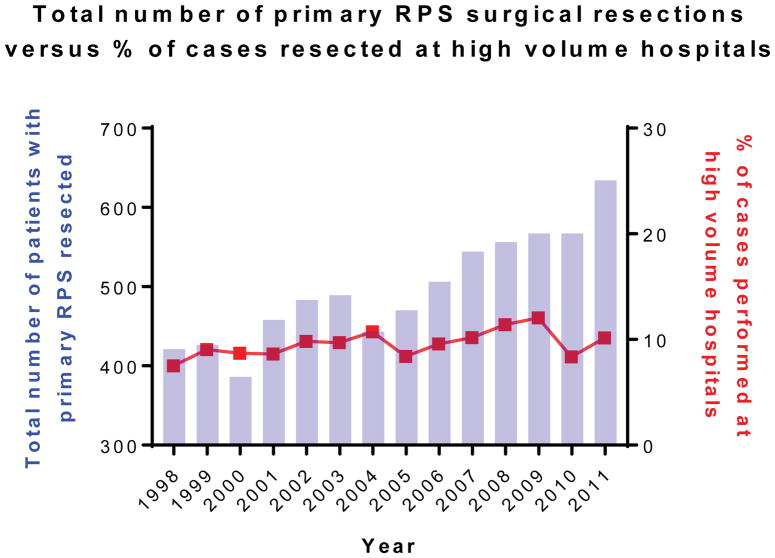
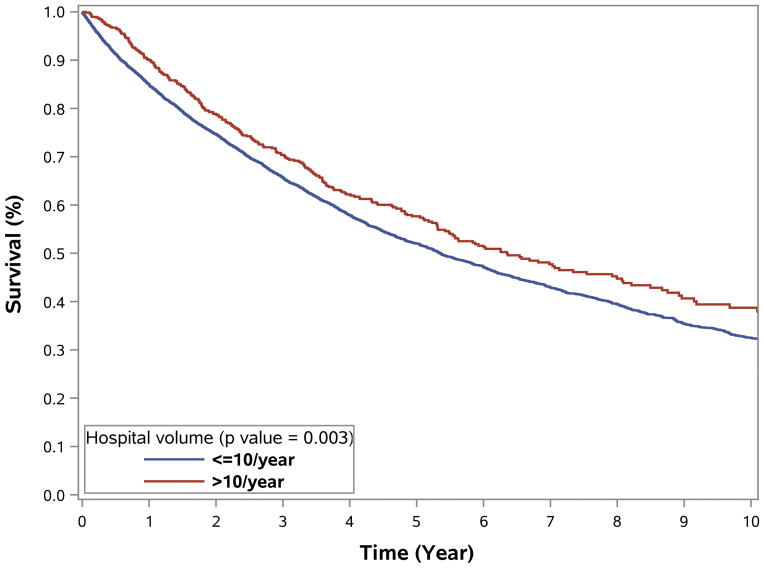
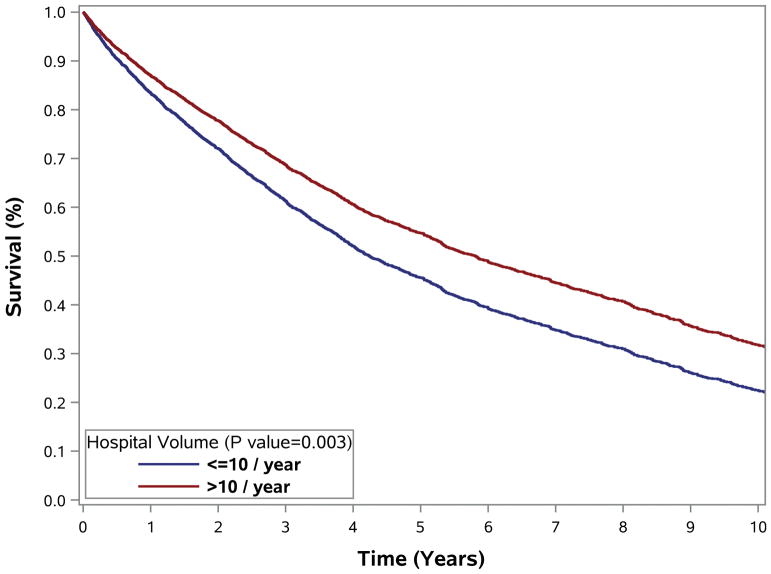
Results: Of the 1131 reporting hospitals, the majority (1127 hospitals; 99.6%) were LVHs treating the majority of patients (6270 patients; 90.2%). Patients treated at LVHs were more likely to have lower grade and smaller tumors, receive radiotherapy, and undergo incomplete macroscopic (R2) resection. Patients treated at HVHs had lower 30-day readmission rates (1.8% vs 3.4%; P<.001), 30-day (1.9% vs 3.1%; P=.004) and 90-day (3.2% vs 5.7%; P=.007) mortality, longer median OS (76.2 months vs 64.2 months; P<.001), and higher 5-year OS rates (58% vs 52%; P<.001). After controlling for age, sex, insurance status, tumor size, tumor grade, surgical resection margin status, and radiotherapy administration, treatment at an HVH was found to be independently associated with a reduced risk of death (hazard ratio, 0.77; 95% confidence interval, 0.65-0.91 [P=.003]).
Conclusions: Primary RPS are rare tumors, and to our knowledge few surgeons and institutions have significant experience and expertise in their multidisciplinary management and surgical resection. Although additional studies are needed, patient outcomes may be impacted by the case volume and expertise of the treating facility.
Keywords: National Cancer Data Base (NCDB); hospital volume; registry; retroperitoneal sarcoma; sarcoma surgery; sarcoma treatment; soft tissue neoplasm; soft tissue sarcoma.
© 2018 American Cancer Society.
Conflict of interest statement
Figures


Comment in
-
A call to action: Why sarcoma surgery needs to be centralized.Cancer. 2018 Dec 1;124(23):4452-4454. doi: 10.1002/cncr.31749. Epub 2018 Oct 14. Cancer. 2018. PMID: 30317538 No abstract available.
-
Is surgery for retroperitoneal sarcoma at "low-volume" hospitals a bad idea?Cancer. 2018 Dec 1;124(23):4447-4451. doi: 10.1002/cncr.31750. Epub 2018 Oct 14. Cancer. 2018. PMID: 30317541 No abstract available.
References
-
- [Accessed January 1, 2018];Adult soft tissue sarcoma treatment. https://www.cancer.gov/types/soft-tissue-sarcoma/hp/adult-soft-tissue-tr....
-
- Fairweather M, Wang J, Jo VY, Baldini EH, Bertagnolli MM, Raut CP. Surgical Management of Primary Retroperitoneal Sarcomas: Rationale for Selective Organ Resection. Ann Surg Oncol. 2018;25(1):98–106. - PubMed
-
- Bonvalot S, Raut CP, Pollock RE, et al. Technical considerations in surgery for retroperitoneal sarcomas: position paper from E-Surge, a master class in sarcoma surgery, and EORTC-STBSG. Ann Surg Oncol. 2012;19(9):2981–2991. - PubMed
-
- ESMO/European Sarcoma Network Working Group. Soft tissue and visceral sarcomas: ESMO Clinical Practice Guidelines for diagnosis, treatment and follow-up. Ann Oncol Off J Eur Soc Med Oncol. 2014;25(Suppl 3):iii102–12. - PubMed
Publication types
MeSH terms
Grants and funding
LinkOut - more resources
Full Text Sources
Medical
