


Health and nutritional aspects of sustainable diet strategies and their association with environmental impacts: a global modelling analysis with country-level detail
- PMID: 30318102
- PMCID: PMC6182055
- DOI: 10.1016/S2542-5196(18)30206-7
Health and nutritional aspects of sustainable diet strategies and their association with environmental impacts: a global modelling analysis with country-level detail
Abstract
Background: Sustainable diets are intended to address the increasing health and environmental concerns related to food production and consumption. Although many candidates for sustainable diets have emerged, a consistent and joint environmental and health analysis of these diets has not been done at a regional level. Using an integrated health and environmental modelling framework for more than 150 countries, we examined three different approaches to sustainable diets motivated by environmental, food security, and public health objectives.
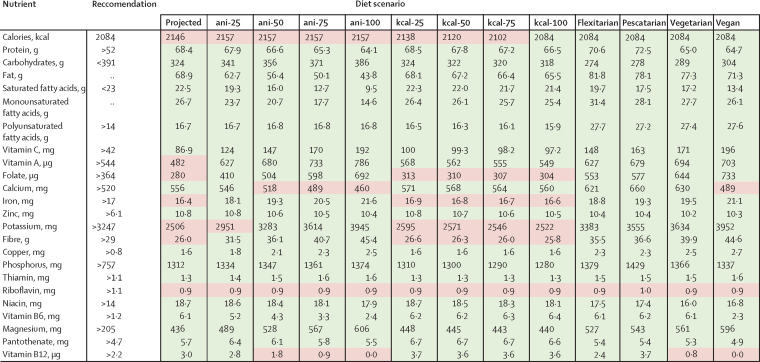
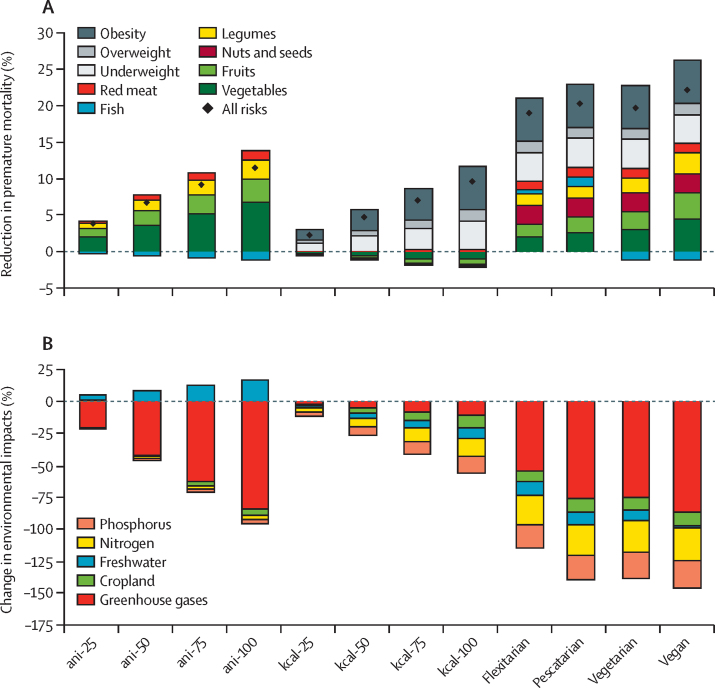
Methods: In this global modelling analysis, we combined analyses of nutrient levels, diet-related and weight-related chronic disease mortality, and environmental impacts for more than 150 countries in three sets of diet scenarios. The first set, based on environmental objectives, replaced 25-100% of animal-source foods with plant-based foods. The second set, based on food security objectives, reduced levels of underweight, overweight, and obesity by 25-100%. The third set, based on public health objectives, consisted of four energy-balanced dietary patterns: flexitarian, pescatarian, vegetarian, and vegan. In the nutrient analysis, we calculated nutrient intake and changes in adequacy based on international recommendations and a global dataset of nutrient content and supply. In the health analysis, we estimated changes in mortality using a comparative risk assessment with nine diet and weight-related risk factors. In the environmental analysis, we combined country-specific and food group-specific footprints for greenhouse gas emissions, cropland use, freshwater use, nitrogen application, and phosphorus application to analyse the relationship between the health and environmental impacts of dietary change.
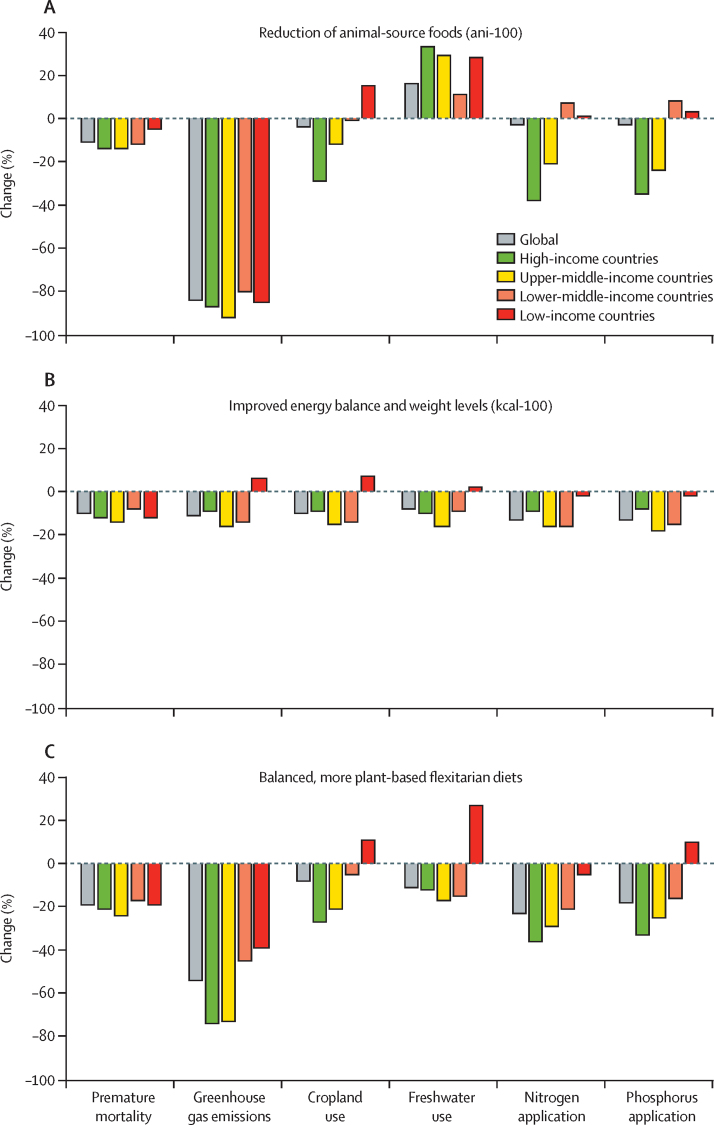
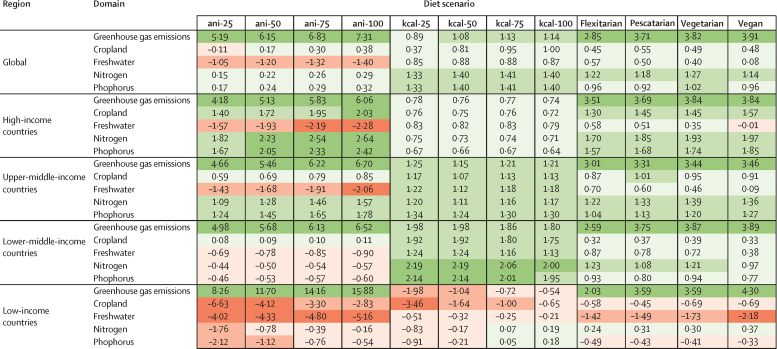
Findings: Following environmental objectives by replacing animal-source foods with plant-based ones was particularly effective in high-income countries for improving nutrient levels, lowering premature mortality (reduction of up to 12% [95% CI 10-13] with complete replacement), and reducing some environmental impacts, in particular greenhouse gas emissions (reductions of up to 84%). However, it also increased freshwater use (increases of up to 16%) and had little effectiveness in countries with low or moderate consumption of animal-source foods. Following food-security objectives by reducing underweight and overweight led to similar reductions in premature mortality (reduction of up to 10% [95% CI 9-11]), and moderately improved nutrient levels. However, it led to only small reductions in environmental impacts at the global level (all impacts changed by <15%), with reduced impacts in high-income and middle-income countries, and increased resource use in low-income countries. Following public health objectives by adopting energy-balanced, low-meat dietary patterns that are in line with available evidence on healthy eating led to an adequate nutrient supply for most nutrients, and large reductions in premature mortality (reduction of 19% [95% CI 18-20] for the flexitarian diet to 22% [18-24] for the vegan diet). It also markedly reduced environmental impacts globally (reducing greenhouse gas emissions by 54-87%, nitrogen application by 23-25%, phosphorus application by 18-21%, cropland use by 8-11%, and freshwater use by 2-11%) and in most regions, except for some environmental domains (cropland use, freshwater use, and phosphorus application) in low-income countries.
Interpretation: Approaches for sustainable diets are context specific and can result in concurrent reductions in environmental and health impacts globally and in most regions, particularly in high-income and middle-income countries, but they can also increase resource use in low-income countries when diets diversify. A public health strategy focused on improving energy balance and dietary changes towards predominantly plant-based diets that are in line with evidence on healthy eating is a suitable approach for sustainable diets. Updating national dietary guidelines to reflect the latest evidence on healthy eating can by itself be important for improving health and reducing environmental impacts and can complement broader and more explicit criteria of sustainability.
Funding: Wellcome Trust, EAT, CGIAR, and British Heart Foundation.
Copyright © 2018 The Author(s). Published by Elsevier Ltd. This is an Open Access article under the CC BY 4.0 license. Published by Elsevier Ltd.. All rights reserved.
Figures
Comment in
-
Sustainable diets are context specific but are they realistic?Lancet Planet Health. 2018 Oct;2(10):e425-e426. doi: 10.1016/S2542-5196(18)30207-9. Lancet Planet Health. 2018. PMID: 30318099 No abstract available.
References
-
- Forouzanfar MH, Alexander L, Anderson HR. Global, regional, and national comparative risk assessment of 79 behavioural, environmental and occupational, and metabolic risks or clusters of risks in 188 countries, 1990–2013: a systematic analysis for the Global Burden of Disease Study 2013. Lancet. 2015;386:2287–2323. - PMC - PubMed
-
- Food and Agriculture Organization of the United Nations. International Fund for Agricultural Development. the United Nations Children's Fund. World Food Programme. WHO . World Health Organization; Geneva: 2018. The state of food security and nutrition in the world.
-
- Vermeulen SJ, Campbell BM, Ingram JSI. Climate change and food systems. Annu Rev Environ Resour. 2012;37:195–222.
-
- Ramankutty N, Evan AT, Monfreda C, Foley JA. Farming the planet: 1. Geographic distribution of global agricultural lands in the year 2000. Global Biogeochem Cycles. 2008;22:GB1003.
Publication types
MeSH terms
Grants and funding
LinkOut - more resources
Full Text Sources
Other Literature Sources
Medical
