


Prognostic Value of International Normalized Ratio in Ischemic Stroke Patients without Atrial Fibrillation or Anticoagulation Therapy
- PMID: 30318486
- PMCID: PMC6456455
- DOI: 10.5551/jat.43752
Prognostic Value of International Normalized Ratio in Ischemic Stroke Patients without Atrial Fibrillation or Anticoagulation Therapy
Abstract
Aim: The impact of international normalized ratio (INR) on prognosis after acute ischemic stroke without anticoagulation therapy is unclear. Herein, the association between baseline INR and stroke outcomes in patients without anticoagulation therapy was investigated.
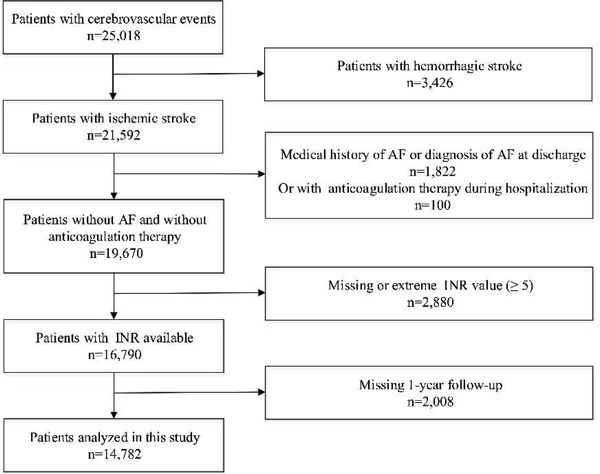
Methods: A total of 14,782 ischemic stroke patients from the China National Stroke Registry Ⅱ were included in this analysis. The period of follow-up was 1 year after stroke onset. Multivariate logistic regression models were used to estimate the relationship between INR and stroke outcomes including all-cause death, recurrent stroke, composite end point, and poor functional outcome.
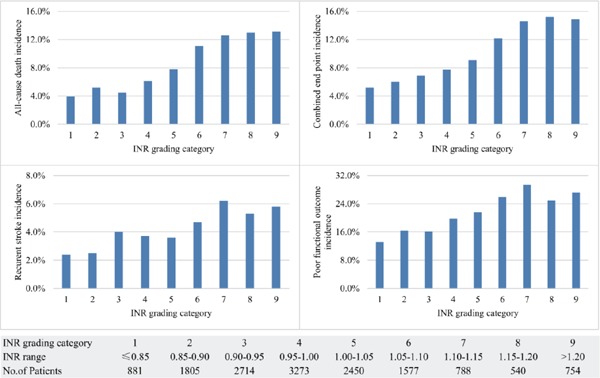
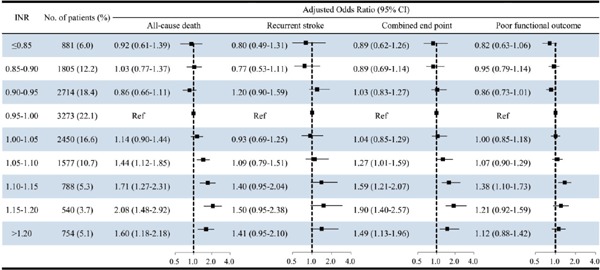
Results: Of 14,782 patients with stroke, all-cause death occurred in 1080 (7.3%), recurrence stroke in 538 (3.9%), combined end point in 1319 (8.9%), and poor functional outcome in 3001 (20.3%). Compared with the medium INR group (0.9-1.1), the odds ratios with confidence intervals of 95% for the high INR group (>1.1) were 1.58 (1.32-1.98) for all-cause death, 1.40 (1.10-1.79) for stroke recurrence, 1.52 (1.29-1.79) for combined end point, and 1.21 (1.06-1.39) for poor functional outcome. No association between low INR (<0.9) and any stroke outcomes was found compared with the medium group.
Conclusions: Increased admission INR was associated with adverse stroke outcomes among acute ischemic stroke patients without atrial fibrillation or anticoagulation therapy.
Keywords: International normalized ratio; Minor stroke; Recurrent stroke; Registries; Transient ischemic attack.
Figures
References
-
- Mukherjee D, Patil CG. Epidemiology and the global burden of stroke. World Neurosurg, 2011; 76: S85-90 - PubMed
-
- Hardie K, Hankey GJ, Jamrozik K, Broadhurst RJ, Anderson C. Ten-year risk of first recurrent stroke and disability after first-ever stroke in the Perth Community Stroke Study. Stroke, 2004; 35: 731-735 - PubMed
-
- Ignjatovic V. Prothrombin time/international normalized ratio. Methods Mol Biol, 2013; 992: 121-129 - PubMed
-
- Go AS, Hylek EM, Chang Y, Phillips KA, Henault LE, Capra AM, Jensvold NG, Selby JV, Singer DE. Anticoagulation therapy for stroke prevention in atrial fibrillation: how well do randomized trials translate into clinical practice? JAMA, 2003; 290: 2685-2692 - PubMed
-
- Wazni OM, Beheiry S, Fahmy T, Barrett C, Hao S, Patel D, Di Biase L, Martin DO, Kanj M, Arruda M, Cummings J, Schweikert R, Saliba W, Natale A. Atrial fibrillation ablation in patients with therapeutic international normalized ratio: comparison of strategies of anticoagulation management in the periprocedural period. Circulation, 2007; 116: 2531-2534 - PubMed
