Review
. 2019 Mar;22(3):506-520.
doi: 10.1017/S1368980018002616. Epub 2018 Oct 15.

Maternal dietary patterns and risk of adverse pregnancy (hypertensive disorders of pregnancy and gestational diabetes mellitus) and birth (preterm birth and low birth weight) outcomes: a systematic review and meta-analysis

Affiliations
Review

Maternal dietary patterns and risk of adverse pregnancy (hypertensive disorders of pregnancy and gestational diabetes mellitus) and birth (preterm birth and low birth weight) outcomes: a systematic review and meta-analysis

Kelemu Tilahun Kibret et al. Public Health Nutr. 2019 Mar.

Abstract

Objective: Epidemiological studies have indicated that dietary patterns during pregnancy are associated with adverse pregnancy and birth outcomes such as hypertensive disorders of pregnancy (HDP), gestational diabetes mellitus (GDM), preterm birth (PTB) and low birth weight (LBW). However, the results of these studies are varied and inconsistent. The present study aimed to assess the association between dietary patterns and the risk of adverse pregnancy and birth outcomes.

Design: Systematic review and meta-analysis. Seven databases were searched for articles. Two reviewers performed the study selection and data extraction. A random-effects model was used to estimate pooled effect sizes of eligible studies.

Setting: Studies conducted all over the world were incorporated.

Subjects: The review focused on pregnant women.

Results: A total of twenty-one studies were identified. Adherence to a healthy dietary pattern (intake of vegetables, fruits, legumes, whole grains) was significantly associated with lower odds (OR; 95 % CI) of pre-eclampsia (0·78; 0·70, 0·86; I2=39·0 %, P=0·178), GDM (0·78; 0·56, 0·99; I2=68·6 %, P=0·013) and PTB (0·75; 0·57, 0·93; I2=89·6 %, P=0·0001).

Conclusions: Our review suggests that dietary patterns with a higher intake of fruits, vegetables, legumes, whole grains and fish are associated with a decreased likelihood of adverse pregnancy and birth outcomes. Further research should be conducted in low-income countries to understand the impact of limited resources on dietary intake and adverse pregnancy and birth outcomes.

Keywords: Dietary intake; Dietary patterns; Pregnancy; Pregnant women.


Figures
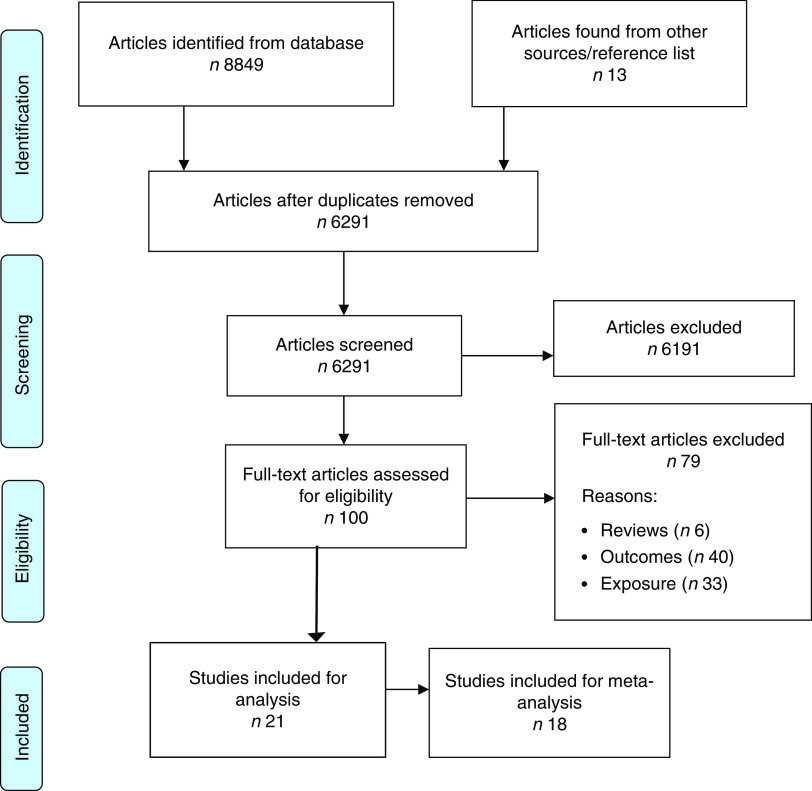
Fig. 1
Fig. 1
(colour online) Flowchart of the study selection process for the current systematic review and meta-analysis on maternal dietary patterns and risk of adverse pregnancy and birth outcomes
Fig. 2
Fig. 2
(colour online) Forest plot for the pooled OR of the association between a healthy dietary pattern and pre-eclampsia. The study-specific OR and 95 % CI are represented by the black diamond and the horizontal line, respectively; the area of the grey square is proportional to the specific-study weight to the overall meta-analysis. The centre of the blue open diamond and the red dashed vertical line represent the pooled OR; and the width of the blue open diamond represents the pooled 95 % CI
Fig. 3
Fig. 3
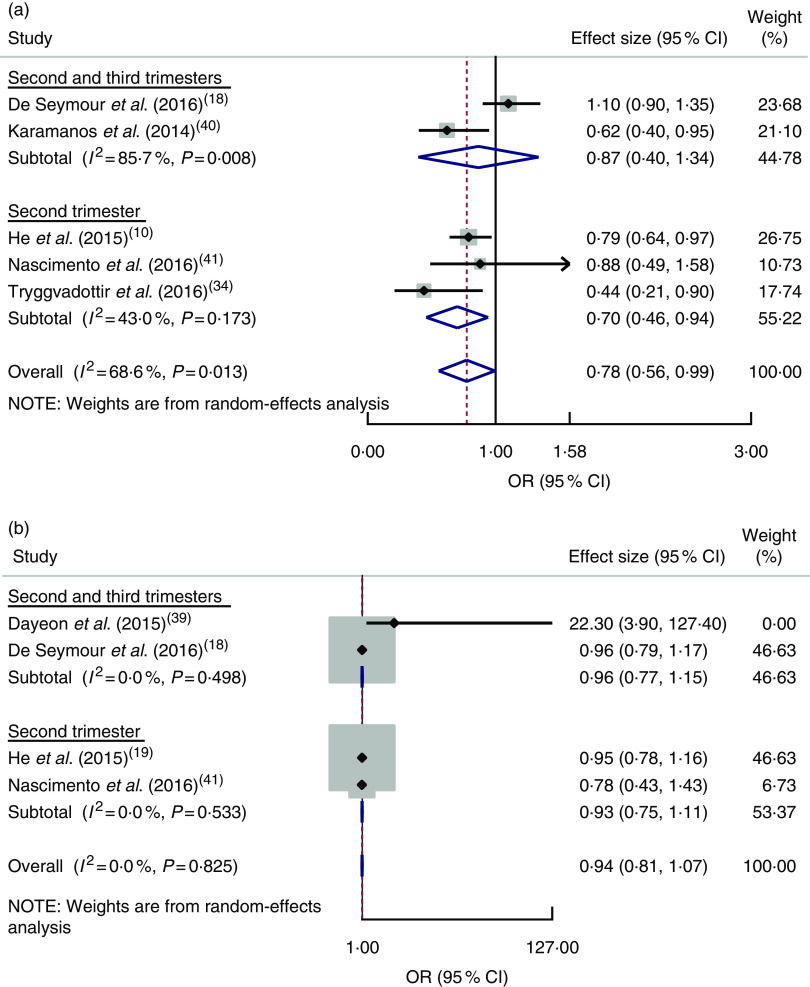
(colour online) Forest plot for the pooled OR of the association between gestational diabetes mellitus (GDM) and different dietary patterns, with subgroup analysis regarding period of dietary assessment (second trimester v. both second and third trimesters): (a) association between GDM and healthy dietary pattern; (b) association between GDM and Western dietary pattern. The study-specific OR and 95 % CI are represented by the black diamond and the horizontal line, respectively; the area of the grey square is proportional to the specific-study weight to the overall meta-analysis. The centre of the blue open diamond and the red dashed vertical line represent the pooled OR; and the width of the blue open diamond represents the pooled 95 % CI
Fig. 4
Fig. 4
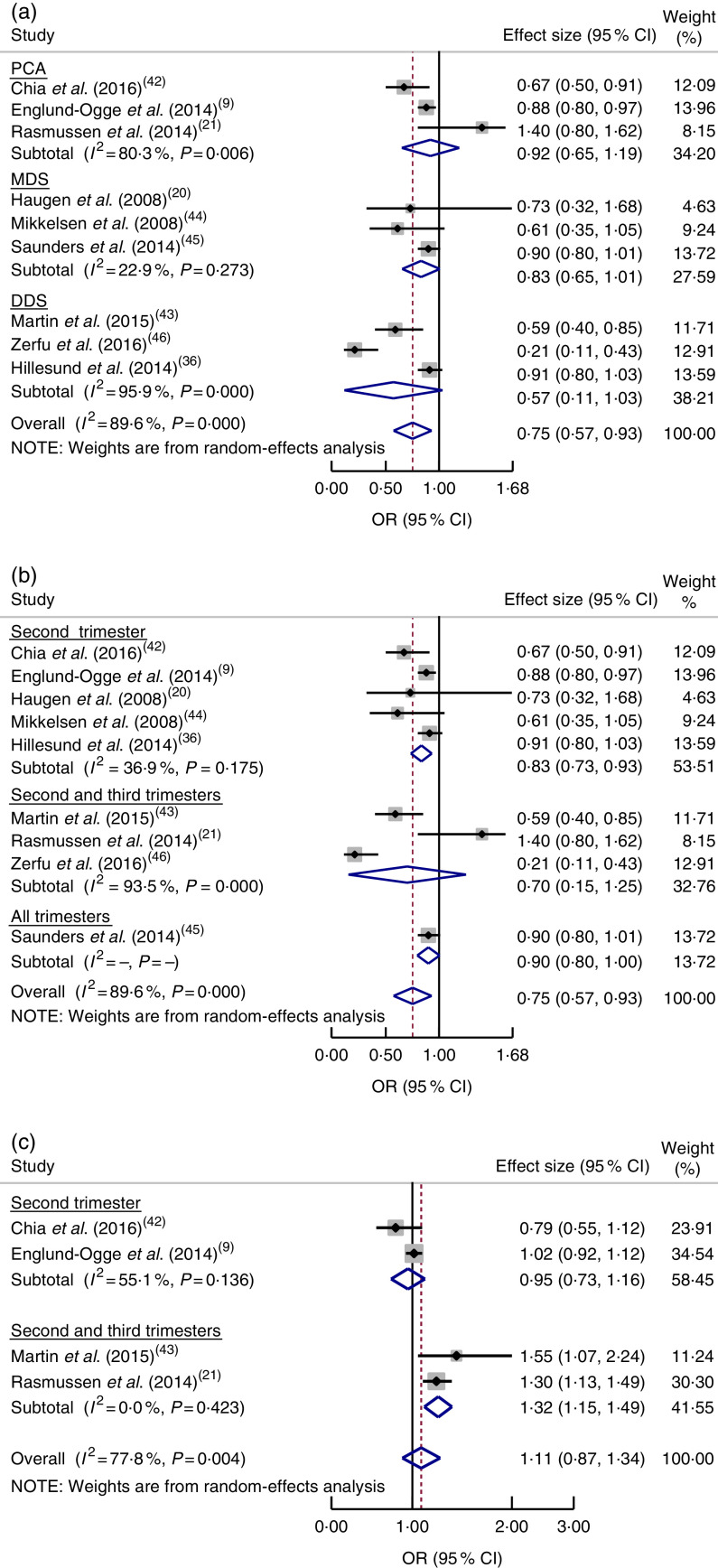
(colour online) Forest plot for the pooled OR of the association between preterm birth (PTB) and different dietary patterns: (a) association between healthy dietary pattern and PTB, with subgroup analysis in relation to dietary pattern assessment methods (Mediterranean diet score (MDS) v. dietary diversity score (DDS) v. principal component analysis (PCA)); (b) association between healthy dietary pattern and PTB, with subgroup analysis regarding period of dietary assessment (second trimester v. both second and third trimesters v. all trimesters); and (c) association between Western pattern and PTB, with subgroup analysis regarding period of dietary assessment (second trimester v. both second and third trimesters). The study-specific OR and 95 % CI are represented by the black diamond and the horizontal line, respectively; the area of the grey square is proportional to the specific-study weight to the overall meta-analysis. The centre of the blue open diamond and the red dashed vertical line represent the pooled OR; and the width of the blue open diamond represents the pooled 95 % CI

References

    1. American College of Obstetricians and Gynecologists (2013) Hypertension in pregnancy. Report of the American College of Obstetricians and Gynecologists’ Task Force on Hypertension in Pregnancy. Obst Gynecol 122, 1122–1131. - PubMed
    1. Say L, Chou D, Gemmill A et al.. (2014) Global causes of maternal death: a WHO systematic analysis. Lancet Glob Health 2, e323–e333. - PubMed
    1. Gemmell L, Martin L, Murphy KE et al.. (2016) Hypertensive disorders of pregnancy and outcomes of preterm infants of 24 to 28 weeks’ gestation. J Perinatol 36, 1067–1072. - PubMed
    1. Lawn JE, Gravett MG, Nunes TM et al.. (2010) Global report on preterm birth and stillbirth (1 of 7): definitions, description of the burden and opportunities to improve data. BMC Pregnancy Childbirth 10, Suppl. 1, S1. - PMC - PubMed
    1. Blencowe H, Cousens S, Chou D et al.. (2013) Born too soon: the global epidemiology of 15 million preterm births. Reprod Health 10 , Suppl. 1, S2. - PMC - PubMed