Protect the Protector: Morbidity and Health Behavior among Police Personnel in National Capital Region of India
- PMID: 30319229
- PMCID: PMC6176699
- DOI: 10.4103/ijoem.IJOEM_28_18
Protect the Protector: Morbidity and Health Behavior among Police Personnel in National Capital Region of India
Abstract
Introduction: At the time of selection, police personnel undergo various health and fitness tests but subsequently health assessments are not done regularly. Unhealthy lifestyle and challenging work environment predispose them to various somatic sequelae, including cardiovascular diseases, musculoskeletal, gastrointestinal, and psychological disorders, etc., There is limited epidemiological data on the morbidity profile among police personnel in India.
Aim: To study the morbidity profile and the treatment-seeking behavior among police personnel in National Capital Region (NCR), India.
Materials and methods: A cross-sectional study was conducted between May and November, 2014 on 300 police personnel working in the NCR, India. We administered a predesigned, pretested questionnaire (α = 0.63) to the study participants based on World Health Organization-STEPS tool for assessing morbidity profile, lifestyle risk factors, and treatment-seeking behavior after obtaining informed consent from the study participants.
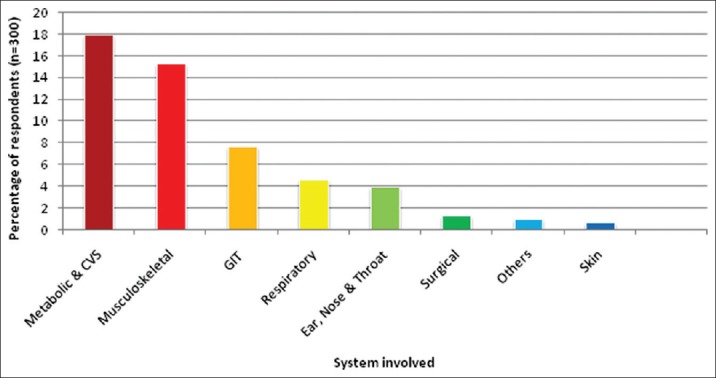
Results: Health complaints were reported by around half (n = 149, 49.6%) of the participants with the morbidity risk of 0.71 per person. The most common complaints were related to the cardiovascular and musculoskeletal system. Only around half of the affected participants took any treatment. Hospitalization rate reflected from past 1-year hospital admissions among participants was (n = 23, 7.7%). Data analysis suggested morbidity status of police personnel to be significantly associated with lifestyle risk factors such as abdominal obesity (n = 129, 86.5%), obstructive sleep apnea (n = 54, 36.2%), and distress (n = 48, 32.2%).
Conclusion: Busy and challenging work life and poor control of health lead to high morbidity among police personnel. Regular health checks and lifestyle promotional activities are highly recommended to maintain a healthy police force.
Keywords: Law enforcement; lifestyle; occupational health.
Conflict of interest statement
There are no conflicts of interest.
Figures
References
-
- Mundewadi AW, Thakare GV, Gorane SS, Agarwal PV. Resting B.P. and cold pressor test in policemen in Dhule city. Int J Basic Med Sci. 2011;2:80–3.
-
- Kanam RN, Basuki B, Nainggolan G. Qualitative work overload and other risk factors related to hypertension risk among Indonesian Police Mobile Brigade (Brimob) Med J Indonesia. 2008;17:188–96.
-
- Franke WD, Cox DF, Schultz DP, Anderson DF. Coronary heart disease risk factors in employees of Iowa's Department of Public Safety compared to a cohort of the general population. Am J Ind Med. 1997;31:733–7. - PubMed
-
- Randall C. Managing occupational stress injury in police services: A literature review. Int Pub Health J. 2013;5:413.
-
- Johns F, Kumar A, Alexander AV. Occupational hazards vs morbidity profile among police force in Kerala. Kerala Med J. 2012;5:63–6.
LinkOut - more resources
Full Text Sources
Miscellaneous