


Obesity and Weight Gain in Pregnancy and Postpartum: an Evidence Review of Lifestyle Interventions to Inform Maternal and Child Health Policies
- PMID: 30319539
- PMCID: PMC6168639
- DOI: 10.3389/fendo.2018.00546
Obesity and Weight Gain in Pregnancy and Postpartum: an Evidence Review of Lifestyle Interventions to Inform Maternal and Child Health Policies
Abstract
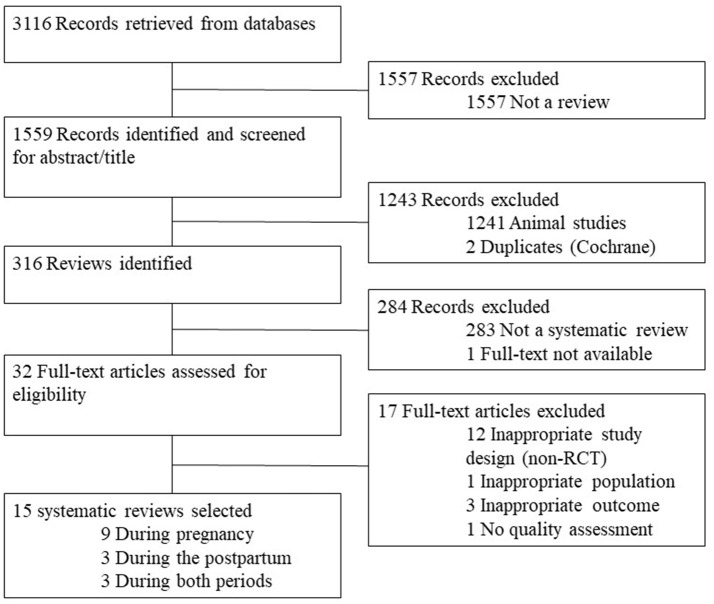
Background: Maternal obesity, excessive gestational weight gain (GWG) and post-partum weight retention (PPWR) constitute new public health challenges, due to the association with negative short- and long-term maternal and neonatal outcomes. The aim of this evidence review was to identify effective lifestyle interventions to manage weight and improve maternal and infant outcomes during pregnancy and postpartum. Methods: A review of systematic reviews and meta-analyses investigating the effects of lifestyle interventions on GWG or PPWR was conducted (Jan 2009-2018) via electronic searches in the databases Medline, Pubmed, Web of Science and Cochrane Library using all keywords related to obesity/weight gain/loss, pregnancy or postpartum and lifestyle interventions;15 relevant reviews were selected. Results: In healthy women from all BMI classes, diet and physical activity interventions can decrease: GWG (mean difference -1.8 to -0.7 kg, high to moderate-quality evidence); the risks of GWG above the IOM guidelines (risk ratio [RR] 0.72 to 0.80, high to low-quality evidence); pregnancy-induced hypertension (RR 0.30 to 0.66, low to very low-quality evidence); cesarean section (RR 0.91 to 0.95; high to moderate-quality evidence) and neonatal respiratory distress syndrome (RR 0.56, high-quality evidence); without any maternal/fetal/neonatal adverse effects. In women with overweight/obesity, multi-component interventions can decrease: GWG (-0.91 to -0.63 kg, moderate to very low-quality evidence); pregnancy-induced hypertension (RR 0.30 to 0.66, low-quality evidence); macrosomia (RR 0.85, 0.73 to 1.0, moderate-quality evidence) and neonatal respiratory distress syndrome (RR 0.47, 0.26 to 0.85, moderate-quality evidence). Diet is associated with greater reduction of the risks of GDM, pregnancy-induced hypertension and preterm birth, compared with any other intervention. After delivery, combined diet and physical activity interventions reduce PPWR in women of any BMI (-2.57 to -2.3 kg, very low quality evidence) or with overweight/obesity (-3.6 to -1.22, moderate to very low-quality-evidence), but no other effects were reported. Conclusions: Multi-component approaches including a balanced diet with low glycaemic load and light to moderate intensity physical activity, 30-60 min per day 3-5 days per week, should be recommended from the first trimester of pregnancy and maintained during the postpartum period. This evidence review should help inform recommendations for health care professionals and women of child-bearing age.
Keywords: intervention; nutrition; obesity; physical activity; postpartum; pregnancy; systematic review; weight gain.
Figures
Comment in
-
Commentary: Obesity and Weight Gain in Pregnancy and Postpartum: an Evidence Review of Lifestyle Interventions to Inform Maternal and Child Health Policies.Front Endocrinol (Lausanne). 2019 Mar 26;10:163. doi: 10.3389/fendo.2019.00163. eCollection 2019. Front Endocrinol (Lausanne). 2019. PMID: 30972021 Free PMC article. No abstract available.
References
Publication types
LinkOut - more resources
Full Text Sources
