Review
. 2018 Sep 27:9:573.
doi: 10.3389/fendo.2018.00573. eCollection 2018.

The Anti-tumoral Properties of Orexin/Hypocretin Hypothalamic Neuropeptides: An Unexpected Therapeutic Role

Affiliations
Review

The Anti-tumoral Properties of Orexin/Hypocretin Hypothalamic Neuropeptides: An Unexpected Therapeutic Role

Alain Couvineau et al. Front Endocrinol (Lausanne). .

Abstract

Orexins (OxA and OxB) also termed hypocretins are hypothalamic neuropeptides involved in central nervous system (CNS) to control the sleep/wake process which is mediated by two G protein-coupled receptor subtypes, OX1R, and OX2R. Beside these central effects, orexins also play a role in various peripheral organs such as the intestine, pancreas, adrenal glands, kidney, adipose tissue and reproductive tract.In the past few years, an unexpected anti-tumoral role of orexins mediated by a new signaling pathway involving the presence of two immunoreceptor tyrosine-based inhibitory motifs (ITIM) in both orexin receptors subtypes, the recruitment of the phosphotyrosine phosphatase SHP2 and the induction of mitochondrial apoptosis has been elucidated. In the present review, we will discuss the anti-tumoral effect of orexin/OXR system in colon, pancreas, prostate and other cancers, and its interest as a possible therapeutic target.

Keywords: GPCR; cancer; gastroenterology; inflammation; neuropeptides; orexins; signaling pathway.


Figures
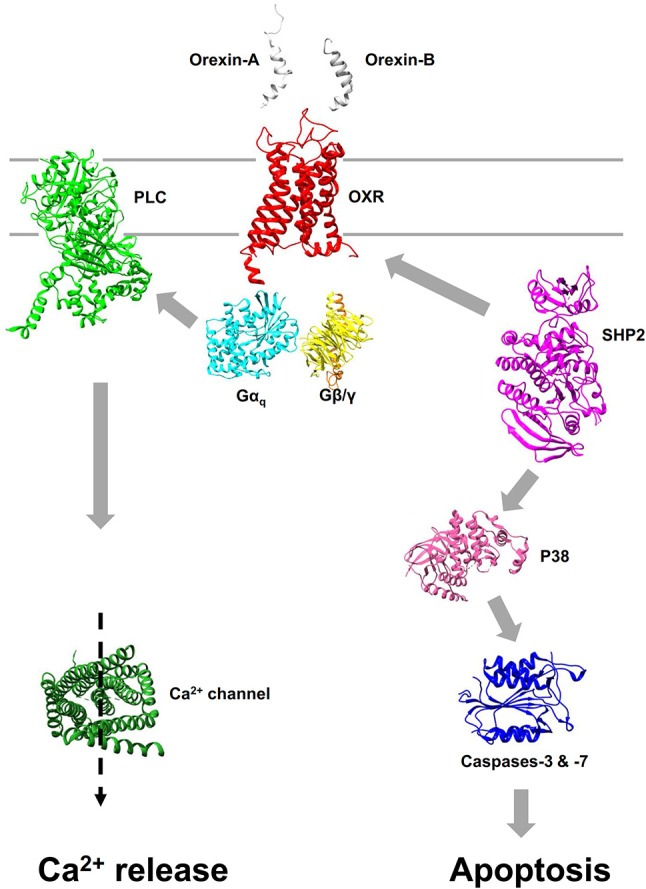
Figure 1
Figure 1
Pro-apoptotic signaling pathway induced by orexins. Interaction of orexins with OX1R or OX2R leads to promote the dissociation of heterotrimer Gq into αq and β/γ subunits. The canonical Ca2+ signaling pathway stimulated by orexins results of phospholipase C (PLC) activation mediated by αq subunit (Left). Apoptosis induced by orexins is mediated, independently of canonical Ca2+ signaling pathway, by the recruitment of the phosphotyrosine phosphatase SHP2 leading to the activation of p38 cascade and activation of caspases-3 and -7 via the mitochondria apoptosis pathway (Right). All structures were obtained in Protein Data Bank (PDB).
Figure 2
Figure 2
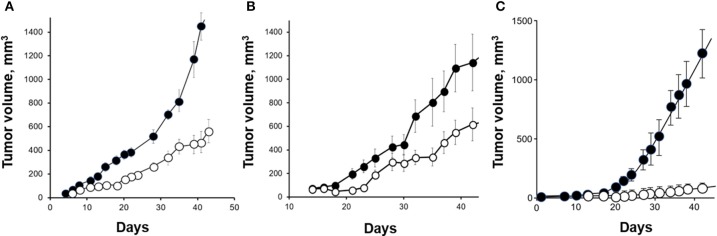
Anti-tumoral effect of OxA in preclinical mouse models. (A) Nude mice were xenografted with the colon adenocarcinoma cell line, HT-29 and then, treated by 1 μmoles of OxA/Kg intraperitoneally (ip) injected. The tumor development was determined by measurement. (B) Nude mice were xenografted with the pancreatic adenocarcinoma cell line, AsPC-1, and ip injected with 1 μmoles of OxA/Kg. (C) Nude mice were xenografted with the prostate cancer cell line, DU145 and treated with 1 μmoles of OxA/Kg. (•), control mice injected with PBS; (◦), treated mice injected with OxA. The sources of graphs were based on Voisin et al. (44), Dayot et al. (46), and Chartrel et al. (47).
Figure 3
Figure 3
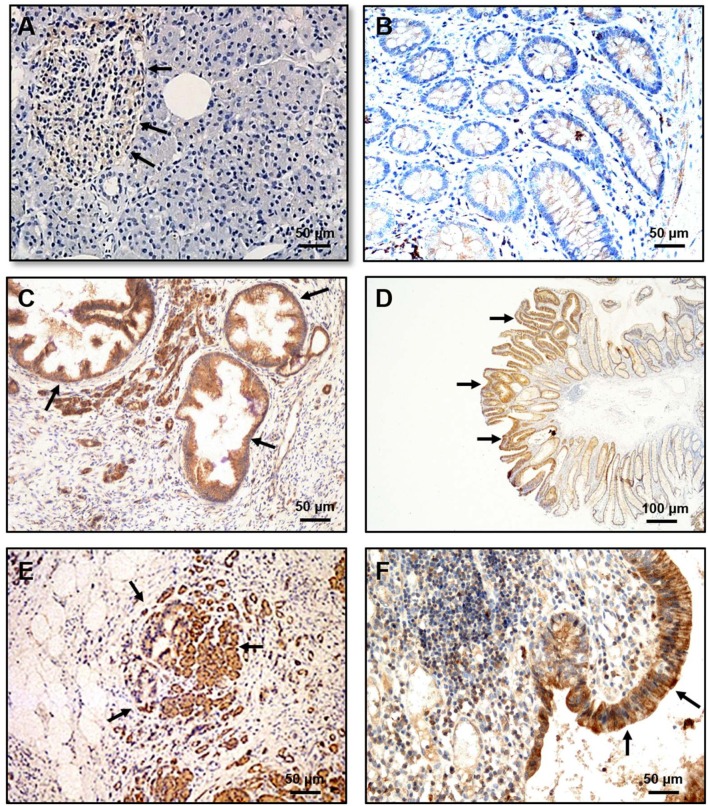
Immunohistochemical expression of OX1R in PanIN, dysplastic colonic polyp, pancreatitis and ulcerative colitis (UC). (A) OX1R was not detected in the normal pancreas either in normal duct and acinar cells. (B) OX1R was not detected in colonic mucosa. (C) OX1R was expressed in PanIN lesions. (D) OX1R was expressed in dysplastic cells present in colonic polyps. (E) OX1R immunostaining of colonic mucosa from patients with pancreatitis. (F) OX1R immunostaining of colonic mucosa from patients with UC. Arrows indicated the OX1R expression. Bar = 50 μm for (A, B C, E, F); Bar = 100 μm for (D). The sources of graphs were based on Voisin et al. (44), Dayot et al. (46), and Messal et al. (56).

References

    1. de Lecea L, Kilduff TS, Peyron C, Gao X, Foye PE, Danielson PE, et al. . The hypocretins: hypothalamus-specific peptides with neuroexcitatory activity. Proc Natl Acad Sci USA. (1998) 95:322–27. 10.1073/pnas.95.1.322 - DOI - PMC - PubMed
    1. Sakurai T, Amemiya A, Ishii M, Matsuzaki I, Chemelli RM, Tanaka H, et al. Orexins and orexin receptors: a family of hypothalamic neuropeptides and G protein-coupled receptors that regulate feeding behavior. Cell (1998) 92:573–85. 10.1016/S0092-8674(00)80949-6 - DOI - PubMed
    1. Laburthe M, Voisin T. The orexin receptor OX(1)R in colon cancer: a promising therapeutic target and a new paradigm in G protein-coupled receptor signaling through ITIMs. Br J Pharmacol. (2012) 165:1678–87. 10.1111/j.1476-5381.2011.01510.x - DOI - PMC - PubMed
    1. de Lecea L, Sutcliffe JG. The hypocretins/orexins: novel hypothalamic neuropeptides involved in different physiological systems. Cell Mol Life Sci. (1999) 56:473–80. 10.1007/s000180050446 - DOI - PMC - PubMed
    1. Mieda M, Yanagisawa M. Sleep, feeding, and neuropeptides: roles of orexins and orexin receptors. Curr Opin Neurobiol. (2002) 12:339–45. 10.1016/S0959-4388(02)00331-8 - DOI - PubMed