Review
. 2018 Sep 27:9:2164.
doi: 10.3389/fimmu.2018.02164. eCollection 2018.

Heterogeneity of HLA-G Expression in Cancers: Facing the Challenges

Affiliations
Review

Heterogeneity of HLA-G Expression in Cancers: Facing the Challenges

Aifen Lin et al. Front Immunol. .

Abstract

Phenotypic heterogeneity has been observed in most malignancies, which represents a considerable challenge for tumor therapy. In recent decades, the biological function and clinical significance of the human leukocyte antigen (HLA)-G have been intensively explored. It is now widely accepted that HLA-G is a critical marker of immunotolerance in cancer cell immune evasion and is strongly associated with disease progress and prognosis for cancer patients. Moreover, it has recently been emphasized that the signaling pathway linking HLA-G and immunoglobulin-like transcripts (ILTs) is considered an immune checkpoint. In addition, HLA-G itself can generate at least seven distinct isoforms, and intertumor and intratumor heterogeneity of HLA-G expression is common across different tumor types. Furthermore, HLA-G heterogeneity in cancers has been related to disease stage and outcomes, metastatic status and response to different therapies. This review focuses on the heterogeneity of HLA-G expression in malignant lesions, and clinical implications of this heterogeneity that might be relevant to personalized treatments are also discussed.

Keywords: HLA-G; cancer; heterogeneity; immune evasion; therapy target.


Figures
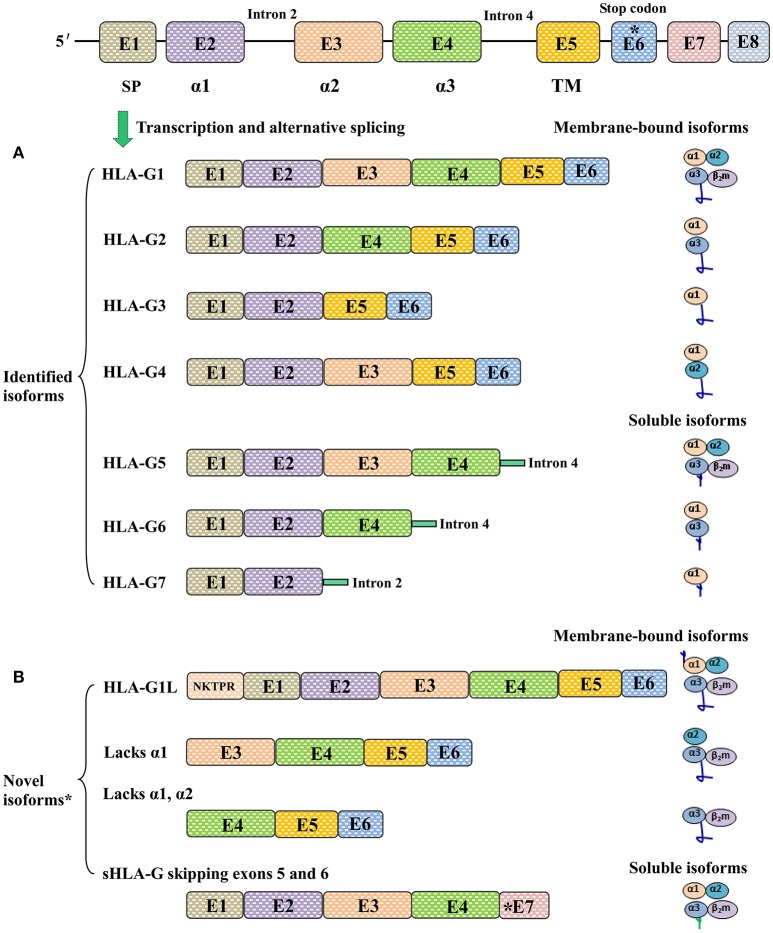
Figure 1
Figure 1
Different HLA-G isoforms generated by alternative splicing of HLA-G mRNA. (A) Seven identified HLA-G isoforms including four membrane-bound (HLA-G1, -G2, -G3, -G4) and three soluble (HLA-G5, -G6, -G7) molecules. The extracellular structures of HLA-G1 and HLA-G5 contain α1, α2, and α3 domains; HLA-G2 and HLA-G6 contain α1 and α3 domains; HLA-G3 contains α1 domains; HLA-G4 contains α1 and α2 domains; HLA-G7 contains an α1 domain linked to two amino acids encoded by intron 2. (B) Novel HLA-G isoforms predicted by Tronik-Le Roux et al. (20)*. N-terminal ends including the additional five amino acids (NKTPR) in HLA-G1L, and potential isoforms contain α2 and α3 domains or only the α3 domain. Novel soluble HLA-G isoforms generated by skipping exons 5 and 6, and with distinct C-terminal ends.
Figure 2
Figure 2
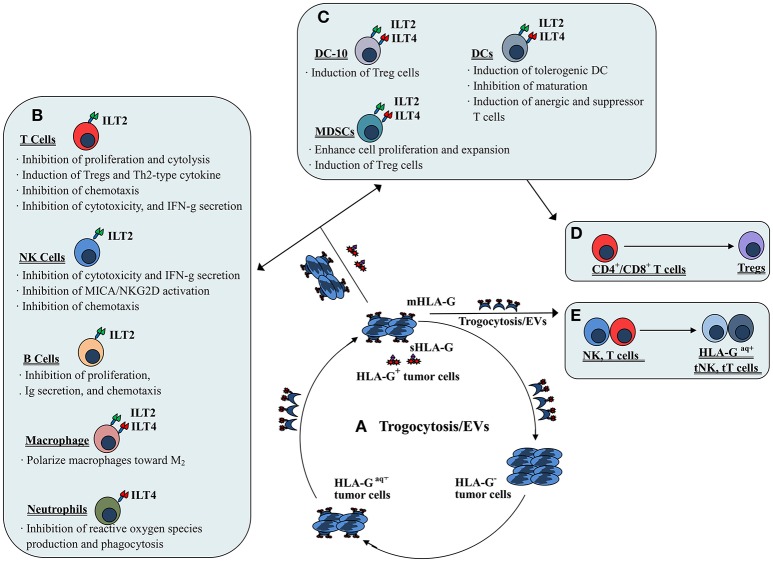
Mechanisms of both membrane-bound and soluble HLA-G-mediated immune suppression in tumor immune evasion. (A) Dynamic transferring of HLA-G by trogocytosis (membrane-bound HLA-G) and/or extracellular vesicles (EVs, both membrane-bound and soluble HLA-G) between HLA-G+ and HLA-G tumor cells. (B) Direct HLA-G-mediated immunosuppressive effects through engagement of inhibitory receptors (ILT2 and/or ILT4) expressed by immune cells such as T cells, NK cells, B cells, macrophages and neutrophils. (C) Indirect HLA-G-mediated immunosuppressive effects by induction of immune suppressive or regulatory cells such as tolerogenic DCs and MDSCs, which induce (D) CD4+/CD8+ T cells to become regulatory T cells (Tregs). (E) Immune effectors such as NK cells and T cells efficiently act as suppressor cells when they acquire HLA-G from HLA-G+ tumor cells or HLA-G+ immune cells via the process of trogocytosis and/or EVs.

References

    1. Gambara G, Gaebler M, Keilholz U, Regenbrecht CRA, Silvestri A. From chemotherapy to combined targeted therapeutics: in vitro and in vivo models to decipher intra-tumor heterogeneity. Front Pharmacol. (2018) 9:77. 10.3389/fphar.2018.00077 - DOI - PMC - PubMed
    1. Grzywa TM, Paskal W, Wlodarski PK. Intratumor and intertumor heterogeneity in melanoma. Transl Oncol. (2017) 10:956–75. 10.1016/j.tranon.2017.09.007 - DOI - PMC - PubMed
    1. Stanta G, Bonin S. Overview on clinical relevance of intra-tumor heterogeneity. Front Med. (2018) 5:85. 10.3389/fmed.2018.00085 - DOI - PMC - PubMed
    1. Kovats S, Main EK, Librach C, Stubblebine M, Fisher SJ, DeMars R. A class I antigen, HLA-G, expressed in human trophoblasts. Science (1990) 248:220–3. 10.1126/science.2326636 - DOI - PubMed
    1. Ferreira LMR, Meissner TB, Tilburgs T, Strominger JL. HLA-G: at the interface of maternal-fetal tolerance. Trends Immunol. (2017) 38:272–86. 10.1016/j.it.2017.01.009 - DOI - PubMed

Publication types