Review
. 2018 Sep 26:9:2180.
doi: 10.3389/fimmu.2018.02180. eCollection 2018.

Flavivirus Receptors: Diversity, Identity, and Cell Entry

Affiliations
Review

Flavivirus Receptors: Diversity, Identity, and Cell Entry

Mathilde Laureti et al. Front Immunol. .

Abstract

Flaviviruses are emerging and re-emerging arthropod-borne pathogens responsible for significant mortality and morbidity worldwide. The genus comprises more than seventy small, positive-sense, single-stranded RNA viruses, which are responsible for a spectrum of human and animal diseases ranging in symptoms from mild, influenza-like infection to fatal encephalitis and haemorrhagic fever. Despite genomic and structural similarities across the genus, infections by different flaviviruses result in disparate clinical presentations. This review focusses on two haemorrhagic flaviviruses, dengue virus and yellow fever virus, and two neurotropic flaviviruses, Japanese encephalitis virus and Zika virus. We review current knowledge on host-pathogen interactions, virus entry strategies and tropism.

Keywords: Japanese encephalitis virus; Zika virus (ZIKV); dengue virus; entry receptor; flaviviruses; yellow fever virus.


Figures
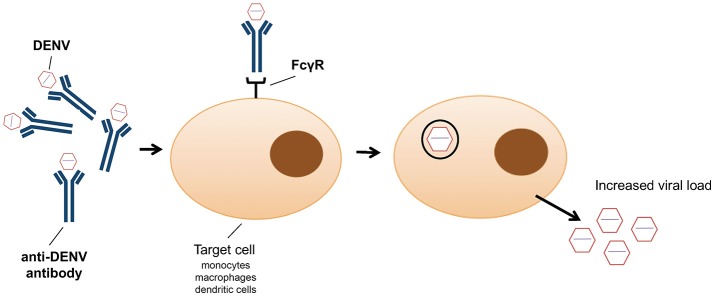
Figure 1
Figure 1
Schematic representation of antibody dependent enhancement (ADE) entry into monocytes, macrophages and dendritic cells as employed by dengue virus.

References

    1. Messina JP, Brady OJ, Scott TW, Zou C, Pigott DM, Duda KA, et al. Global spread of dengue virus types: mapping the 70 year history. Trends Microbiol. (2014) 2:138–46. 10.1016/j.tim.2013.12.011 - DOI - PMC - PubMed
    1. Weaver SC, Costa F, Garcia-Blanco MA, Ko AI, Ribeiro GS, Saade G, et al. Zika virus: History, emergence, biology, and prospects for control. Antiviral Res. (2016) 30:69–80. 10.1016/j.antiviral.2016.03.010 - DOI - PMC - PubMed
    1. Kraemer MUG, Faria NR, Reiner RC, Jr, Golding N, Nikolay B, Stasse S, et al. Spread of yellow fever virus outbreak in angola and the democratic republic of the Congo 2015-16: a modelling study. Lancet Infect Dis. (2017) 7:330–8. 10.1016/S1473-3099(16)30513-8 - DOI - PMC - PubMed
    1. Hamer DH, Angelo K, Caumes E, van Genderen PJJ, Florescu SA, Popescu CP, et al. . Fatal Yellow Fever in Travelers to Brazil, 2018. MMWR Morb Mortal Wkly Rep. (2018) 67:340–1. 10.15585/mmwr.mm6711e1 - DOI - PMC - PubMed
    1. Hayes EB, Gubler DJ. West Nile virus: epidemiology and clinical features of an emerging epidemic in the United States. Annu Rev Med. (2006) 7:181–94. 10.1146/annurev.med.57.121304.131418 - DOI - PubMed

MeSH terms

LinkOut - more resources
