


STI Risk Perception in the British Population and How It Relates to Sexual Behaviour and STI Healthcare Use: Findings From a Cross-sectional Survey (Natsal-3)
- PMID: 30320305
- PMCID: PMC6180228
- DOI: 10.1016/j.eclinm.2018.08.001
STI Risk Perception in the British Population and How It Relates to Sexual Behaviour and STI Healthcare Use: Findings From a Cross-sectional Survey (Natsal-3)
Abstract
Background: We investigated how STI risk perception relates to behavioural STI risk and STI healthcare (sexual health clinic attendance/chlamydia testing) in the British population.
Methods: Natsal-3, a national probability-sample survey undertaken 2010-12, included 8397 sexually-active 16-44 year-olds. Participants rated their risk of STIs (excluding HIV) given their current sexual lifestyle. Urine from a randomly-selected sub-sample of participants (n = 4550) was tested for prevalent STIs (Chlamydia trachomatis, Neisseria gonorrhoeae, Mycoplasma genitalium, Trichomonas vaginalis).
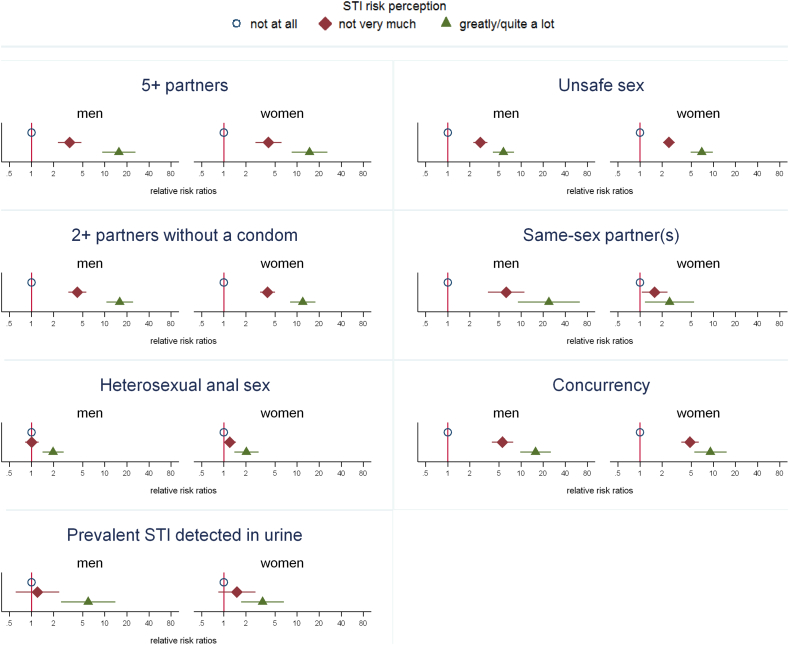
Findings: Most men (64% (95% CI: 62-66)) and women (73% (72-74)) rated themselves as not at all at risk of STIs, 30% (29-32) men and 23% (22-25) women self-rated as not very much, and 5% (5-6) men and 3% (3-4) women as greatly/quite a lot at risk. Although those reporting STI risk behaviours were more likely to perceive themselves as at risk, > 70% men and > 85% women classified as having had unsafe sex in the past year, and similar proportions of those with a prevalent STI, perceived themselves as not at all or not very much at risk. Increased risk perception was associated with greater STI healthcare-use (past year), although not after adjusting for sexual behaviour, indicating in a mediation analysis that risk perception was neither necessary or sufficient for seeking care Furthermore, 58% (48-67) men and 31% (22-41) women who had unsafe sex (past year) and rated themselves as greatly/quite a lot at risk had neither attended nor tested.
Interpretation: Many people at risk of STIs in Britain underestimated their risk, and many who correctly perceived themselves to be at risk had not recently accessed STI healthcare. Health promotion needs to address this mismatch and ensure that people access healthcare appropriate to their needs.
Figures
References
-
- Nutbeam D., Harries E., Wise M. 3rd edition. McGraw-Hill; North Ryde: 2010. Theory in a nutshell: a practical guide to health promotion theories.http://www.mheducation.co.uk/9780070278431-emea-theory-in-a-nutshell-a-p... Available from:
-
- Ropeik D. The Perception Gap: recognizing and managing the risks that arise when we get risk wrong. Food Chem Toxicol. 2012;50:1222–1225. - PubMed
-
- Bouyer M., Bagdassarian S., Chaabanne S., Mullet E. Personality correlates of risk perception. Risk Anal. 2001;21:457–466. - PubMed
-
- Buck R., Ferrer R. Emotion, warnings, and the ethics of risk communication. In: Roeser S., Hillerbrand P., Peterson M., editors. Handbook of risk theory. Delft; The Netherlands: 2012.
-
- Ropeik D. Risk Communication: an overlooked tool for improving public health. In: Last J., Wallace R., editors. Public health and preventative medicine. 2007. http://www.dropeik.com/dropeik/pdf/text_book_chapter.pdf Available from:
Grants and funding
LinkOut - more resources
Full Text Sources
Miscellaneous
