


Ergonomic interventions for preventing musculoskeletal disorders in dental care practitioners
- PMID: 30320459
- PMCID: PMC6516890
- DOI: 10.1002/14651858.CD011261.pub2
Ergonomic interventions for preventing musculoskeletal disorders in dental care practitioners
Abstract
Background: Dentistry is a profession with a high prevalence of work-related musculoskeletal disorders (WMSD) among practitioners, with symptoms often starting as early in the career as the student phase. Ergonomic interventions in physical, cognitive, and organisational domains have been suggested to prevent their occurrence, but evidence of their effects remains unclear.
Objectives: To assess the effect of ergonomic interventions for the prevention of work-related musculoskeletal disorders among dental care practitioners.
Search methods: We searched CENTRAL, MEDLINE PubMed, Embase, PsycINFO ProQuest, NIOSHTIC, NIOSHTIC-2, HSELINE, CISDOC (OSH-UPDATE), ClinicalTrials.gov, and the World Health Organization International Clinical Trials Registry Platform (ICTRP) Search Portal to August 2018, without language or date restrictions.
Selection criteria: We included randomised controlled trials (RCTs), quasi-RCTs, and cluster RCTs, in which participants were adults, aged 18 and older, who were engaged in the practice of dentistry. At least 75% of them had to be free from musculoskeletal pain at baseline. We only included studies that measured at least one of our primary outcomes; i.e. physician diagnosed WMSD, self-reported pain, or work functioning.
Data collection and analysis: Three authors independently screened and selected 20 potentially eligible references from 946 relevant references identified from the search results. Based on the full-text screening, we included two studies, excluded 16 studies, and two are awaiting classification. Four review authors independently extracted data, and two authors assessed the risk of bias. We calculated the mean difference (MD) with 95% confidence intervals (CI) for continuous outcomes and risk ratios (RR) with 95% confidence intervals for dichotomous outcomes. We assessed the quality of the evidence for each outcome using the GRADE approach.
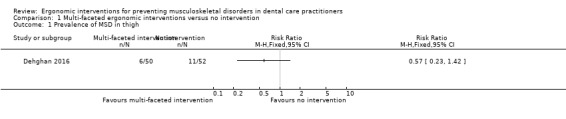
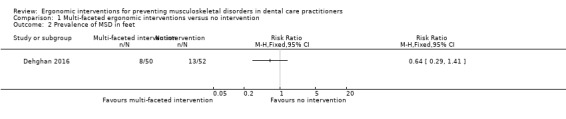
Main results: We included two RCTs (212 participants), one of which was a cluster-randomised trial. Adjusting for the design effect from clustering, reduced the total sample size to 210. Both studies were carried out in dental clinics and assessed ergonomic interventions in the physical domain, one by evaluating a multi-faceted ergonomic intervention, which consisted of imparting knowledge and training about ergonomics, work station modification, training and surveying ergonomics at the work station, and a regular exercise program; the other by studying the effectiveness of two different types of instrument used for scaling in preventing WMSDs. We were unable to combine the results from the two studies because of the diversity of interventions and outcomes.Physical ergonomic interventions. Based on one study, there is very low-quality evidence that a multi-faceted intervention has no clear effect on dentists' risk of WMSD in the thighs (RR 0.57, 95% CI 0.23 to 1.42; 102 participants), or feet (RR 0.64, 95% CI 0.29 to 1.41; 102 participants) when compared to no intervention over a six-month period. Based on one study, there is low-quality evidence of no clear difference in elbow pain (MD -0.14, 95% CI -0.39 to 0.11; 110 participants), or shoulder pain (MD -0.32, 95% CI -0.75 to 0.11; 110 participants) in participants who used light weight curettes with wider handles or heavier curettes with narrow handles for scaling over a 16-week period.Cognitive ergonomic interventions. We found no studies evaluating the effectiveness of cognitive ergonomic interventions.Organisational ergonomic interventions. We found no studies evaluating the effectiveness of organisational ergonomic interventions.
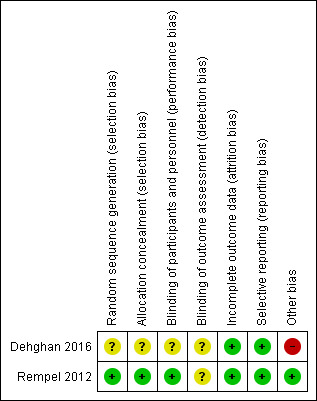
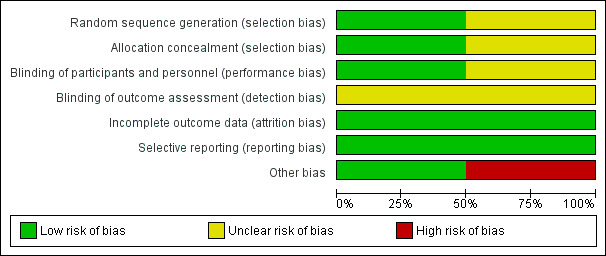
Authors' conclusions: There is very low-quality evidence from one study showing that a multi-faceted intervention has no clear effect on dentists' risk of WMSD in the thighs or feet when compared to no intervention over a six-month period. This was a poorly conducted study with several shortcomings and errors in statistical analysis of data. There is low-quality evidence from one study showing no clear difference in elbow pain or shoulder pain in participants using light weight, wider handled curettes or heavier and narrow handled curettes for scaling over a 16-week period.We did not find any studies evaluating the effectiveness of cognitive ergonomic interventions or organisational ergonomic interventions.Our ability to draw definitive conclusions is restricted by the paucity of suitable studies available to us, and the high risk of bias of the studies that are available. This review highlights the need for well-designed, conducted, and reported RCTs, with long-term follow-up that assess prevention strategies for WMSDs among dental care practitioners.
Conflict of interest statement
Priti Mulimani: None known.
Victor Hoe: I have been invited as a speaker by Pfizer to deliver a one‐hour lecture on the topic, 'The GP in Occupational Health', on three occasions.
Melanie Hayes: I have published research papers and presented conference papers on the topic of musculoskeletal disorders in the dental profession.
Jose Idiculla: None known.
Adinegara Abas: None known.
Laxminarayan Karanth: None known.
Figures



Comment in
-
Evidence regarding the benefits of ergonomic interventions is limited and low quality, but there is also no evidence of harms.J Am Dent Assoc. 2019 Apr;150(4):e46. doi: 10.1016/j.adaj.2018.11.006. Epub 2019 Jan 2. J Am Dent Assoc. 2019. PMID: 30611394 No abstract available.
-
Are ergonomic interventions effective for preventing musculoskeletal disorders in dental care practitioners? - A Cochrane Review summary with commentary.Musculoskelet Sci Pract. 2019 Dec;44:102061. doi: 10.1016/j.msksp.2019.102061. Epub 2019 Sep 14. Musculoskelet Sci Pract. 2019. PMID: 31561182 No abstract available.
References
References to studies included in this review
Dehghan 2016 {published data only}
Rempel 2012 {published data only}
-
- Rempel D, Lee DL, Dawson K, Loomer P. The effects of periodontal curette handle weight and diameter on arm pain: a four‐month randomized controlled trial. Journal of American Dental Association 2012 Oct;143(10):1105‐13. - PubMed
References to studies excluded from this review
Aghilinejad 2016 {published data only}
Branson 2004 {published data only}
-
- Branson BG, Bray KK, Gadbury‐Amyot C, Holt LA, Keselyak NT, Mitchell TV, et al. Effect of magnification lenses on student operator posture. Journal of Dental Education 2004;68(3):384‐9. - PubMed
Cosaboom‐FitzSimons 2008 {published data only}
-
- Cosaboom‐FitzSimons ME, Tolle SL, Darby ML, Walker ML. Effects of 5 different finger rest positions on arm muscle activity during scaling by dental hygiene students. Journal of Dental Hygiene 2008;82(4):34. - PubMed
Hayes 2014b {published data only}
-
- Hayes MJ, Osmotherly PG, Taylor JA, Smith DR, Ho A. The effect of loupes on neck pain and disability among dental hygienists. Work 2016;53:755‐62. - PubMed
-
- Hayes MJ, Osmotherly PG, Taylor JA, Smith DR, Ho A. The effect of wearing loupes on upper extremity musculoskeletal disorders among dental hygienists. International Journal of Dental Hygiene 2014;12(3):174‐9. - PubMed
IRCT2016062128529N2 {unpublished data only}
-
- IRCT2016062128529N2. Effect of educational intervention according to theory of planned behavior‐based new media on promoting health work and ergonomic status in the dentists. en.irct.ir/trial/23131 (first registered 07 May 2016).
James 2010 {published data only}
-
- James DM, Branson BG, Simmer‐Beck M, Bray KK. Examining the effect of the Flextend Orthotic device on grip strength: a pilot study. Work 2010;35(4):487‐94. - PubMed
Lindegård 2012 {published data only}
-
- Lindegård A, Gustafsson M, Hansson GÅ. Effects of prismatic glasses including optometric correction on head and neck kinematics, perceived exertion and comfort during dental work in the oral cavity – a randomised controlled intervention. Applied Ergonomics 2012;43(1):246‐53. - PubMed
Maillet 2008 {published data only}
-
- Maillet JP, Millar AM, Burke JM, Maillet MA, Maillet WA, Neish NR. Effect of magnification loupes on dental hygiene student posture. Journal of Dental Education 2008;72(1):33‐44. - PubMed
McCombs 2014 {published data only}
-
- McCombs G, Russell DM. Comparison of corded and cordless handpieces on forearm muscle activity, procedure time and ease of use during simulated tooth polishing. Journal of Dental Hygiene 2014;88(6):386‐93. - PubMed
Ouivirach 2014 {published data only}
-
- Thanathornwong B, Suebnukarn S, Ouivirach K. A system for predicting musculoskeletal disorders among dental students. International Journal of Occupational Safety and Ergonomics 2014;20(3):463‐75. - PubMed
Ryan 2005 {published data only}
-
- Ryan DL, Darby M, Bauman D, Tolle SL, Naik D. Effects of ultrasonic scaling and hand‐activated scaling on tactile sensitivity in dental hygiene students. Journal of Dental Hygiene 2005;79(1):9. - PubMed
Simmer‐Beck 2006 {published data only}
-
- Simmer‐Beck M, Bray KK, Branson B, Glaros A, Weeks J. Comparison of muscle activity associated with structural differences in dental hygiene mirrors. Journal of Dental Hygiene 2006;80(1):8. - PubMed
Simmer‐Beck 2007 {published data only}
-
- Simmer‐Beck M, Branson BG, Mitchell TV, Holt L. Comparison of tactile discrimination associated with varying weights of explorers. Journal of Dental Education 2007;71(5):687‐93. - PubMed
Thanathornwong 2014 {published data only}
-
- Thanathornwong B, Suebnukarn S, Songpaisan Y, Ouivirach K. A system for predicting and preventing work‐related musculoskeletal disorders among dentists. Computer Methods in Biomechanics and Biomedical Engineering 2014;17(2):177‐85. - PubMed
Thanathornwong 2015 {published data only}
-
- Thanathornwong B, Suebnukarn S. The improvement of dental posture using personalized biofeedback. Studies in Health Technology and Informatics 2015;216:756‐60. - PubMed
von Thiele Schwarz 2008 {published data only}
-
- Thiele Schwarz U, Lindfors P, Lundberg U. Health‐related effects of worksite interventions involving physical exercise and reduced workhours. Scandinavian Journal of Work, Environment & Health 2008;34(3):179‐88. - PubMed
References to studies awaiting assessment
IRCT2014051117649N1 {unpublished data only}
-
- IRCT2014051117649N1. Clinical trial of evaluation the effect of ergonomic trainings in reducing the musculoskeletal disorders comparing to pre‐training measurements in dentists with at least 5‐years working background. en.irct.ir/trial/16177 (first registered 18 November 2014).
IRCT2015113024199N2 {unpublished data only}
-
- IRCT2015113024199N2. Investigate the effectiveness of ergonomic interventions to reduce the prevalence of musculoskeletal disorders with participatory ergonomics approach to dentists and their assistants in Milad hospital at 2015. en.irct.ir/trial/20488 (first registered 09 December 2015).
Additional references
ADA 2004
-
- Ergonomics and Disability Support Advisory Committee (EDSAC). An introduction to ergonomics: risk factors, MSDs, approaches and interventions. A report of the EDSAC to Council on Dental Practice (CDP). https://cdn.shopify.com/s/files/1/1171/2566/files/topics_ergonomics_pape.... American Dental Association, 2004 (accessed 5 October 2018).
ADA 2014
-
- American Dental Association. ADA members insurance plans: Income protection plan. insurance.ada.org/ada‐insurance‐plans/disability‐insurance.aspx 2014 (accessed 5 October 2018).
Ahearn 2010
-
- Ahearn DJ, Sanders MJ, Turcotte C. Ergonomic design for dental offices. Work 2010;35(4):495‐503. - PubMed
Al Wazzan 2001
-
- Al Wazzan KA, Almas K, Shethri SE, Al Quahtani MQ. Back and neck problems among dentists and dental auxiliaries. Journal of Contemporary Dental Practice 2001;2(3):1‐10. - PubMed
ASCC 2006
-
- Australian Safety and Compensation Council. Work‐related Musculoskeletal Disorders in Australia. https://www.safeworkaustralia.gov.au/system/files/documents/1702/workrel... (accessed 5 October 2018).
Bernard 1997
-
- Bernard BP. Musculoskeletal disorders and workplace factors: a critical review of epidemiologic evidence for work‐related musculoskeletal disorders of the neck, upper extremity, and lower back. U.S. Department of Health and Human Services, Centers for Disease Control and Prevention, National Institute of Occupational Safety and Health July 1997, issue DHHS (NIOSH) Publication No. 97‐141.
Breurs 2017
-
- Bruers JJM, Trommelen LECM, Hawi P, Brand HS. Musculoskeletal disorders among dentists and dental students in the Netherlands. Nederlands Tijdschrift voor Tandheelkunde 2017;124(11):581‐7. - PubMed
Buckle 2002
-
- Buckle P. Adapting work to people: new approaches to preventing musculoskeletal disorders. Sharpening the Focus on Performance. Proceedings of the Safety & Health at Work Congress; 2002 May 13‐16; Birmingham, UK. Birmingham: Royal Society for the Prevention of Accidents, 2002.
Burke 1997
-
- Burke FJ, Main JR, Freeman R. The practice of dentistry: an assessment of reasons for premature retirement. British Dental Journal 1997;182(7):250‐4. - PubMed
Campbell 2001
-
- Campbell MK, Mollison J, Grimshaw JM. Cluster trials in implementation research: estimation of intracluster correlation coefficients and sample size. Statistics in Medicine 2001;20(3):391‐9. - PubMed
Conrad 1990
-
- Conrad J, Osborn J, Conrad K, Jetzer T. Peripheral nerve dysfunction in practicing hygienists. Journal of Dental Hygiene 1990;64(8):382‐7. - PubMed
Covidence [Computer program]
-
- Veritas Health Innovation. Covidence systematic review software. Melbourne: Veritas Health Innovation, 2014.
De Sio 2018
Droeze 2005
-
- Droeze EH, Jonsson H. Evaluation of ergonomic interventions to reduce musculoskeletal disorders of dentists in the Netherlands. Work 2005;25:211‐20. - PubMed
EASHW 2008
-
- Podniece Z, Taylor TN, Takala E, David G, Kudasz F, Heuvel, et al. Work‐related musculoskeletal disorders: prevention report. https://osha.europa.eu/en/publications/reports/en_TE8107132ENC.pdf/view. European Agency for Safety and Health at Work, 2008 (accessed 5 October 2018).
Goldstep 1998
-
- Goldstep F. Designing the esthetic dental environment. Dental Clinics of North America 1998;42:643‐51. - PubMed
GRADEpro GDT [Computer program]
-
- McMaster University (developed by Evidence Prime). GRADEpro GDT. Version accessed 5 October 2018. Hamilton (ON): McMaster University (developed by Evidence Prime), 2015.
Gupta 2014
Hawn 2006
-
- Hawn C, Tolle S, Darby M, Walker M. A laboratory study to determine the effects of universal and rotating ultrasonic inserts on wrist movement and scaling time efficiency of dental hygienists. International Journal of Dental Hygiene 2006;4(1):15‐23. - PubMed
Hayes 2009
-
- Hayes MJ, Cockrell D, Smith DR. A systematic review of musculoskeletal disorders among dental professionals. International Journal of Dental Hygiene 2009;7(3):159‐65. - PubMed
Hayes 2010
-
- Hayes MJ, Smith DR, Cockrell D. An international review of musculoskeletal disorders in the dental hygiene profession. International Dental Journal 2010;60:343‐52. - PubMed
Hayes 2012
-
- Hayes MJ, Smith DR, Taylor JA. Predictors of work‐related musculoskeletal disorders among dental hygienists. International Journal of Dental Hygiene 2012;10(4):265‐9. - PubMed
Hayes 2013
Hayes 2014a
-
- Hayes MJ, Smith DR, Taylor JA. Musculoskeletal Disorders in a 3 Year Longitudinal Cohort of Dental Hygiene Students. Journal of Dental Hygiene 2014;88(1):36‐41. - PubMed
Higgins 2011
-
- Higgins JPT, Green S, editor(s). Cochrane Handbook for Systematic Reviews of Interventions Version 5.1.0 (updated March 2011). The Cochrane Collaboration, 2011. Available from handbook.cochrane.org.
IEA 2014
-
- International Ergonomics Association. What is ergonomics – definition and domains of ergonomics. www.iea.cc/whats/index.html (accessed 10 July 2014).
Khalekar 2016
-
- Khalekar Y, Zope A, Chaudahari L, Brahmankar U, Gadge H, Deore S. Prevention is better than cure: ergonomics in dentistry. Journal of Applied Dental and Medical Sciences 2016;2:209–16.
Khan 2013
Kierklo 2011
-
- Kierklo A, Kobus A, Jaworska M, Botulinski B. Work‐related musculoskeletal disorders among dentists – a questionnaire survey. Annals of Agricultural and Environmental Medicine 2011;18(1):79‐84. - PubMed
Lalumandier 2001
-
- Lalumandier JA, McPhee SD. Prevalence and risk factors of hand problems and carpal tunnel syndrome among dental hygienists. Journal of Dental Hygiene 2001;75(2):130‐4. - PubMed
Leggat 2006
-
- Leggat PA, Smith DR. Musculoskeletal disorders self‐reported by dentists in Queensland, Australia. Australian Dental Journal 2006;51(4):324‐7. - PubMed
Leggat 2007
-
- Leggat PA, Kedjarune U, Smith DR. Occupational health problems in modern dentistry. Industrial Health 2007;45:611‐21. - PubMed
Liskiewicz 1997
-
- Liskiewicz S, Kerschbaum W. Cumulative trauma disorders: an ergonomic approach for prevention. Journal of Dental Hygiene 1997;71(4):162‐7. - PubMed
Michalak‐Turcotte 2000
-
- Michalak‐Turcotte C. Controlling dental hygiene work‐related musculoskeletal disorders: the ergonomic process. Journal of Dental Hygiene 2000;74(1):41‐8. - PubMed
Michalak‐Turcotte 2005
-
- Michalak‐Turcotte C, Sanders MJ. A problem‐solving approach to ergonomic intervention in dental hygiene: part I. Dimensions of Dental Hygiene 2005;3(9):18, 20‐1.
Miller 1989
-
- Miller DJ, Shugars DA. Back pain in dentists: current research and prevention. Revista Odontologica de Puerto Rico 1989;27(3):22‐5. - PubMed
Miller 1991
-
- Miller DL. An investigation into attrition of dental hygienists from the work force. Journal of Dental Hygiene 1991;65(1):25‐31. - PubMed
Moher 2009
Moodley 2018
Morse 2003
-
- Morse TF, Michalak‐Turcotte C, Atwood‐Sanders M, Warren N, Peterson DR, Bruneau H, et al. A pilot study of hand and arm musculoskeletal disorders in dental hygiene students. Journal of Dental Hygiene 2003;77(3):173‐9. - PubMed
Morse 2007
-
- Morse T, Bruneau T, Michalak‐Turcotte C, Sanders M, Warren N. Musculoskeletal disorders of the neck and shoulder in dental hygienists and dental hygiene students. Journal of Dental Hygiene 2007;81(1):1‐20. - PubMed
Morse 2010
-
- Morse T, Bruneau H, Dussetschleger J. Musculoskeletal disorders of the neck and shoulder in the dental professions. Work 2010;35(4):419‐29. - PubMed
NIOSH 1997
-
- The National Institute for Occupational Safety and Health (NIOSH), Centers for Disease Control and Prevention. Musculoskeletal disorders and workplace factors – A critical review of epidemiologic evidence for work‐related musculoskeletal disorders of the neck, upper extremity, and low back. www.cdc.gov/niosh/docs/97‐141/ 1997 (accessed 5 October 2018).
Osborn 1990
-
- Osborn JB, Newell KJ, Rudney JD, Stoltenberg JL. Musculoskeletal pain among Minnesota dental hygienists. Journal of Dental Hygiene 1990;64(3):132‐8. - PubMed
Petren 2007
-
- Petren V, Petzall K, Preber H, Bergstrom J. The relationship between working conditions and sick leave in Swedish dental hygienists. International Journal of Dental Hygiene 2007;5(1):27‐35. - PubMed
Pirvu 2014
Review Manager 2014 [Computer program]
-
- Nordic Cochrane Centre, The Cochrane Collaboration. Review Manager 5 (RevMan 5). Version 5.3. Copenhagen: Nordic Cochrane Centre, The Cochrane Collaboration, 2014.
Rolander 2001
-
- Rolander B, Bellner A. Experience of musculoskeletal disorders, intensity of pain, and general conditions in work – the case of employees in non‐private dental clinics in a county in southern Sweden. Work 2001;17(1):65‐73. - PubMed
Rucker 2002
-
- Rucker LM, Sunell S. Ergonomic risk factors associated with clinical dentistry. Journal of California Dental Association 2002;30(2):139‐46. - PubMed
Sakzewski 2014
-
- Sakzewski L, Naser‐ud‐Din S. Work‐related musculoskeletal disorders in dentists and orthodontists: a review of the literature. Work 2014;48(1):37‐45. - PubMed
Sanders 2002
-
- Sanders MA, Turcotte CM. Strategies to reduce work‐related musculoskeletal disorders in dental hygienists: two case studies. Journal of Hand Therapy 2002;15(4):363‐74. - PubMed
Twadell 2009
-
- Twadell S. Surrogate outcome markers in research and clinical practice. Australian Prescriber 2009;32:47‐50.
Valachi 2003
-
- Valachi B, Valachi K. Mechanisms leading to musculoskeletal disorders in dentistry. Journal of American Dental Association 2003;134(10):1344‐50. - PubMed
Yamalik 2007
-
- Yamalik N. Musculoskeletal disorders (MSDs) and dental practice. Part 2. Risk factors for dentistry, magnitude of the problem, prevention, and dental ergonomics. International Dental Journal 2007;57(1):45‐54. - PubMed
Ylipaa 1999
-
- Ylippa V, Arnetz BB, Preber H. Predictors of good general health, well‐being, and musculoskeletal disorders in Swedish dental hygienists. Acta Odontologica Scandinavica 1999;57(5):277‐82. - PubMed
References to other published versions of this review
Publication types
MeSH terms
LinkOut - more resources
Full Text Sources
Medical
