


A Whole Methylome Study of Ethanol Exposure in Brain and Blood: An Exploration of the Utility of Peripheral Blood as Proxy Tissue for Brain in Alcohol Methylation Studies
- PMID: 30320886
- PMCID: PMC6286207
- DOI: 10.1111/acer.13905
A Whole Methylome Study of Ethanol Exposure in Brain and Blood: An Exploration of the Utility of Peripheral Blood as Proxy Tissue for Brain in Alcohol Methylation Studies
Abstract
Background: Recent reviews have highlighted the potential use of blood-based methylation biomarkers as diagnostic and prognostic tools of current and future alcohol use and addiction. Due to the substantial overlap that often exists between methylation patterns across different tissues, including blood and brain, blood-based methylation may track methylation changes in brain; however, little work has explored the overlap in alcohol-related methylation in these tissues.
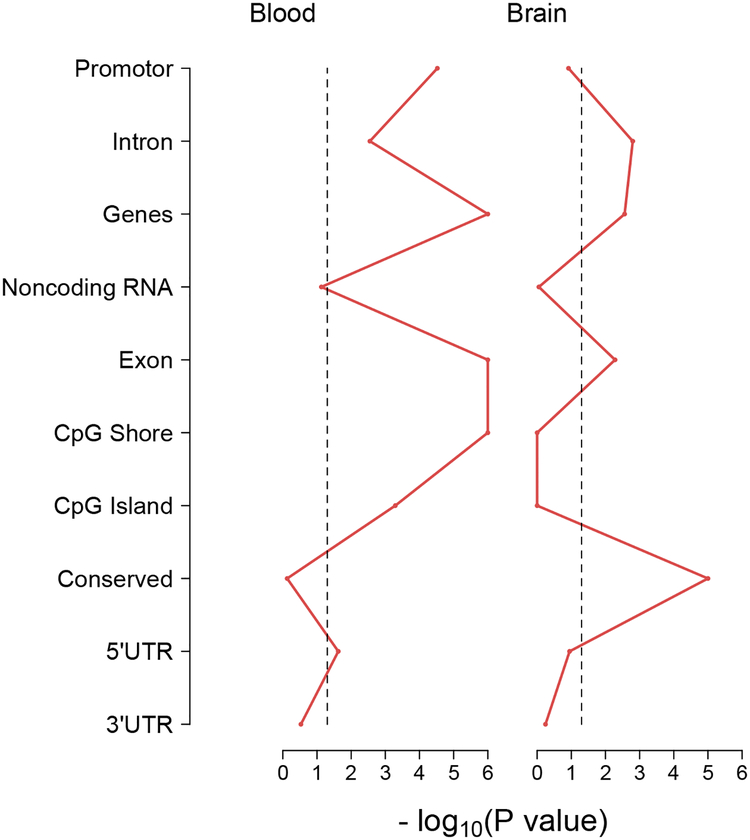
Methods: To study the effects of alcohol on the brain methylome and identify possible biomarkers of these changes in blood, we performed a methylome-wide association study in brain and blood from 40 male DBA/2J mice that received either an acute ethanol (EtOH) or saline intraperitoneal injection. To investigate all 22 million CpGs in the mouse genome, we enriched for the methylated genomic fraction using methyl-CpG binding domain (MBD) protein capture followed by next-generation sequencing (MBD-seq). We performed association tests in blood and brain separately followed by enrichment testing to determine whether there was overlapping alcohol-related methylation in the 2 tissues.
Results: The top result for brain was a CpG located in an intron of Ttc39b (p = 5.65 × 10-08 ), and for blood, the top result was located in Espnl (p = 5.11 × 10-08 ). Analyses implicated pathways involved in inflammation and neuronal differentiation, such as CXCR4, IL-7, and Wnt signaling. Enrichment tests indicated significant overlap among the top results in brain and blood. Pathway analyses of the overlapping genes converge on MAPKinase signaling (p = 5.6 × 10-05 ) which plays a central role in acute and chronic responses to alcohol and glutamate receptor pathways, which can regulate neuroplastic changes underlying addictive behavior.
Conclusions: Overall, we have shown some methylation changes in brain and blood after acute EtOH administration and that the changes in blood partly mirror the changes in brain suggesting the potential for DNA methylation in blood to be biomarkers of alcohol use.
Keywords: Alcohol; Biomarker; Epigenetics; Glutamate; Methylation.
© 2018 by the Research Society on Alcoholism.
Figures
References
-
- Aberg KA, Mcclay JL, Nerella S, Xie LY, Clark SL, Hudson AD, Bukszar J, Adkins D, Consortium SS, Hultman CM, Sullivan PF, Magnusson PK & Van Den Oord EJ 2012. MBD-seq as a cost-effective approach for methylome-wide association studies: demonstration in 1500 case--control samples. Epigenomics, 4, 605–21. - PMC - PubMed
-
- Adkins AE, Hack LM, Bigdeli TB, Williamson VS, Mcmichael GO, Mamdani M, Edwards AC, Aliev F, Chan RF, Bhandari P, Raabe RC, Alaimo JT, Blackwell GG, Moscati A, Poland RS, Rood B, Patterson DG, Walsh D, Collaborative Study of the Genetics of Alcoholism, C., Whitfield JB, Zhu G, Montgomery GW, Henders AK, Martin NG, Heath AC, Madden P. a. F., Frank J, Ridinger M, Wodarz N, Soyka M, Zill P, Ising M, Nothen MM, Kiefer F, Rietschel M, German Study of the Genetics of Addiction, C., Gelernter J, Sherva R, Koesterer R, Almasy L, Zhao H, Kranzler HR, Farrer LA, Maher BS, Prescott CA, Dick DM, Bacanu SA, Mathies LD, Davies AG, Vladimirov VI, Grotewiel M, Bowers MS, Bettinger JC, Webb BT, Miles MF, Kendler KS & Riley BP 2017. Genomewide Association Study of Alcohol Dependence Identifies Risk Loci Altering Ethanol-Response Behaviors in Model Organisms. Alcohol Clin Exp Res, 41, 911–928. - PMC - PubMed
Publication types
MeSH terms
Substances
Grants and funding
LinkOut - more resources
Full Text Sources
Other Literature Sources
